Improving soil health can increase drought resilience and nutrient availability, reduce erosion, and help fight disease. When considering adopting soil health practices, farmers want to understand the economic impact on their operations. That’s why the Soil Health Institute conducts partial budget analysis of real farms and their practices, comparing the costs and savings of soil health management systems.
We analyzed partial budgets of 41 cotton farmers in nine regions across eight states – each with at least five years of experience adopting soil health management systems. While gains in cotton profitability varied widely across the Cotton Belt as well as for operations within the same state, all farmers reported an increase in net cotton income.
The bottom-line benefits they saw include:
Cotton net income rose an average of $118/acre, with increases ranging from $7 to $369/acre.
No farms lost yield, and 51% of farms increased yield.
For farms with a yield change, the average increase was 19%.
Farmers in the study also reported benefits including increased crop resilience, better access to their fields, improved water quality, enhanced public perception of agricultural production, and improvements to their soil structure.
“Our profitability gains have been from reduced inputs as far as tractor time, man hours, fuel, as well as the yields have gone up because of the increased organic matter and improved soil health.”
For decades, yield has been at the center of agricultural decision-making. More bushels per acre have often been viewed as the clearest measure of productivity, progress, and success.
But higher yield doesn’t always mean higher profit.
As farmers navigate rising input costs, market volatility, and increasing weather risk, there is an opportunity for technical advisors to help redirect the conversation from maximizing yield to improving profitability and long-term farm resilience.
Profitability comes down to a simple equation: revenue minus total costs. A field with lower yield can still deliver a stronger profit margin if input costs are lower, which means yield and profitability don’t always move together.
A profitable farm is better positioned to:
Withstand volatile markets
Manage weather risks
Invest in future improvements
Reduce financial stress
Achieve long-term sustainability
Shifting from a Yield Mindset to a Profitability Mindset
Many farmers already use the term return on investment (ROI) when discussing equipment, technology implementation or marketing decisions. Applying ROI thinking to crop production can make profitability discussions more relatable:
Where are costs increasing without adding value?
Which practices generate the strongest return per acre?
Which inputs consistently pay off?
“We’re not seeing more productivity: What we’re seeing is better ROI,” says Nebraska farmer Jordan Uldrich, describing what happened as he worked to build more resilient soil and reduce his reliance on synthetic inputs.
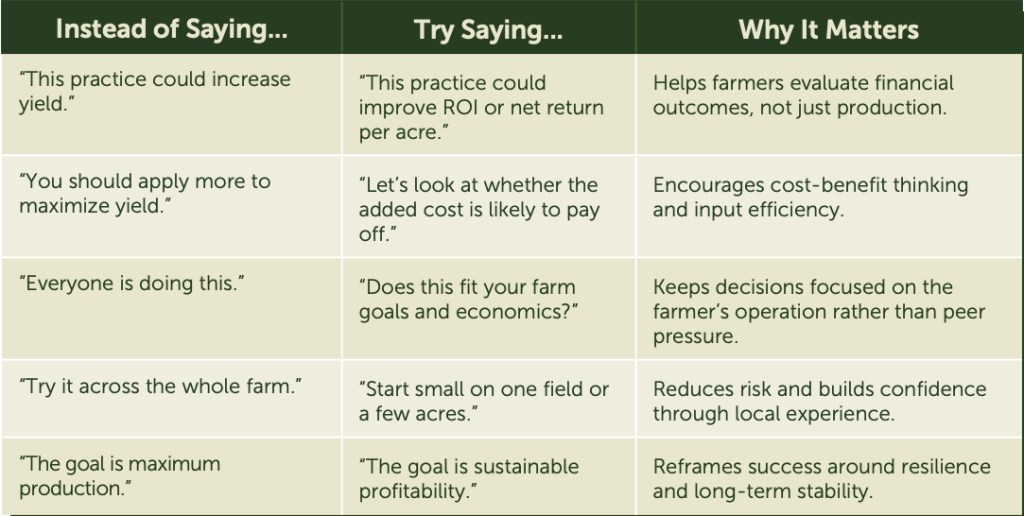
A Few Language Shifts That Change the Conversation
Small changes in how advisors frame recommendations can open the door to a more productive conversation:
When working with producers, advisors can steer the conversation by shifting the language used in recommendations away from maximizing yield and toward improving overall profitability and return on investment. Rather than focusing solely on yield, conversations should emphasize the outcomes that support long-term farm profitability and resilience, including margin stability, input efficiency, risk management, soil health, sustained productivity and financial flexibility during periods of market volatility.
Encouraging producers to start small can help reduce perceived risk and build confidence in new practices. For example, suggesting a reduced nitrogen application rate on a single field allows them to evaluate results firsthand before making changes across their whole operation.
Advisors can help redirect the conversation from maximizing yield to improving profitability by sharing examples of producers who have achieved stronger financial results through a more holistic approach to decision-making. Whenever possible, advisors should incorporate local data and real-world economic performance metrics, as these help ground conversations in operational realities and support more informed business decisions. You can find real-world farm profitability data at soilhealthinstitute.org/profitability.
By focusing on long-term stability, resilience and profitability rather than short-term yield gains alone, advisors can initiate more productive conversations and support more sustainable decision-making.
Advisors can also anchor conversations around cost per bushel rather than yield per acre or frame soil health and reduced erosion as land and soil equity: long-term value in the land itself, not just this season’s margin.
This resource is one of many developed through the Farmers for Soil Health partnership. The Farmers for Soil Health (FSH) collaboration, covering 20 states across the Midwest, Great Lakes, and Chesapeake Bay, aims to boost cover crop adoption on corn and soybean acres to 30 million by 2030. Along with the University of Missouri Center for Regenerative Agriculture, SHI leads the FSH education team, collaborating with technical assistance leads in each state to offer education and resources for successful adoption of soil health management systems.
Soil health helps Barry Evans boost profitability and make the most of limited water
Cotton grower Barry Evans didn’t think he’d come back to the farm after college, but after more than a decade away, he found himself missing farm life. The West Texas operation he returned to, however, wasn’t the same as when he left. Wind was carrying away the topsoil, and water was becoming scarce. It was time for a different approach.
“Things changed a lot as our Ogallala Aquifer declined. The big question we had is how we’d go on farming in West Texas without irrigation water. Conservation farming is to allow us to capture rainfall and improve water infiltration. That’s really the way we’re going to make it: You’ve got to capture rainfall and not let it get away.”
How it started
“I came back to the farm in 1992 and in 1996 and I start managing for dirt storms. We were full tilling like everyone was. I saw the research on no-till and got interested in it. We’ve seen such a change. It has helped with the dirt storms, but also with so much more than what I planned when I started.”
What’s working?
No-till cotton helped keep Evans’ soil in place, but when he started rotating grain sorghum, he began to see his soil improve and was able to reduce his irrigation to just 600 of his 4,500 crop acres. “We started seeing the benefits of both water capture and helping our water infiltration rate. We like to stabilize our yield, but it’s just really hard with our erratic weather. We found out that capturing rainfall and having a residue on the ground really helps. It’s giving me hope for the future without irrigation.”
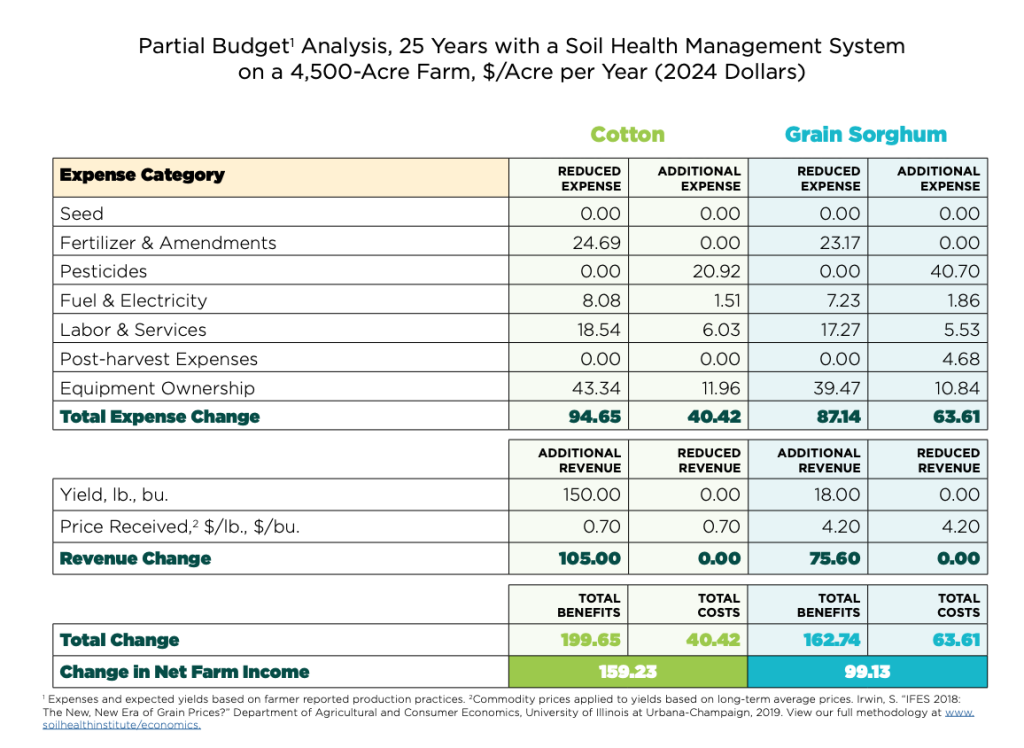
Over time, the changes also reduced production costs and increased yields, boosting profitability. Net farm income increased $159/acre for cotton and $99/acre for grain sorghum due to soil health practices.
Here’s a closer look at how those changes improved Evans’ bottom line:
What he learned the hard way
“You’ve got to kill weeds early. It’s so critical to our farming operation because our moisture is so valuable. If you wait on herbicide, it will cost you more money in the end.”
His advice
“It’s probably not as hard as you think it is. When I first started, I bought a drag planter because I thought I needed lots of weight and I bought a heavy planter coulter and row cleaners and all kind of stuff I thought I would need. It is really not that complicated. You just don’t need all the extra tools you think you do.”
Want to know what managing for soil health can do for your operation?
Here are three things you can do today:
Download our printable fact sheet for full details on this farm’s profitability analysis
Understanding your soil is the foundation of good farm management. Soil testing gives farmers, agronomists, and landowners the data needed to assess and improve their soil’s physical, chemical, and biological properties, supporting better decisions that enhance productivity and long-term sustainability. Butnot all soil tests tell the same story.
There are two different approaches – soil fertility testing and soil health testing – and understanding the difference between them is key to getting the most out of your farming operation. Here’s what each test measures and why using both gives you the fullest picture of your soil.
Soil fertility is the measure of a soil’s capacity to supply essential nutrients for crop growth. It’s assessed through routine soil tests that quantify nutrient levels (like phosphorus and potassium), which have been researched and calibrated over decades to optimize crop yield responses and guide fertilizer and lime application rates.
Soil health is really about how alive and well your soil is. It’s not just about nutrients. It reflects the physical, chemical and biological characteristics of soil working together to hold water, support the tiny organisms that cycle nutrients, and bounce back from stress. Because these properties can shift over time in response to management, soil health is both a snapshot of how well your soil functions today and a long-term measure of whether your practices are sustaining the land for the future.
While soil fertility testing tells you what nutrients your soil has and what to add, soil health testing tells you how well your soil is functioning as a living system. Used together, fertility testing optimizes what you apply today, while soil health testing helps you understand whether your broader management practices (tillage, cover crops, and rotations) are moving the soil in the right direction over time.
The bottom line: Soil health testing is not a replacement for regular soil fertility testing and vice versa; they are complementary and each is needed to get a full picture of your soil’s condition.
This resource is one of many developed through the Farmers for Soil Health partnership. The Farmers for Soil Health (FSH) collaboration, covering 20 states across the Midwest, Great Lakes, and Chesapeake Bay, aims to boost cover crop adoption on corn and soybean acres to 30 million by 2030. Along with the University of Missouri Center for Regenerative Agriculture, SHI leads the FSH education team, collaborating with technical assistance leads in each state to offer education and resources for successful adoption of soil health management systems.
When Mississippi farmer Sledge Taylor started experimenting with no-till, he wasn’t trying to improve his soil, he was trying to keep it from getting washed away.
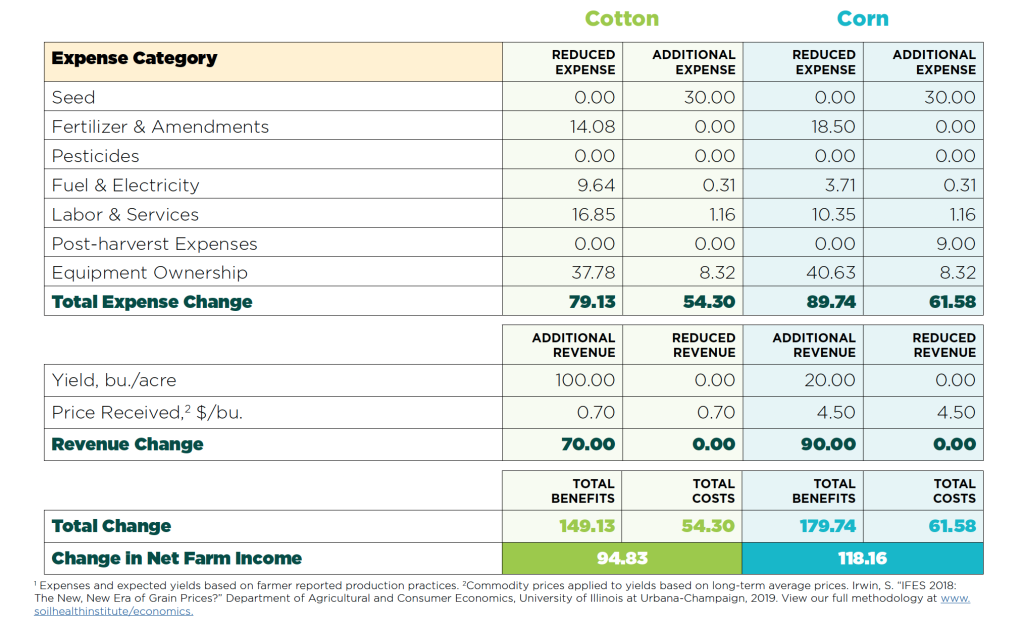
After adding cover crops to his sandy loam and silt loam soils, he not only succeeded in decreasing erosion, but increased his 6,200-acre operation’s profitability by $70/acre for cotton and $90/acre for corn. While he has seen yield increases, the biggest profitability gains came from reduced expenses for fertilizer, fuel, labor and equipment.
“I can’t tell you it makes me a whole lot more money, but we cut costs, and some of the costs are not immediate, like replacing a tractor maybe every 10 years instead of every five years,” he said.
Partial budget1 analysis, 10 years with a soil health management system on a 6,200-acre farm, $ per acre per year in 2024 dollars
What’s working?
“We’ve been able to increase soil organic matter at least double, if not triple over the years. That’s one of the main benefits. And, of course, the water runs pretty clear from the farm. We don’t see much loss of soil. We’ve also got our pasture so much healthier because we rotate paddocks. We rotate every three to five days, and I’ve seen an incredible improvement.”
What he learned the hard way:
“It doesn’t happen overnight. There’s not a whole lot of cutting corners. You’ve got to go ahead and make up your mind to do it. I’ve certainly made some mistakes out there, but probably my main mistake in the beginning was being too cautious.”
His advice:
“My biggest thing is just to not get frustrated. Just trust the process. It’s an art, and part of that art is that sometimes you go out there and feel like it’s impossible, but then you do it. It’s just learning how to do it. It sounds silly, but it’s really it’s kind of given me a kind of a new lease on life. I’ve really gotten excited about all of it, and there’s a lot I still want to learn.”
Want to know what managing for soil health can do for your operation?
Farmers can benefit by using soil health management systems, such as reduced tillage and cover crops, because they may improve soil and increase profits. However, uncertainty about the financial benefits, especially during the transition period, have kept adoption rates low. Most research looks only at long-term outcomes and does not explain how profits change in the years right after adoption.
A new study from the Soil Health Institute interviewed eight cotton farmers in Georgia who had used soil health management systems for at least five years to compare their current practices to how they farmed before adoption. Changes in costs and income with the adoption of soil health management systems were tracked. These changes in income were broken into five stages (reduced tillage, adding cover crops, reduced irrigation, reduced inputs, and increased yields) to show how profitability changes over time.
The analysis, published in Agronomy Journal, showed that profits do not improve right away. In the early stages, especially when adding cover crops, costs increase and income can drop. Over time, however, farmers save money through reduced irrigation, fertilizer, pesticide use, labor, and equipment costs. Over time, some farmers also see higher yields. By the later stages, these combined benefits lead to higher net farm income.
This research helps explain the financial transition period that farmers face when adopting soil health practices. It shows that while there may be short-term losses, long-term gains are likely if the practices are maintained. This information is important for farmers making decisions, as well as for policymakers designing programs to support adoption. It highlights the need for continued use of soil health management systems over time to achieve maximum improved net farm income from these practices.
Improving soil health can increase drought resilience and nutrient availability, reduce erosion, and help fight disease. However, when considering soil health practices, farmers need information on the return on investment. That’s why the Soil Health Institute conducts partial budget analysis of real farms and their practices, comparing the costs and savings of soil health management systems.
We analyzed partial budgets of five Alabama cotton farmers – each with at least five years of experience adopting soil health management systems. All farmers reported an increase in net cotton income.
The bottom-line benefits they saw include:
Cotton net income rose an average of $108/acre
Other crops in rotation with cotton saw net income rise an average of $94/acre for peanut and $36/acre for corn
Average cotton yield increased 160 lb/acre
For the full report, view our fact sheet or watch our webinar detailing the findings.
Founding CEO and President Dr. Wayne Honeycutt Reflects on a Decade at SHI
As he prepares for retirement, the Soil Health Institute’s Founding CEO and President Dr. Wayne Honeycutt looked back on his journey at SHI, from becoming the first employee in 2016 to leading a team working globally to advance soil health. He shared his proudest moments, toughest lessons, and hopes for the future.
What made you want to take on the challenge of leading SHI?
It was just something that felt so right to me in so many ways. I’d had a career of conducting the science and then working at USDA’s NRCS to get that science translated and out in the world to benefit farmers. I realized that so many of these things that we were talking about with conservation, water quality, wildlife habitat, pollinator habitat, and climate change can be addressed through soil health. So when the opportunity came to help launch the Soil Health Institute, it just felt like the rightest thing in the world.
How did you feel when you officially got word that you would be SHI’s Founding President and CEO?
Completely elated. When you work in conservation, you realize how much that you owe to those who came before you, and that gives you a responsibility to providing for those that come after you. So much of this work at the Soil Health Institute is about preparing the Earth, not just for those that are living on it now, but those that are coming after us. It was an opportunity to embrace what gives my life meaning. Here I am on the tail end of that, and I still feel the same way every single day. I count my lucky stars. I remember the very first week, taking a trip to the Samuel Roberts Noble Foundation, the foundation that provided that financial backing to get the Institute started. I remember sitting out on the porch and looking up at the stars and thinking, ‘I cannot believe how lucky I am.’
Launching a brand new organization must have been a major shift from being part of a large established institution. How did that feel at the start?
It was like being an animal let out of his cage. The landscape was wide open. I realized that there was this world of possibilities and such a huge opportunity for having impact. When you start a new organization, you realize that, hey, we get to do things the way that we think it needs to be done and we don’t have to be mired by all of the checklists. We will do things right, but we can cut right to it, conduct the science and get it immediately translated and delivered to farmers.
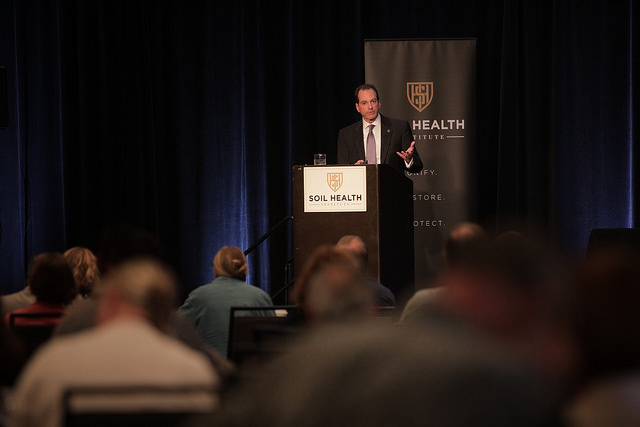
Speaking at SHI’s 2nd Annual Meeting, 2018.
How did your past experiences to shape how you approached the challenge of launching SHI?
I heavily relied on my science training and background. I spent a lot of time in the National Agricultural Library researching how particular practices improve soil health, what impact they have on water quality in different soils and different climates, how they impact greenhouse gas emissions, how they impact farmers, and the best ways for measuring. That helped formulate the overall strategy. When we saw all these environmental benefits of adopting soil health practices, but then looked at the statistics on how much of the land does not use those practices, we knew we need to get more people using these practices. That’s our farmers and ranchers, they’re the ones managing all this land. And so that means we needed to think about what information farmers need to know when they’re deciding whether or not to adopt some new management practice. We know that they need to understand the business case. Is it going to increase or reduce their economic risk and their profitability? There was so little information out there on that at the time. We also know that farmers need to be able to measure their progress. We needed to focus on the right measurements. And we needed to help develop tools for farmers, and so that they can make well-informed decisions when they’re thinking about adopting these practices. That meant we needed an education program. The scientific background that I had was really critical because I was a firm believer in it, and when you’re a firm believer in something, there’s not going to be very much that stops you.
What challenges did you encounter in the beginning?
At the beginning, I was a bit naive thinking everybody’s just going to agree, this is good science, so we’ll support that. Well, that wasn’t the case. Some of the challenges at the time were getting funding, getting convergence, getting people to even talk about soil health. We knocked on a lot of doors and they weren’t opened. But we believed in what we were doing, so we kept pushing. And then as we got some doors to crack open and start to support us, we were able to start conducting the work, prove ourselves, and prove the science, and that brought in more supporters.
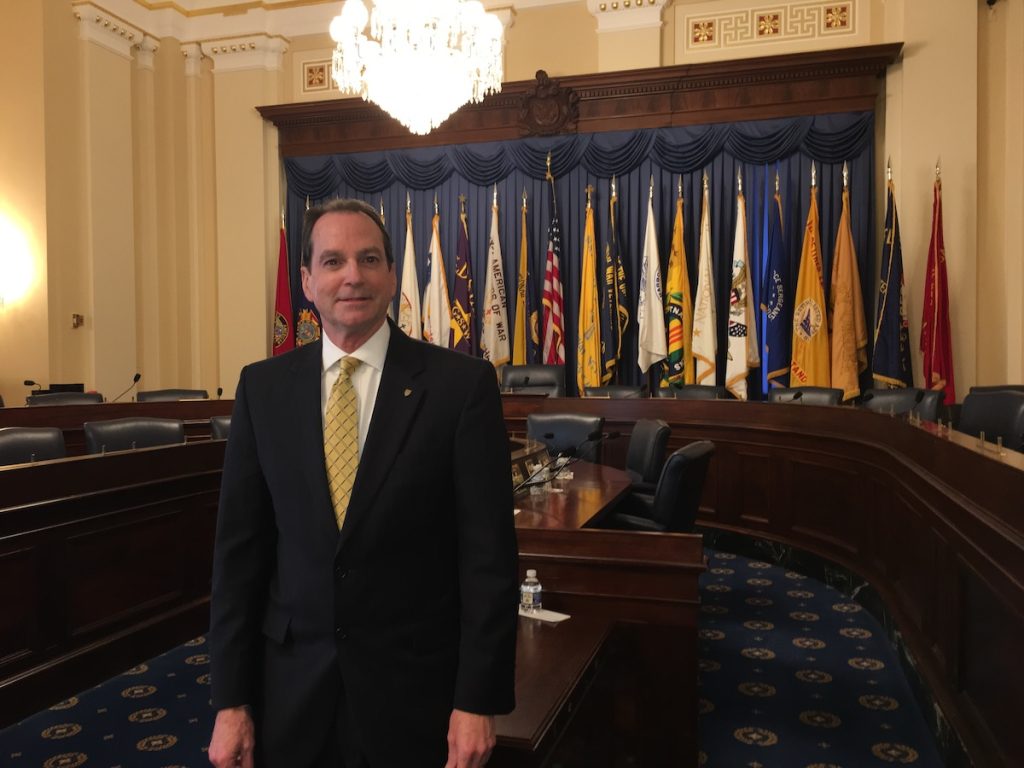
In Washington D.C. for a Congressional briefing, 2018.
Was there a time you and the team achieved something people said was impossible?
Often people would say, well, what is soil health? How do we know if we’re improving it or not? And so we evaluated over 30 different measurements across the U.S., Canada, and Mexico, all those different crops and climates and soils and management practices, to help us identify the most effective ones that could be widely used. That type of work helped provide a really solid foundation for moving forward. Some of those challenges almost looked insurmountable, but we knew that was our role to help answer the big challenges. We’ve built that foundation now, and it can just take off.
You’ve overseen tremendous growth of SHI in your tenure. Can you discuss the development of the team?
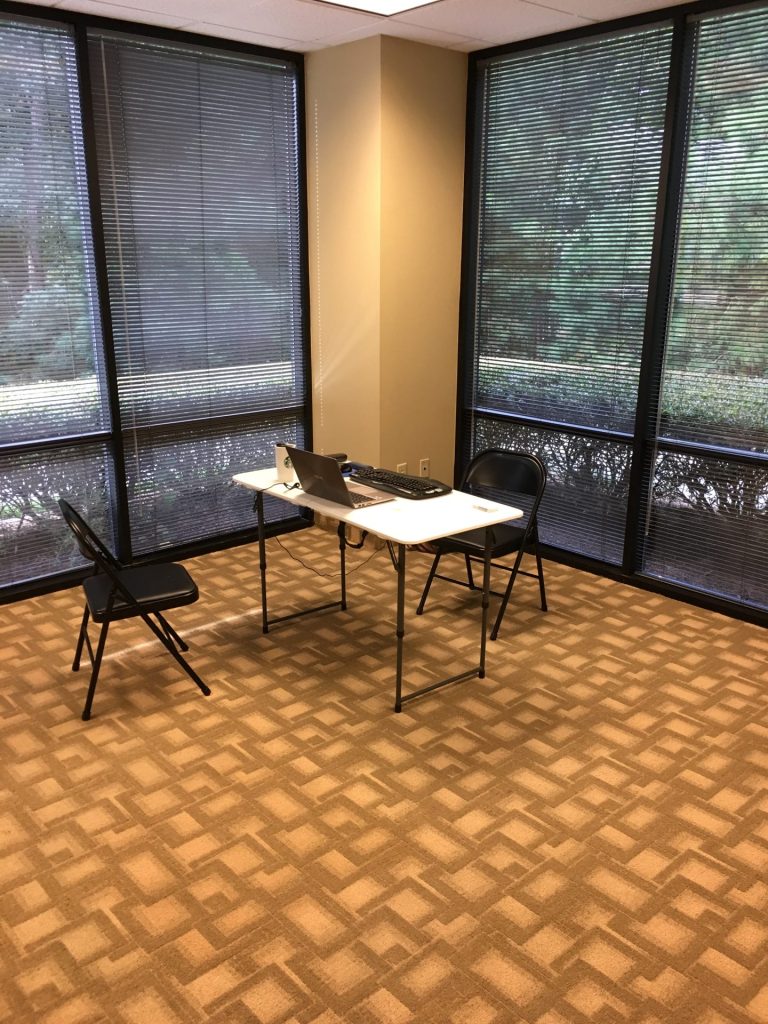
In many ways, I’m just the very fortunate beneficiary of the team’s work. I was the only employee first, and then we hired three more to get things started. We were a four-person team for the first two or three years. We were remote at first, then when we found the offices here near Research Triangle Park, just outside of Raleigh, that’s when we first came together. It was kind of comical. We had card tables, camp tables, a little computer. Now we’re in the fortunate position of having many top candidates wanting to work at SHI. About a year ago at an internal workshop, I asked, ‘What was it that brought you to the Soil Health Institute? What keeps you here?’ And the real common thread going around the table was the opportunity to have impact and to scale it up. That’s what drives so many of us: We want to make sure the work is scientifically credible, but the science is not our end game. It’s getting it out there, getting that adoption and helping farmers stay in business.
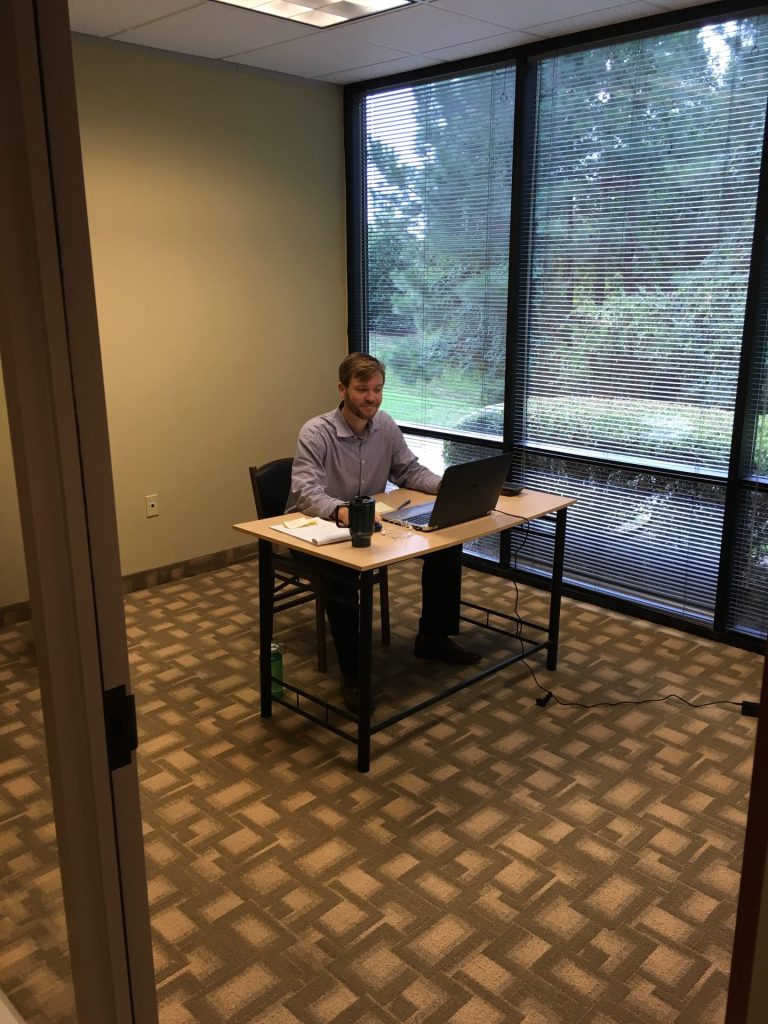
Byron Rath, now SHI’s Chief Impact Officer, in the first days of SHI’s headquarters in Morrisville, North Carolina.Camp tables and folding chairs furnished the office in its early days. “It was kind of comical,” Dr. Honeycutt said.
What has been the most rewarding part about building SHI?
One of the most rewarding parts is seeing the conversation change. When we started, soil health was not mainstream. Now it is much more mainstream. People are recognizing that the number one outcome of regenerative agriculture is soil health. Farmers are recognizing themselves not just as a corn or soybean farmer, but also as a soil health manager. When they focus on that, they can bring benefits to themselves, to their neighbors, to society.
What accomplishments will you look back on most fondly?
The bottom line is the people. I love seeing fellow employees challenge themselves and prove things to themselves. Working with individuals and seeing them progress in their careers has been a big part of the accomplishment. In a broader sense I do feel that the elevation of the soil health terminology and concept is one of the accomplishments I feel like we’ve had a role in here.
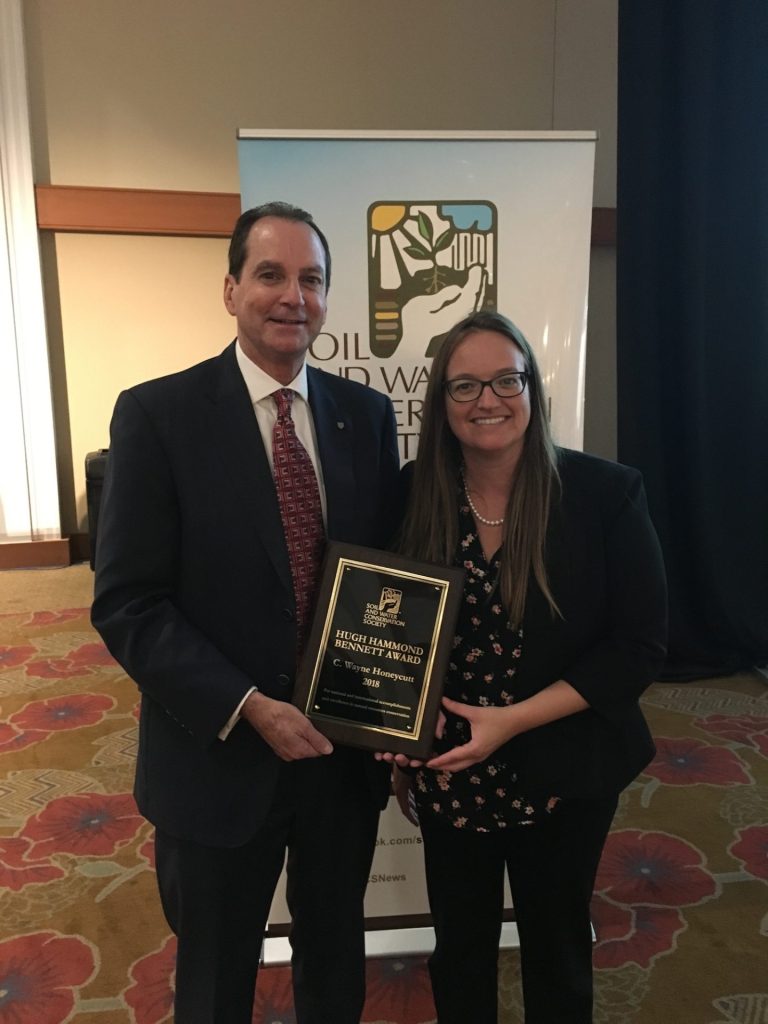
Receiving the Hugh Hammond Bennett Award from the Soil and Water Conservation Society. The award recognizes “extraordinary accomplishments in the conservation of soil, water, and related natural resources.”
How did you find your way into soil health?
When I was about 10 or 11, my father purchased some farmland, so I started spending time with him out on the farm. I developed a real appreciation for for the land: As Wendell Berry describes, when you put your hand into the ground, if you leave it, your heart will ache to go back because you’ve made a marriage with your place. That was just really eye opening for me. I was basically a nature nut, so I got my first degree in forestry, but I started taking some soils classes and I’d got more and more interested in that, so I minored in soils. When I got my bachelor’s degree in forestry, there were no job opportunities. A professor offered me an assistantship to get my master’s in soils and forest soils, so I did that, and but after, with a master’s degree, I ended up laying carpet for minimum wage. I realized, this is not working. I’ve been following my passions. Maybe I should try to do something that’s not my passion, but will make me good money and I could take great vacations. So I went back to school in computer science, but it was really clear that it just was not aligned with my interests and passions. At that point, I thought, well, the only thing I’ve been halfway good at so far is school, so I’ll apply for Ph.D. programs. After a Ph.D., I was hired as a scientist for USDA’s Agricultural Research Service. I remember thinking, ‘If I don’t make the grade here, maybe they will at least keep me on as a technician.’ That’s where my confidence level was, because I hadn’t proved things to myself. My point for people starting off is, it’s not a straight line. It’s not predetermined. Stay aligned with your passions and believe that you can achieve what you want to achieve.
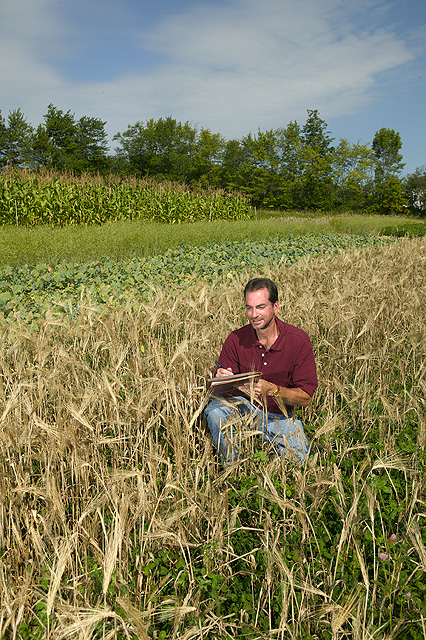
As Research Leader at USDA Agricultural Research Service, 2005. Photo by Peggy Greb, USDA ARS.
When you think about the soil health movement as a whole, what makes you feel hopeful?
What makes me feel hopeful is the recognition that soil health is the foundation for regenerative agriculture, the foundation for managing agricultural lands. When you focus on soil health and you are achieving so many of these other benefits, with stable yields, a stable income, and environmental benefits. Another thing that really helps me have faith in the future is the level of inspiration for the generations that are younger than me, that are excited about this work and committed to helping bring those benefits to scale.
What are you looking forward to in your next chapter?
I really want to get back to nature. I want to get a small topper for my pickup truck and build a platform for a bed and some shelves underneath it and do a lot of camping and hiking. I love being on mountaintops above the tree line, so I’m planning on doing a lot of that.
You’re working side by side with incoming CEO Ashley McKeon until your retirement this month. What are you looking forward to in Ashley’s leadership at SHI?
She has so many ideas and she’s so enthusiastic. I know she’s going to do such a great job, and everyone is so excited about her coming in. It’s a new level of energy, which is exactly the way it should be. I’m really, really happy to see that good things are in store.