How Do We Measure the Profitability of Soil Health?

Soil health isn’t just about improving your fields; it can also make a real difference to your bottom line. 

Through interviews with farmers who have used soil health practices for five years or more, we quantify the real economic impact of soil health practices like cover crops and reduced tillage.

What method do you use?

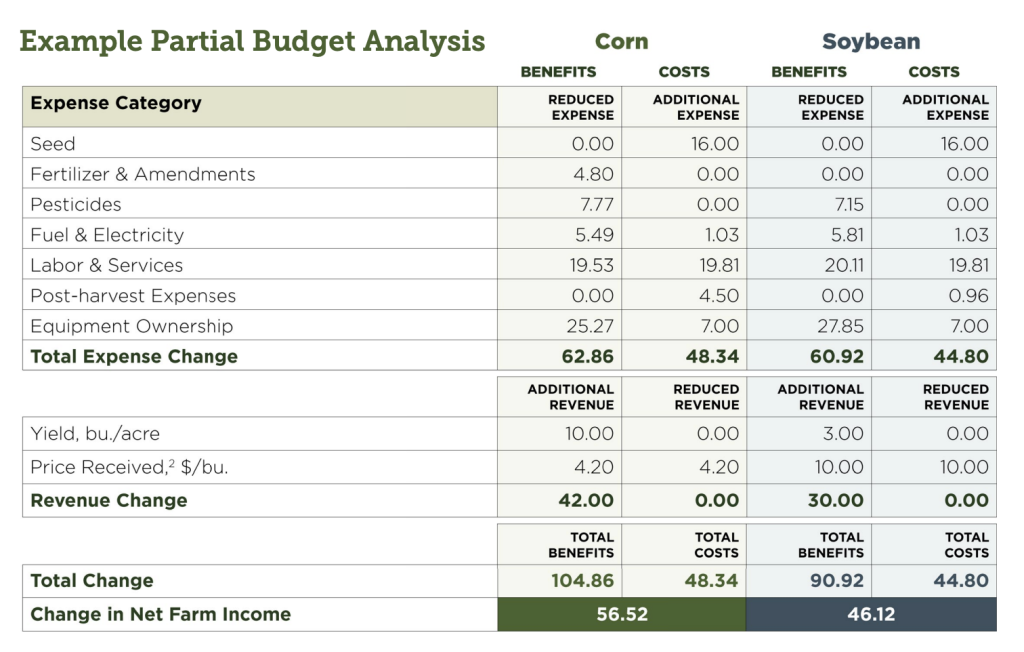
We use partial budget analysis to measure how soil health practices affect net farm income. Instead of analyzing every farm expense, this approach focuses only on what changes after adopting soil health practices.

What are some examples of expense changes?

  • Reduced fuel and equipment costs from fewer tillage passes
  • Lower fertilizer expenses due to improved nutrient cycling
  • Reduced pesticide use over time
  • Increased seed costs from adding cover crops

Here’s an example of a partial budget from a real farm:
How do you choose growers for the interviews?

We select participants based on several criteria. Participating producers must have managed for soil health for at least five years. We also focus on different regions and climates representating various crop types and farming systems. We often work with local partnering organizations to identify suitable producers.

What do you do with producers’ information?

We take participants’ confidentially seriously. We never share any individual producer data without permission from participants. This includes farmer names, farm details (i.e. exact location, size, etc.), and responses to partial budget interview questions.

We use the collected data to create:

  • Aggregated regional reports that combine and synthesize findings across multiple farms in a geographic area, available at https://soilhealthinstitute.org/resources/
  • Individual case studies that highlight specific farms and their experiences (only with participant permission)

By focusing on real farmer experiences and measurable financial outcomes, we are helping producers better understand the business case for soil health.

To learn more about SHI’s methodology or view detailed profitability reports, visit our Resources page. You can also connect with a Soil Health Educator to learn how these practices could work on your farm.

This resource is one of many developed through the Farmers for Soil Health partnership. The Farmers for Soil Health (FSH) collaboration, covering 20 states across the Midwest, Great Lakes, and Chesapeake Bay, aims to boost cover crop adoption on corn and soybean acres to 30 million by 2030. Along with the University of Missouri Center for Regenerative Agriculture, SHI leads the FSH education team, collaborating with technical assistance leads in each state to offer education and resources for successful adoption of soil health management systems.

Sustainability Leader Ashley McKeon Selected as Soil Health Institute’s President and CEO

Ashley McKeon, a seasoned agriculture and sustainability executive, will lead the Soil Health Institute into its next decade.

McKeon, who previously led regenerative agriculture strategy for Cargill in Washington, D.C., will assume the role on June 1, 2026. She will work alongside Founding President and CEO Dr. C. Wayne Honeycutt during a brief transition period before Dr. Honeycutt retires.

“Under Dr. Honeycutt’s leadership, the Soil Health Institute has developed into a trusted, science-based organization focused on helping farmers protect and improve their most valuable asset — their soil. I’m honored and excited to build on that legacy,” McKeon said. “I look forward to working with SHI’s talented staff and partners to expand our impact and strengthen the resilience of farms, ranches, and the land we all depend on.”

Ashley McKeon will lead the Soil Health Institute as its President and CEO. A portrait of Ashley in a sunlit office hallway.

McKeon was selected by SHI’s Board of Directors after a nationwide search.

“Ashley’s deep and varied experience make her an exceptional choice to steward not just SHI’s evolution, but the soil health movement as a whole,” said Dr. Diana Jerkins, SHI’s Board Chair.

McKeon’s appointment comes at a time when a resilient agriculture industry and sustainable supply chains matter more than ever. She brings experience across government, business, and nonprofit sectors, with a focus on advancing systems that support farmers and ranchers and strengthen conservation and environmental outcomes across landscapes.

McKeon previously served in leadership roles in the U.S. Department of Agriculture and as Senior Professional Staff with the U.S. Senate Committee on Agriculture, where she helped shape federal conservation policy and championed significant new investments in soil health and conservation through the 2018 Farm Bill.

She later joined Cargill, one of the world’s largest privately held companies, where she held roles including Director of Federal Government Relations and Director of Regenerative Agriculture. In these positions, she helped develop and advance the company’s first global regenerative agriculture strategy, working across business units and supply chains supporting farmer adoption across more than 1 million acres and building scalable sustainability partnerships. A key initiative she led at Cargill was increasing investment in soil health.

In 2025, McKeon founded the advisory firm Growing Strategy, working with organizations including Environmental Defense Fund, where she later became Director of Agricultural Policy.

McKeon holds a master’s degree in natural resources with a graduate certificate in sustainability from Virginia Tech, and a bachelor’s degree in political science from the University of Portland.

As SHI’s President and Chief Executive Officer, McKeon will direct the global nonprofit’s efforts to empower farmers and ranchers to use regenerative soil health systems that improve profitability and resilience, benefiting rural communities and the environment. 

Dr. Honeycutt will retire on June 20. 

“I feel very fortunate to pass SHI’s leadership into such capable hands,” Dr. Honeycutt said. “Ashley brings new skills, experiences, and networks that will elevate SHI’s programs and impact to another level.”

During Dr. Honeycutt’s tenure, SHI assessed the business case for adopting soil health practices; identified cost-effective, widely applicable measurements; and established benchmarks across North America showing farmers how healthy their soils can become. These and other advances inform SHI’s education programs, which support farmers across 35 states and three provinces.

In its second decade, SHI is poised to meet the growing interest in soil health with science-backed assessment, locally relevant insights, and actionable information to help farmers, advisors, and businesses secure the future of our food, fuel, and fiber.


Free Tool Helps Growers, Advisors See Impact of Regenerative Practices on Drought Resilience

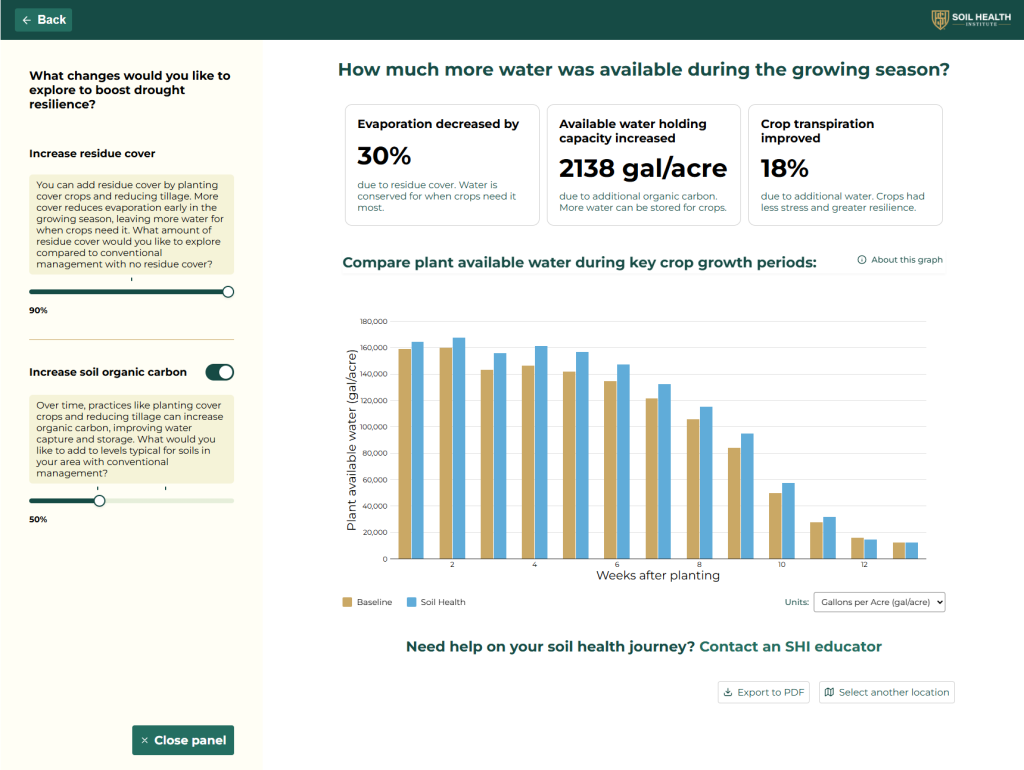
As drought risk intensifies across U.S. farmland, the Soil Health Institute (SHI) has launched a new, science-based tool to help farmers and advisors understand how soil health management can improve water availability and crop resilience. The Drought Resilience Calculator (DRC) models how increased residue cover and soil organic carbon can help crops better withstand dry conditions.

The web-based DRC simulates the soil water cycle using historical weather data for a specific location and compares conventional management with soil health management. By quantifying changes in evaporation, transpiration, and plant available water, the tool shows how healthier soils can store more water and save water for when crops need it most. This supports more stable yields — especially in regions and growing seasons where water is limited.

“Looking at water use through a growing season with the DRC is helpful for showing how soil health management can leave more water for crops, allowing you to go longer between rain events without the crop experiencing stress,” said Sledge Taylor, a farmer who has explored the tool’s applications.

The Drought Resilience Calculator was developed with support from Cargill and draws on soil health data and management insights from real-world production systems.

“A more food-secure world starts on the farm – with farmers,” said Ryan Sirolli, senior director of sustainability solutions at Cargill. “Advancing that progress means helping farmers access the support and tools they need to overcome barriers to improving soil health. That’s why Cargill supported the development of SHI’s Drought Resilience Calculator – a practical tool that helps assess how soil health affects water availability. This effort is part of Cargill’s broader work to advance regenerative agriculture through programs and partnerships in more than 16 countries.”

Results from the drought resilience calculator show how much water could have been saved with soil health practices in each week of the growing season.

Users choose an area within the United States, select a crop and typical planting date, and choose an increase in residue cover and soil organic carbon to model. The calculator then looks at prior drought years to show how much water could have been available for crops.

The Drought Resilience Calculator builds on research conducted by the Soil Health Institute, a global nonprofit, during its North American Project to Evaluate Soil Health Measurements. By combining open-source models with research showing that building soil organic carbon increases available water holding capacity, the tool translates scientific discovery into locally relevant insight for farmers.

“These practical insights can help farmers and advisors make informed management decisions, building drought resilience into their production systems,” said SHI President and CEO Dr. Wayne Honeycutt.

A second phase of the DRC will explore the impact of soil health management on drought resilience across a region, allowing organizations to view the benefits of regenerative practices in their supply sheds.

The Drought Resilience Calculator is available at drc.soilhealthinstitute.org.


New Resource for Lenders on Soil Health Investments 

As lenders navigate increasing climate variability, fluctuating input costs, and evolving regulations, practices like cover crops, conservation tillage, rotational grazing, and nutrient management can strengthen both farm performance and loan portfolios. The Soil Health Institute, in collaboration with Farmers for Soil Health, has released a new fact sheet designed to help agricultural lenders better understand the financial value of soil health practices. 

Key takeaways: 

  • Soil health practices reduce lending risk by building more resilient soils and productive farms.  
  • Reduced reliance on inputs supports stronger margins and more consistent cash flow 
  • Stronger soil health supports farmland value and collateral protection 
  • Emerging revenue streams (e.g., grazing, carbon markets) can diversify farm income 
  • Incorporating soil health into lending decisions can strengthen portfolios over time 

By connecting soil health to financial outcomes, this new resource encourages lenders to incorporate these practices into risk assessments, borrower conversations, and long-term strategy. Supporting soil health adoption isn’t just good for farmers and the environment — it’s a sound investment for agricultural lenders. 

This resource is one of many developed through a broader partnership. The Farmers for Soil Health (FSH) collaboration, covering 20 states across the Midwest, Great Lakes, and Chesapeake Bay, aims to boost cover crop adoption on corn and soybean acres to 30 million by 2030. Along with the University of Missouri Center for Regenerative Agriculture, SHI leads the FSH education team, collaborating with technical assistance leads in each state to offer education and resources for successful adoption of soil health management systems. 


Turning Data into Decisions: Strengthening Soil Health Models for Dairy Producers

Data collected through the Dairy Soil & Water Regeneration (DSWR) project is helping improve how we model soil health outcomes, supporting more confident decision-making around agricultural management, ecosystem services, and sustainability.

A collaboration between Dairy Management, Inc., Soil Health Institute, USDA’s Agricultural Research Service and seven research universities, DSWR advances progress toward the dairy industry’s 2050 environmental stewardship goals, studying soil health and manure management and their effects on greenhouse gas reduction, water quality improvement, and factors such as yield and forage quality.

 
Why do we need models? 

Direct measurements from the field are the gold standard for quantifying ecosystem services, but it isn’t feasible to measure every outcome on every field in every year. Decision support tools and the models that drive them help us to reasonably estimate the impacts of management changes on soil carbon sequestration, greenhouse gas fluxes, and water quality. However, models are only as reliable as the data used to build them. For heavily manured dairy silage systems, datasets that enable robust model calibration are limited. Improving model performance in these manured systems requires high-quality, long-term measurements that capture changes to soil and agronomics.

How is the DSWR project contributing to this effort? 

For five years, DSWR project partners have been collecting extensive soil samples, gas flux measurements, and agronomic data from large plot and field-scale trials in multiple dairy regions across the U.S. The data collected from these locations represent a modeler’s dream dataset: robust measurements of soil properties collected at multiple time points, coupled with thoroughly documented management information.

Scientists at the Soil Health Institute are collaborating with Field to Market and modelers at Colorado State University to begin testing the Soil and Water Assessment Tool (SWAT) using DSWR data. SWAT is an open-source, process-based model that can quantify field-scale or regional hydrology and biogeochemistry. Field to Market employs the restructured version of the model, SWAT+, within their Fieldprint Calculator for carbon stock quantification.  

Running simulations with these data will enable us to 1) determine how well the models are currently performing and 2) begin the work of pinpointing where model improvements may be made. Changes may be as simple as updating the values of specific model parameters through calibration, or as complex as adding entirely new functions into model subroutines. 

What have we found thus far? 

Initial simulations have been run for soil health and conventional treatments at a large plot trial and a field scale trial in Wisconsin. Both sites contain well-drained and poorly drained soil types, allowing us to additionally interpret the interaction between inherent soil properties and management on ecosystem service outcomes.

Our preliminary results showed a disparity between modeled and measured carbon stocks, particularly for carbon stocks at the beginning of the experiments. Upon review, it was found that model runs did not differentiate between inorganic and organic fertilizer types. While N and P were both appropriately accounted for, the contribution of organic amendments to the carbon pool was not, leading to an underestimation of carbon stocks after manure application. 

As a result, SWAT+ within the Fieldprint Calculator is now being updated to distinguish synthetic fertilizer from organic amendments, to ensure that carbon is realistically represented. Nutrient values and manure properties from laboratory analyses of the manure products in this project (livestock water recycling, dissolved air flocculation, composted manure, liquid dairy manure) are also being compared to values within the current internal database that SWAT+ uses. 

 
Why does the accuracy of ecosystem service models matter?

Decision support tools are increasingly used to show the impacts of soil health management, incentivize adoption, prioritize resources throughout supply chains, and in some instances, to support the monetization of ecosystem services caused by field-level management change. Ensuring that these tools provide accurate estimates of environmental outcomes is essential for building confidence among farmers, advisors, and stakeholders.

Our goal is to develop models capable of capturing the complexity and nuance of dairy systems, including diverse manure products and region-specific management practices. By improving model accuracy, we strengthen the foundation for informed decisions, credible environmental outcomes, and the continued advancement of soil health for dairy operations.

Find out more about DSWR at https://dairysoilwater.org.


How to Sample Soil for Accurate Results

As more growers and land managers turn to soil health assessments, one thing is clear: Your results are only as good as the sample you collect. The Soil Health Institute’s Sampling 101 series is here to show you how to sample soil and get the information you need for soil health management.

This series of videos and blogs helps you gather the needed equipment, choose a place and time to sample, and avoid common sampling mistakes.

What equipment do I need to sample soil?

You’ll need a soil probe or shovel, a soil knife, a bucket, bags for each sample, a screwdriver, a cooler with ice packs, and an extra bucket or backpack. Watch our short video for more information on gathering supplies for successful sampling.

When should I sample my soil?

Take into consideration where you are in your rotation, time of year, and timing relative to management and environment. View the full blog on when to sample.

Where should I sample my soil?

Avoid areas that are recently disturbed, compacted or eroded. You should also avoid field edges, high or low points, areas that are too wet or too dry, or places with inconsistent crop growth (unless you are specifically trying to get information on soils where you have stunted crops). For more on each of these recommendations, view our blog on where to sample.

How should I collect soil core samples?

Within a row, remove any debris, then insert your soil probe to the 6-inch mark. Pull the probe up carefully, push the soil up into the barrel to make sure nothing has been compacted or lost, then tip the soil into a bucket. Repeat this process to collect 10 samples across a 15-foot radius circle as described in the video below. Add the 10 cores to the bag, seal, and be sure to keep it out of the sun before sending to the lab.

How should I collect aggregate stability samples?

Using a narrow shovel, pull a plug of soil following the method in the video below, then use a soil knife to cut off the top 2 inches and put it in a bucket. Repeat the process two more times about 10 steps out from that point, adding each to the bucket. Gently transfer into your bag to avoid damaging the aggregates in your sample.

What if my soil is heavy or clayey?

In heavy soils, you will need to select aggregates in the field rather than sending the whole soil sample to the lab. Follow the instructions in our video below if your soils are heavy or have a high clay content.

Do you still have questions on how to sample? Reach out to us at info@soilhealthinstitute.org.

This work was supported by the partnership led by Dr. Jeffrey Steiner at Oregon State University on the Advancing Markets for Pacific Northwest Potatoes, Industrial Hemp, and Commodities from American Indian Reservations project funded by USDA-NRCS.


Soil Health Monitoring: It’s Like Maintaining Your Equipment

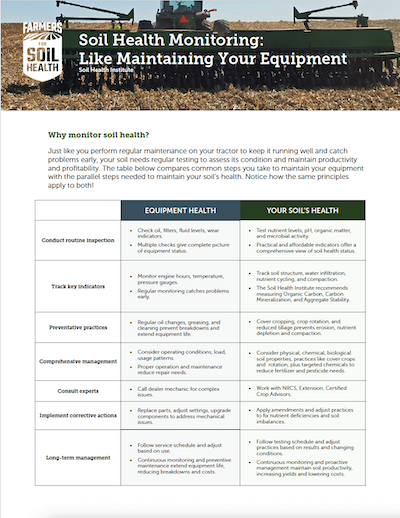
Just like you perform regular maintenance on your tractor to keep it running well and catch problems early, your soil needs regular testing to assess its condition and maintain productivity and profitability.

Our new fact sheet produced in partnership with Farmers for Soil Health compares common steps you take to maintain your equipment with the parallel steps needed to maintain your soil’s health.

 Equipment HealthYour Soil’s Health
CONDUCT ROUTINE INSPECTIONCheck oil, filters, fluid levels, wear indicators. Multiple checks give complete picture of equipment status.Test nutrient levels, pH, organic matter, microbial activity.Practical and affordable indicators offer comprehensive view of soil health status.
TRACKING KEY INDICATORSTrack engine hours, temperature, pressure gauges.Regular monitoring catches problems early.Track soil structure, water infiltration, nutrient cycling, compaction. The Soil Health Institute recommends Organic Carbon, Carbon Mineralization, Aggregate Stability
PREVENTATIVE PRACTICESRegular oil changes, greasing, cleaning prevent breakdowns and extend equipment lifeCover cropping, crop rotation, reduced tillage prevents erosion, nutrient depletion and compaction.
COMPREHENSIVE MANAGEMENTConsider operating conditions, load, usage patternsProper operation and maintenance reduce repair needsConsider physical, chemical, biological soil properties, practices like cover crops and  rotation, plus targeted chemicals to reduce fertilizer and pesticide needs
CONSULT EXPERTSCall dealer mechanic for complex issuesWork with NRCS, extension, certified crop advisors
IMPLEMENT CORRECTIVE ACTIONSReplace parts, adjust settings, upgrade components to address specific mechanical issuesApply amendments and adjust practices to fix nutrient deficiencies and soil imbalances
LONG-TERM MANAGEMENTFollow service schedule and adjust based on use. Continuous monitoring and preventive maintenance extend equipment life, reducing breakdowns and costsFollow testing schedule and adjust practices based on results and changing conditions. Continuous monitoring and proactive management maintain soil productivity, increasing yields and lowering costs

Bottom Line: Soil health monitoring helps you make better management decisions, leading to higher yields, reduced input costs, and improved long-term profitability.

Download a printable version of this fact sheet

chart on first page of fact sheet

The Farmers for Soil Health (FSH) collaboration, covering 20 states across the Midwest, Great Lakes, and Chesapeake Bay, aims to boost cover crop adoption on corn and soybean acres to 30 million by 2030. Along with the University of Missouri Center for Regenerative Agriculture, SHI leads the FSH education team, collaborating with technical assistance leads in each state to offer education and resources for successful adoption of soil health management systems.


Partial Budgets Quantify Economic Outcomes of Soil Health Management for Farmers

Farmers across the United States are continually searching for ways to maintain productive farmland while protecting the environment. Practices that improve soil health — like using cover crops or reducing tillage — are known to benefit the land by preventing erosion, improving water quality, and supporting long-term fertility. 

However, many farmers are uncertain whether these soil health systems are financially worthwhile. Without clear data on how such practices affect profits, adopting them can seem risky, especially for farmers managing tight budgets and variable weather conditions. 

The Soil Health Institute set out to understand how soil health management systems impact farm income. They worked directly with more than 150 farmers across 23 states, focusing on real-world operations rather than controlled research plots. 

Using a financial tool called partial budget analysis, comparisons were made to changes in income and expenses when farmers switched from conventional practices to soil-focused systems. Changes included factors like seed costs, fertilizer use, equipment needs, labor, and yields to calculate whether the transition increased profits or added costs. 

The analysis informed the development of crop- and region-specific fact sheets and online webinars. These resources were designed to help farmers understand how soil health practices performed under conditions similar to their own — providing local, evidence-based guidance for making financial and environmental decisions. 

This research, published in the Journal of Extension, bridges the gap between environmental sustainability and economic reality. By showing that soil health practices can often increase profits through reduced costs and better yields, the study gives farmers the confidence to adopt more sustainable methods. 

In turn, this contributes to cleaner water, healthier soils, and stronger rural economies and supports both the financial well-being of farmers and the long-term health of the land — helping ensure that U.S. agriculture remains productive and resilient for generations to come. 

Read the peer-reviewed manuscript.