The “Soil Health on the Farm” field day was held on February 5, 2024, in Shaw, Mississippi, at the farm of SHI Farmer Mentor Lars Ely. The event engaged a diverse group of attendees from cotton producers to representatives from Delta F.A.R.M. and Mississippi State University (MSU) in conversations focused on cover crop selection, equipment considerations, and soil health sampling techniques. This event was organized by SHI Soil Health Educator Jessica Kelton, and speakers included SHI Soil Scientist Bo Collins; U.S. Department of Agriculture Natural Resources Conservation Service Area Agronomists Greg Swain and Lou Andrews; and MSU Extension Ag Economist Will Maples.
SHI Soil Scientist Bo Collins demonstrating in-field soil sampling to USRCF field day attendees in Shaw, Mississippi. Photo credit: Jessica Kelton, SHI Soil Health Educator.
If you want to contact an SHI Soil Health Educator, Technical Specialist, or Farmer Mentor, please visit our Contacts page.
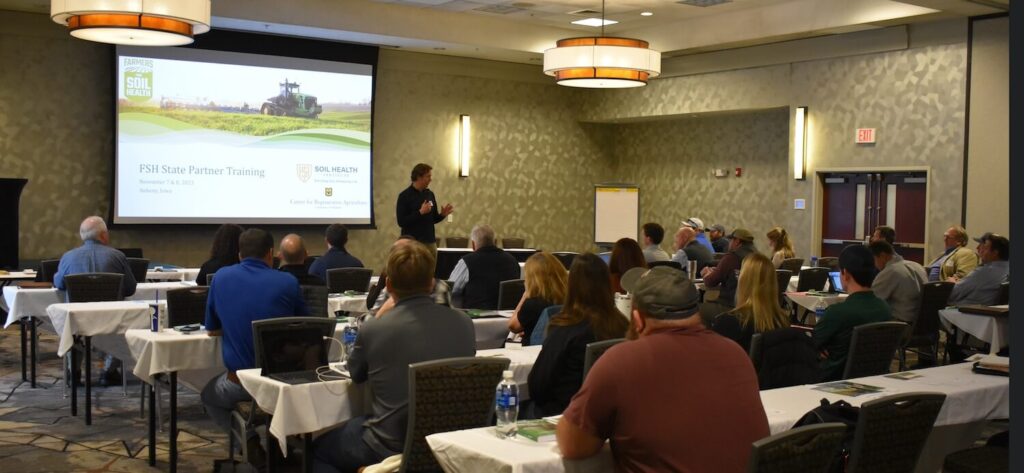
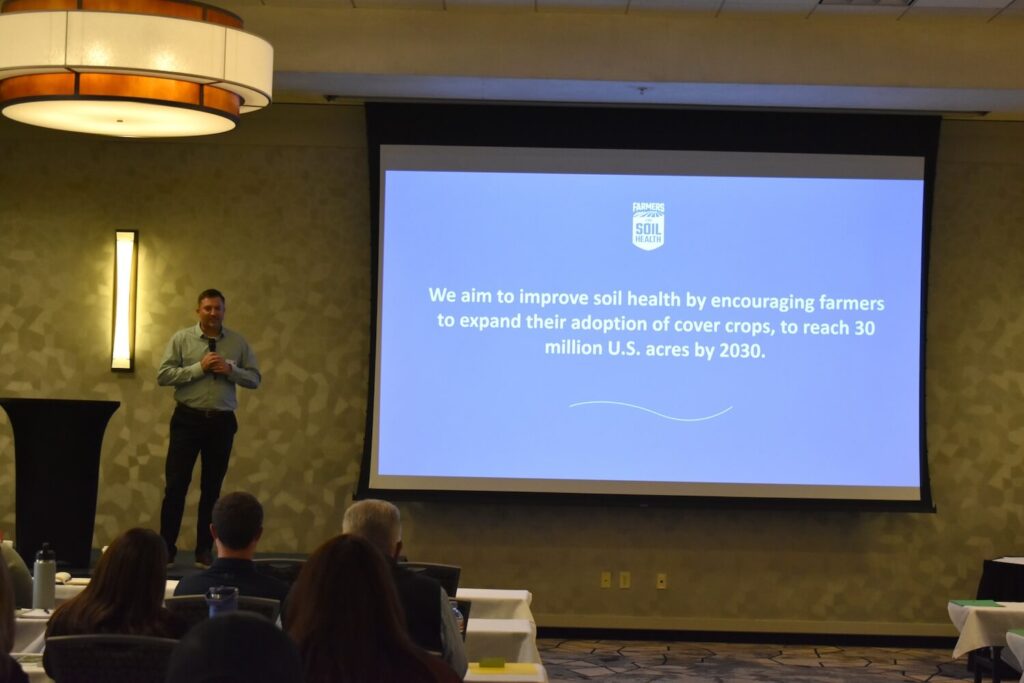
On November 7th and 8th, 2023, the Soil Health Institute (SHI) and the University of Missouri Center for Regenerative Agriculture (CRA) held an in-person education event for state technical assistance (TAs) providers in Ankeny, IA, as part of the Farmers for Soil Health (FSH) Climate-Smart Commodities Partnership. The FSH Collaboration, covering 20 states across the Midwest, Great Lakes, and Chesapeake Bay, aims to boost cover crop adoption on 30 million corn and soy acres by 2030. SHI and CRA lead the FSH education team, collaborating with individual TA leads in each state to offer education and resources for successful adoption of soil health management systems.
The 2-day event brought together TAs and advisors representing a multitude of organizations and affiliations, including North Dakota State University Extension, Conservation Technology Information Center, The Nature Conservancy, New Vision Coop, Precision Conservation Management, Kansas Soil Health Alliance, Kansas Association of Conservation Districts, Heartland Soil Services, Iowa Soybean Association, Missouri Soybean Association, and Illinois Corn Growers Association. Additional project partners and local technical service providers, including Ben West, FSH Executive Director, and Jack Cornell, Director of Sustainable Supply for the United Soybean Board (USB), were also in attendance. SHI’s Erin Gundy and Ann Marie Calabro facilitated the event, drawing 48 participants from 9 states.
November 7
The event commenced with a welcoming address from Ann Marie Calabro, SHI Program Manager & Soil Health Educator. The first session, led by Ben West, provided an overview of FSH, followed by an informative Q and A session with Jack Cornell, covering FSH background and objectives.
Ben West, FSH Executive Director, provides an overview of the FSH project.
Jack Cornell, USB, explains the purpose of FSH.
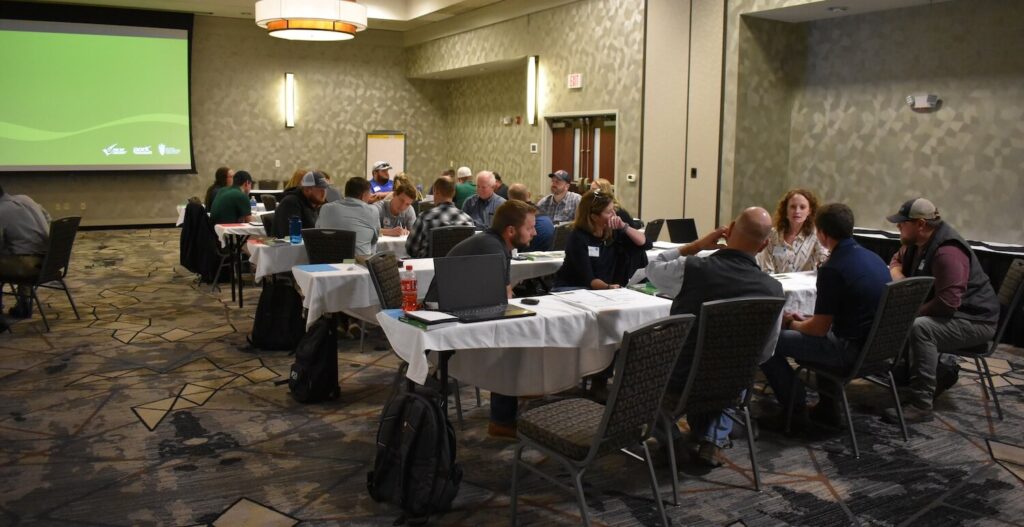
Next, participants engaged in an interactive activity centered on ‘working backward’ from a conservation plan, allowing attendees to form groups, brainstorm, network, and share ideas. Each group had the opportunity to reflect on their experiences in supporting farmers to effectively integrate cover crops into their operations and collectively identify minimum technical elements that farmers need to know.
Attendees work in groups through an interactive activity on conservation planning.
Bethany Bedeker, CRA Cover Crop Outreach Manager, and Rob Myers, CRA Director, kicked off the day 1 technical sessions, discussing the benefits of soil health practices and providing recommendations for selecting region-specific cover crop species.
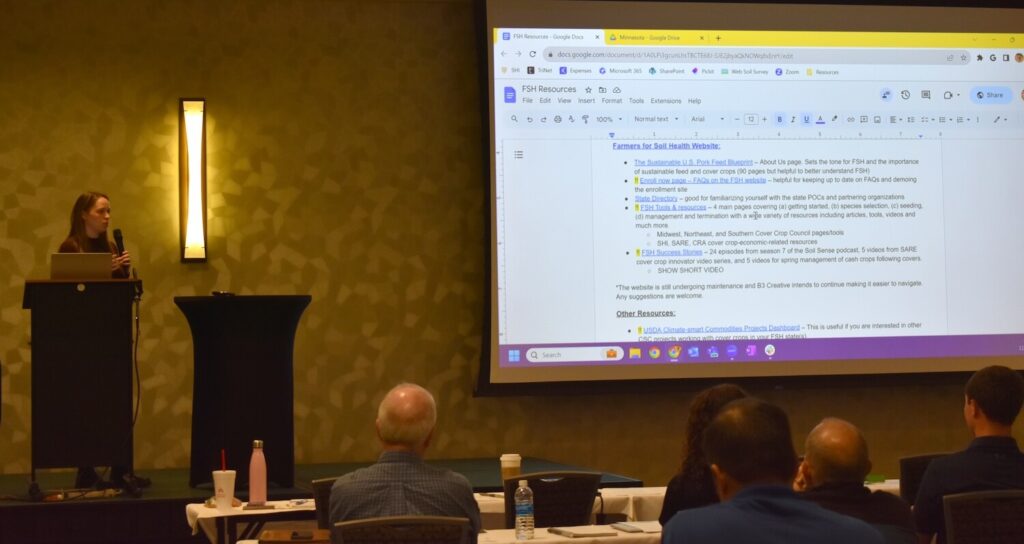
Throughout the project, FSH partners have compiled extensive resources for advisors, farmers, and landowners, including outreach templates, videos, podcasts, factsheets, FAQs, and more housed on the FSH website. Erin Gundy, SHI Soil Health Educator, provided an overview of these resources and insights on upcoming additions.
SHI Soil Health Educator, Erin Gundy, provides technical advisors with an overview of resources available for the FSH project.
Day 1 wrapped up with a panel discussion led by SHI Soil Health Educator, Shannon Moeller. Landowner Jean Eells and farmers Steve Anderson and Chris Deal shared their experiences in integrating cover crops and soil health practices into their operations, offering valuable insights for TAs working with farmers and landowners in their respective states.
November 8
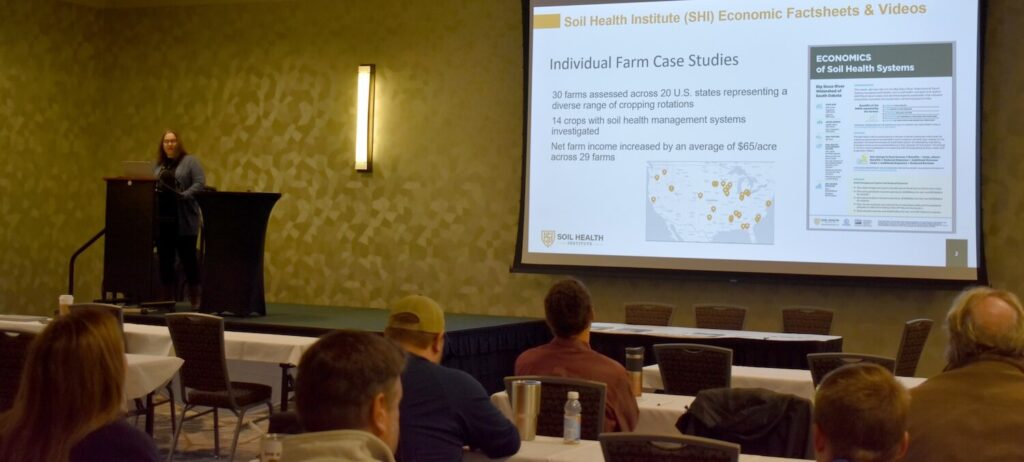
Day 2 of the education program kicked off with engaging discussions focused on the economics of soil health. Rob Myers started the session by presenting the National Cover Crop Survey results, an annual survey conducted by the Conservation Technology Information Center (CTIC) and the Sustainable Agriculture Research & Education (SARE) program. Ann Marie Calabro followed with an overview of results from SHI’s economic case studies, specifically highlighting the economics of soil health systems on 100 corn and soy farms across 9 Midwest states. Laura Gentry, Director of Water Quality Research at Illinois Corn, concluded the economic segment by explaining the purpose and outcomes of the Precision Conservation Management (PCM) program in Illinois.
SHI Program Manager & Soil Health Educator, Ann Marie Calabro, presents on SHI Economic Case Studies.
One of the primary goals of the FSH project is to engage historically underserved producers, and state TAs will receive continuous education to conduct outreach and provide support to these communities throughout the project period. Liz Kolbe, Farmer-Led Education Director at Practical Farmers of Iowa (PFI), provided an insightful overview of PFI’s efforts in working with these communities, highlighting essential dos and don’ts while underscoring the significance of collaborative efforts between organizations.
Abigail Peterson, Director of Agronomy at the Illinois Soybean Association, wrapped up day 2 by providing attendees with important considerations to keep in mind when advising farmers on cover crop termination techniques and planting cash crops after cover crops.
Learn More, Stay Connected
SHI and CRA will continue to host virtual and in-person education events over the next three years to support the FSH education team. Virtual webinars will be open to everyone and geared towards farmers, landowners, and TAs.
Farmers and other landowners are encouraged to utilize the FSH website to find tools and resources that will assist with implementing and managing cover crops. Find more information and connect with local technical assistance here: www.farmersforsoilhealth.com.
In celebration of World Soil Day, December 5, the Soil Health Institute (SHI) announced the release of a free phone application, Slakes, to empower and engage citizens around the world to measure aggregate stability: one of the most common indicators of soil health. Soils with greater aggregate stability are more resistant to wind and water erosion, and are linked to improved water capture, infiltration, and storage, contributing to improved water management and agricultural productivity.
“Improving soil health benefits all,” said Dr. Cristine Morgan, SHI’s Chief Scientific Officer.
“I am excited to see our team and partners make credible soil health measurement technology readily available to anyone with a smartphone.”
The Slakes app uses a smartphone camera to take a picture of three dry soil aggregates before and after exposing them to water for 10 minutes. The app then automatically calculates an aggregate stability value. Weaker aggregates will slake (or break apart) more easily, while stronger aggregates will slake less, indicating better soil aggregation and healthier soil.
“The Ida and Robert Gordon Family Foundation has been a long-time supporter of the Soil Health Institute because SHI brings us catalytic ideas that can scale,” said Roberta Gordon, President & CEO of the Ida and Robert Gordon Family Foundation. “Slakes is a great example.”
SHI envisions that this application will be used by the public, K-12, and college educators in their curricula, as well as conservation professionals, farmers, advisors, and industry/policy stakeholders who are interested in quantifying the impact of management on soil health.
“As one of the top commercial bank agricultural lenders in the U.S., Wells Fargo is a proud supporter of the Soil Health Institute and the development of Slakes,” added Robyn Luhning, Chief Sustainability Officer at Wells Fargo. “Maintaining soil health is an important part of supporting climate resiliency for our customers and communities.”
SHI recommends measuring aggregate stability using the Slakes app as part of a minimum suite of measurements to assess management induced changes in soil health. Aggregate stability index values from Slakes can be compared across management practices to measure improvements in soil health.
“Everyone should be able to analyze their soil quickly, inexpensively and accurately” added Dr. Alex McBratney from the University of Sydney in Australia.
“Which technology for doing this is more accessible and fun than a free app on your mobile phone?”
The Slakes app is available on Google Play and the App Store, and its development was made possible due to a partnership with the University of Sydney and the generous financial support from Wells Fargo Foundation and The Ida and Robert Gordon Family Foundation.
The Soil Health Institute is a global non-profit with a mission of safeguarding and enhancing the vitality and productivity of soils through scientific research and advancement. Our vision is a world where farmers and ranchers grow quality food, fiber, and fuel using soil health systems that sustain farms and rural communities, promote a stable climate and clean environment, and improve human health and well-being. Accordingly, the Institute brings together leaders in soil health science and the industry to conduct research and empower farmers and other landowners with the knowledge to successfully adopt regenerative soil health systems that contribute economic and environmental benefits to agriculture and society. The Institute’s scientific team holds doctorates in various soil science and related disciplines, with specialties in carbon cycling, nutrient cycling, water cycling, nutrient management, soil microbiome, farmer/adviser education, ecosystem services, soil-plant relationships, on-farm economics, and others. The team follows a comprehensive strategy for advancing adoption of regenerative soil health systems, as briefly described in this 5-minute video: https://soilhealthinstitute.org/our-strategy/.
Healthy soils are the foundation for restoring our land. Together, we can create a secure future for all, mitigate the effects of climate change, and help farmers and organizations meet production and environmental goals at scale. Visit www.soilhealthinstitute.org to learn more, and follow us on YouTube, LinkedIn, and Facebook.
The Soil Health Institute (SHI) and Cargill are coming together to advance implementation of regenerative agriculture practices through the promotion of water stewardship within agricultural supply chains. This 3-year, $3 million partnership will equip farmers, conservation planners, and sustainability experts across North America with innovative tools to enhance drought resilience, improve soil health, and encourage sustainable water use.
“Climate change-induced extreme weather events, including drought, heavy precipitation, and elevated temperatures, have dramatically intensified operational risks for farmers and the broader food, fiber, fuel, and beverage sector,” said Wayne Honeycutt, president and CEO of SHI.
“Through this partnership, we’re expediting adoption of regenerative systems by offering stakeholders practical insights to assess improvements in water storage and availability resulting from changes in on-farm practices.”
Recent SHI research has demonstrated that increases in available water holding capacity (AWHC) associated with soil organic carbon gains from soil health practice implementation can lead to twice as much water storage in the topsoil compared to previous estimates. This important finding, currently available as a set of mathematical equations, provides a scientifically robust framework to measure the impact of soil health management on water storage. Continuing efforts supported by this partnership will make this data more accessible to farmers and sustainability experts, enabling farmers to estimate how many more inches of water their soil can capture during the growing season due to improved soil health.
Ashley McKeon, director of regenerative agriculture at Cargill, affirmed, “We strongly believe that regenerative agricultural practices can play a pivotal role in mitigating the impacts of climate change and water stress on our agricultural systems, which is why we are committed to advancing regenerative agriculture across 10 million acres of agricultural land in North America by 2030. Building on more than five years of partnering with the Soil Health Institute, we are empowering farmers and stakeholders across the agricultural value chain with the tools they need to make informed decisions that contribute to a more sustainable and resilient future.”
This partnership between SHI and Cargill will enable farmers, businesses, researchers, governments, and other sustainability experts to assess their progress toward water stewardship objectives and build industry convergence around the value of soil health in enhancing drought resilience and sustainable water management. Both partners are committed to ensuring free, fair, and equitable access to project tools and resources, facilitating widespread adoption and benefits. Learn more about SHI’s research here.
The collaboration will also support Cargill’s global sustainability priorities, including the company’s goal to advance regenerative agriculture across 10 million acres of agricultural land in North America by 2030. Learn more about Cargill’s commitments here.
About the Soil Health Institute
The Soil Health Institute is a global non-profit with a mission of safeguarding and enhancing the vitality and productivity of soils through scientific research and advancement. Our vision is a world where farmers and ranchers grow quality food, fiber, and fuel using soil health systems that sustain farms and rural communities, promote a stable climate and clean environment, and improve human health and well-being. Accordingly, the Institute brings together leaders in soil health science and the industry to conduct research and empower farmers and other landowners with the knowledge to successfully adopt regenerative soil health systems that contribute economic and environmental benefits to agriculture and society. The Institute’s scientific team holds doctorates in various soil science and related disciplines, with specialties in carbon cycling, nutrient cycling, water cycling, nutrient management, soil microbiome, farmer/adviser education, ecosystem services, soil-plant relationships, on-farm economics, and others. The team follows a comprehensive strategy for advancing adoption of regenerative soil health systems, as briefly described in this 5-minute video.
Healthy soils are the foundation for restoring our land. Together, we can create a secure future for all, mitigate the effects of climate change, and help farmers and organizations meet production and environmental goals at scale. Visit www.soilhealthinstitute.org to learn more, and follow us on YouTube, LinkedIn, and Facebook.
About Cargill
Cargill helps the world’s food system work for you. We connect farmers with markets, customers with ingredients and families with daily essentials — from the foods they eat to the floors they walk on. Our 160,000 team members around the world innovate with purpose, empowering our partners and communities as we work to nourish the world in a safe, responsible, sustainable way.
From the feed that reduces methane emissions to waste-based renewable fuels, the possibilities are boundless. But our values remain the same. We put people first. We reach higher. We do the right thing. It’s how we’ve met the needs of the people we call neighbors and the planet we call home for 158 years — and how we’ll do so for generations to come. For more information, visit Cargill.com and our News Center.
The “Cotton and Cover Crops” field day was held on August 22, 2023, in Rich Square, North Carolina, at the farm of SHI Farmer Mentor Donny Lassiter, with SHI Technical Specialist Will Mann also in attendance. The agenda featured discussions by growers, including SHI Farmer Mentors Donny Lassiter and Zeb Winslow, as well as SHI’s Chief Scientific Officer, Dr. Cristine Morgan. Topics covered included practical insights into planting and terminating cover crops, selecting appropriate cover crops, and the various benefits associated with cover cropping. The field day was highly interactive, with Dr. Cristine Morgan’s soil pit presentation being particularly well-received by the attendees. The event drew around 45 participants, including seven growers, and saw a significant presence from SHI, the United States Department of Agriculture Natural Resources Conservation Service, and local Soil and Water Conservation Districts. Thank you to SHI Soil Health Educator Emily Ball for organizing this field day.
SHI Chief Scientific Officer Dr. Cristine Morgan describes how water moves through soil under dry conditions to USRCF field day attendees in Rich Square, North Carolina. Photo credit: Jessica Kelton, SHI Soil Health Educator.
If you would like to get in contact with an SHI Soil Health Educator, Technical Specialist, or Farmer Mentor, please visit our Contacts page.
The “Scouting for Soil Health” field day was held in conjunction with the Annual Row Crops Field Day at the Wiregrass Research Center in Headland, Alabama, on August 18, 2023. The event was attended by over 125 individuals, predominantly growers. Due to concerns about the heat, the sessions were conducted indoors rather than in a soil pit as originally planned. The focus of the day was on the selection and variety of cover crops, providing guidance for growers and consultants on choosing the most suitable cover crop for their needs. Retired University of Florida Forages Professor Dr. Ann Blount shared insights on new and upcoming cover crop species. Alabama Crop Improvement Association Executive Vice President Dr. Jim Bostick discussed their initiatives to boost the availability of cover crop seeds tailored for Alabama’s agricultural conditions. SHI Technical Specialist Brandon Dillard and SHI Farmer Mentor Myron Johnson also participated in the event. While SHI Soil Health Educator Jessica Kelton organized this field day, she also introduced the U.S. Climate Smart Cotton Program, outlining the criteria for grower enrollment.
Retired Forages Professor at the University of Florida Dr. Ann Blount discussed the benefits of cover crops in production systems and considerations for making cover crop selections during a field day in Headland, Alabama. Photo credit: Jessica Kelton, SHI Soil Health Educator.
If you would like to get in contact with an SHI Soil Health Educator, Technical Specialist, or Farmer Mentor, please visit our Contacts page.
The “Getting Started with Cover Crops and Fine-Tuning Cover Crop Plans” field day was held at the Judd Hill Research and Commercial Farm in Judd Hill, Arkansas, on August 15, 2023. This farm is managed by SHI Farmer Mentor Jesse Flye. There were 30 attendees, eight of whom were growers. Growers discussed their experiences using cover crops and learned from others about new soil health management strategies. The United States Department of Agriculture Natural Resources Conservation Service (NRCS) spoke about their cover crop programs and SHI spoke about the SHI USRCF Cover Crop Challenge Program. NRCS District Conservationist Adam Eades said this was one of the best roundtables he’s been a part of in his career. Thank you to SHI Soil Health Educator Emily Ball for organizing this event.
If you would like to get in contact with an SHI Soil Health Educator, Technical Specialist, or Farmer Mentor, please visit our Contacts page.