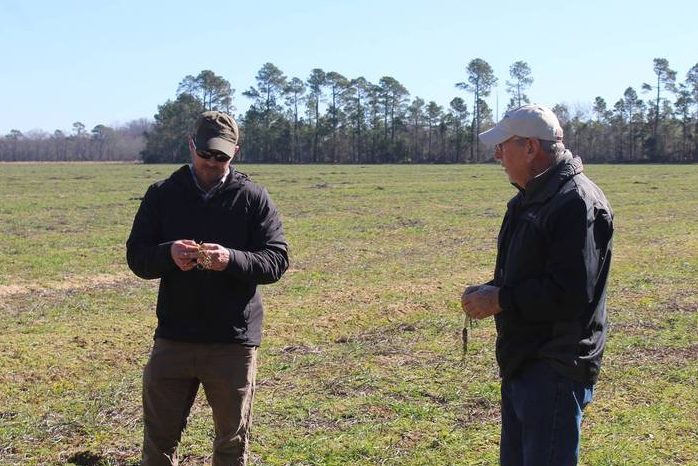
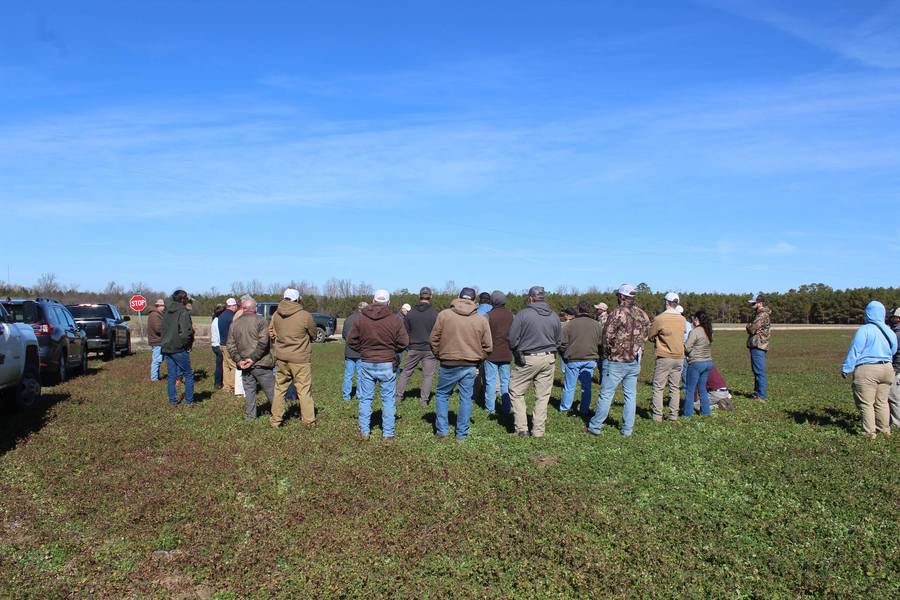
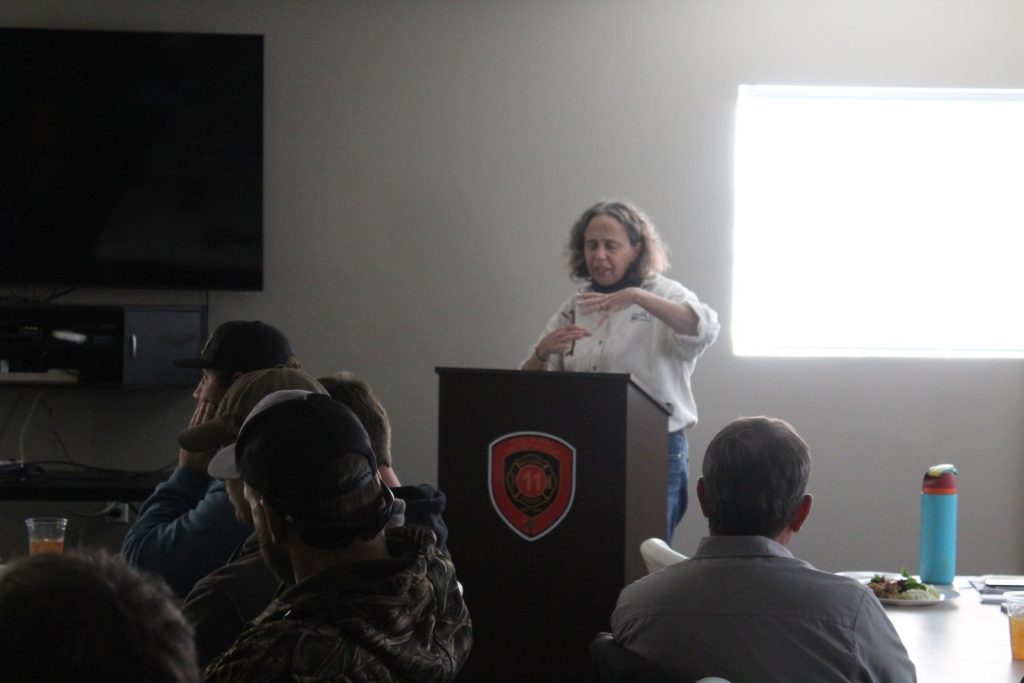
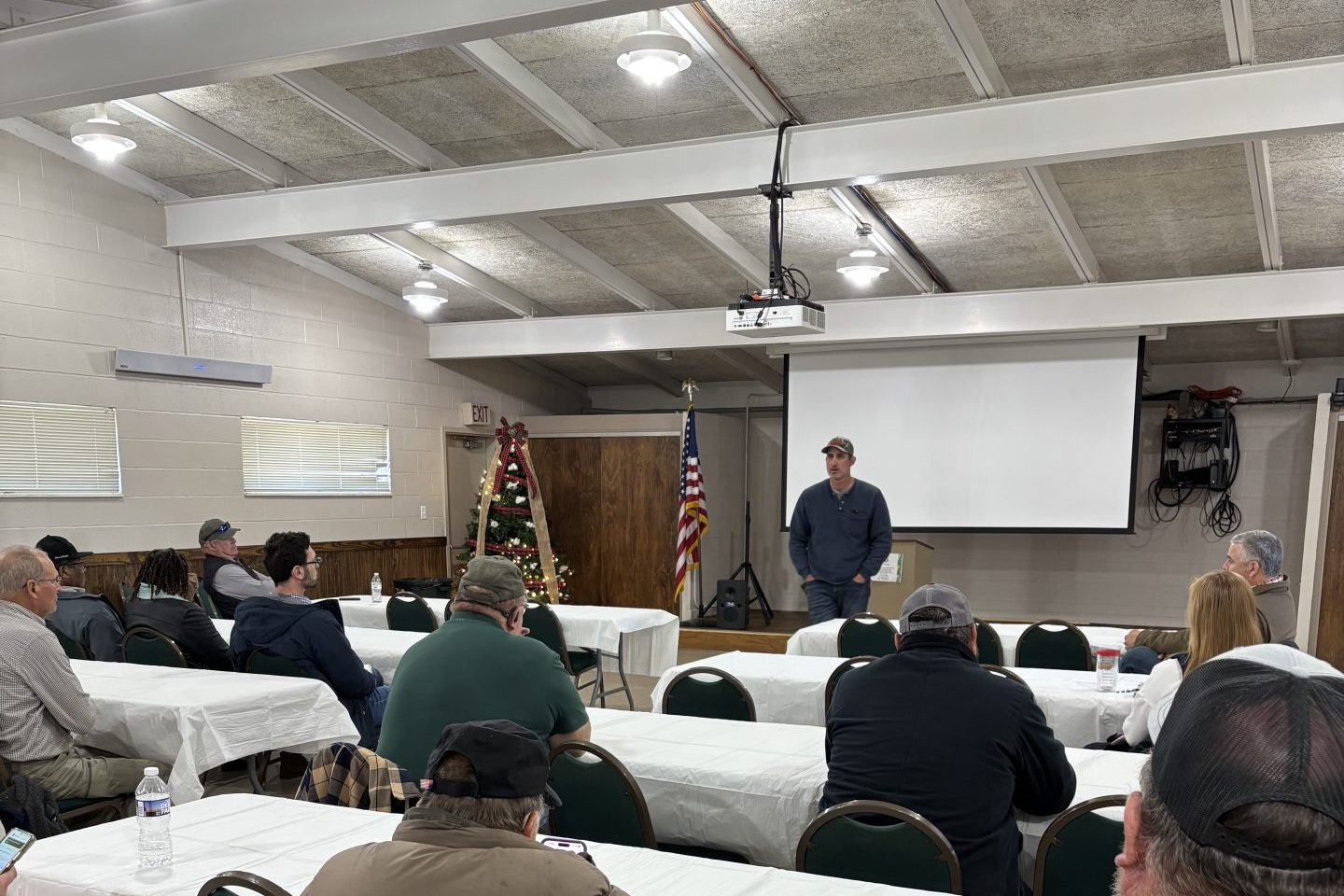
Join us for a field day focused on soil health for profitability, including discussions on the economics of soil health, marketing strategies, the U.S. Cotton Trust Protocol, and crop insurance selection in times of weather extremes.
The field day will be held on March 11, 2025, from 9 a.m. to 12 p.m. in Sylvester, Georgia. Please RSVP to Jessica Kelton (jkelton@soilhealthinstitute.org) to be counted for lunch.
Speakers include:
Soil Health Institute: Jessica Kelton
University of Georgia: Dr. Ford Ramsey
University of Georgia Extension: Seth McAllister
Staplcotn: Tom Pinson
Georgia Farmer and SHI Farmer Mentor: Ricky Dollison
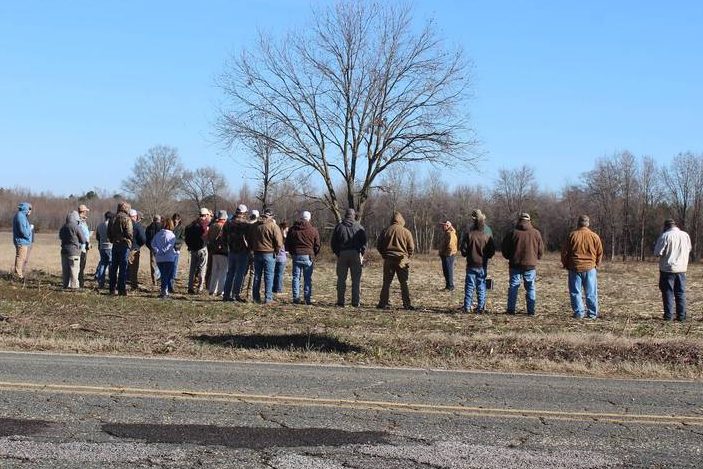
At the Soil Health for Profitability field day, attendees had the opportunity to learn from local experts on how to incorporate cover crops into their farming operations. This field day on January 29, 2025, was facilitated by Soil Health Educator Jared Conner and SHI Technical Specialist Doug Newton in fields near Clio, South Carolina.
South Carolina farmer Sonny Price shared insights from one of his fields, where he uses a cover crop mix that includes tillage radish, winter pea, triticale, clover, and vetch. He explained that the use of cover crops has significantly increased organic matter in the soil, reducing his reliance on fertilizers. Additionally, they’ve helped with weed suppression, which has allowed him to use less herbicide. He also added that he does not have to subsoil anymore due to having the cover crops improve the soil, which he says saves him more than $35/acre.
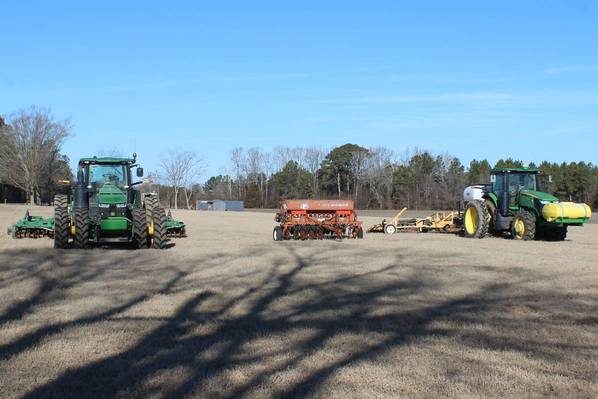
Cover crop seeding equipment was on display, which included an air seeder mounted on a turbo till, an air seeder connected to a Phillips harrow, and a no-till drill.
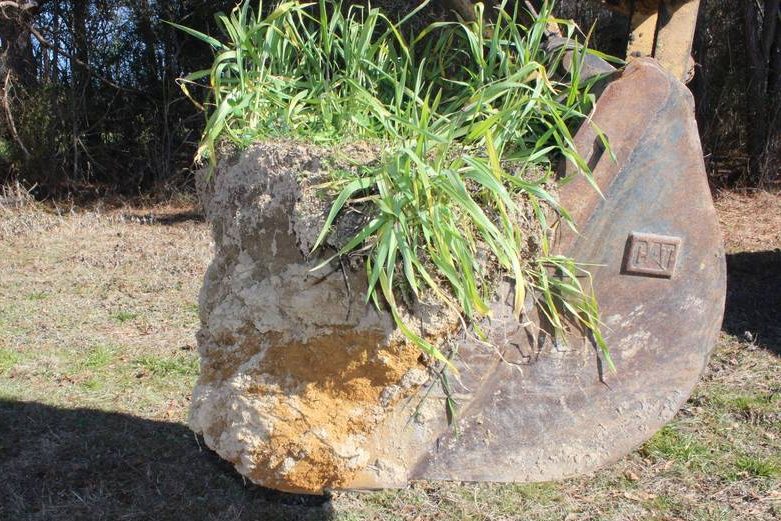
Attendees carpooled to South Carolina farmer Billy Covington’s field to see a soil profile sample in a bucket. The profile showed that cover crop roots from clover and triticale were making their way almost 30 inches below the surface through clay. Newton explained that one of the benefits of using cover crops is their ability to recycle nutrients. He’s taken biomass samples to send off for testing to determine how much fertility has been captured and recycled from the soil.
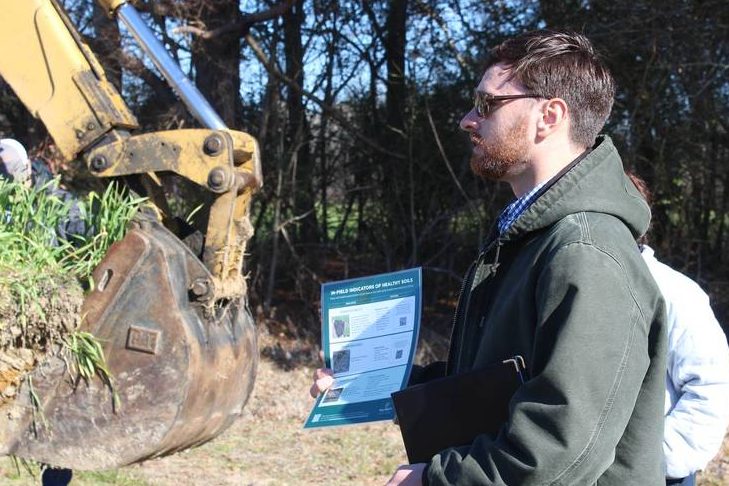
Next, Soil Health Educator Jared Conner discussed In-Field Indicators of Healthy Soils, which are soil health assessments done in the field using a shovel and your senses.
At the next field, attendees heard about SHI Farmer Mentor Pat Rogers’ experience using cover crops. Rogers mentioned years ago he had the chance to rent some underperforming ground and decided to enroll it in EQIP and plant cover crops on it for a few years. Each year his corn yield increased due to soil health management systems and now it’s one of his best performing fields.
During a shovel test, Conner compared soil from a crop field (left) to soil from a nearby fence row that is under perennial vegetation (right). By examining the color and structure of the soil, one can see how organic matter levels and aggregate stability differ between the two. Attendees learned about soil health management systems and how comparing crop field soil with perennial soil can provide valuable insights for improving soil health.
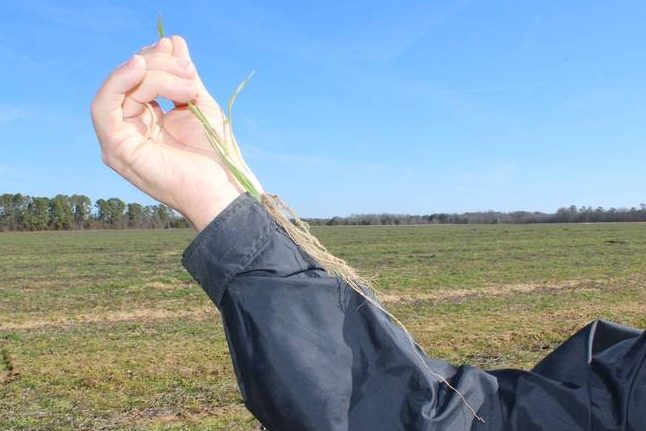
Newton shows how deep cover crop roots go, further emphasizing their benefits for soil health.
Cade Baughman, owner of Scout Seed Company, explained how they create custom cover crop mixes and strongly advocated for their use. He highlighted that these mixes offer a broader range of benefits for soil health and future cash crops, compared to single-species plantings. He cautioned that relying on one species for a cover crop limits the potential benefits, especially if weather conditions or other factors deviate from expectations.
The field day concluded at the Clio Rural Fire Department Station 1 where attendees received an overview of carbon credits from Clemson Extension Dr. Nathan Smith, who explained to growers how carbon credits work and considerations when evaluating a carbon contract. NRCS District Conservationist Sue Griggs explained how NRCS programs work and how farmers can take advantage of federal programs like EQIP to help them plant cover crops.
To contact an SHI Soil Health Educator, Technical Specialist, or Farmer Mentor, please visit our Contacts page.
Join us on the farm for a field day in South Carolina focused on soil health for profitability, including discussions on how cover crops can benefit cotton operations, in-field indicators of soil health, an overview of carbon credit opportunities, and an update on NRCS programs and funding opportunities.
The field day will be held on January 29, 2025, from 9 a.m. to 1:45 p.m. Please RSVP to be counted for lunch.
Speakers include: Soil Health Institute: Jared Conner South Carolina Grower and SHI Technical Specialist: Doug Newton South Carolina Grower and SHI Farmer Mentor: Pat Rogers Clemson Extension Economist: Dr. Nathan Smith NRCS District Conservationist: Sue Griggs
RSVP and Questions: Jared Conner, jconner@soilhealthinstitute.org
Want to find out about future events? Join our mailing list!
At the recent Farming with Cover Crops field day, attendees gained a deeper understanding of how cover crops can be tailored to their specific needs, from soil health to crop rotation strategies. This December 3, 2024, field day was facilitated by Soil Health Educator Jessica Kelton at the Wiregrass Research and Extension Center in Headland, Alabama. Local farmers Myron Johnson, Brandon Dillard, and Chris Parker shared their insights on the benefits and challenges of using cover crops.
Personnel from NRCS, USCTP, and ADM were present to discuss cost share programs available to help offset the costs of cover crops. One of the most discussed topics of the day was the use of a summer cover crop in rotation with cotton – a relatively novel approach that piqued interest given the current market conditions. Specifically, a sunn hemp cover crop was highlighted for its potential to improve soil health the following year.
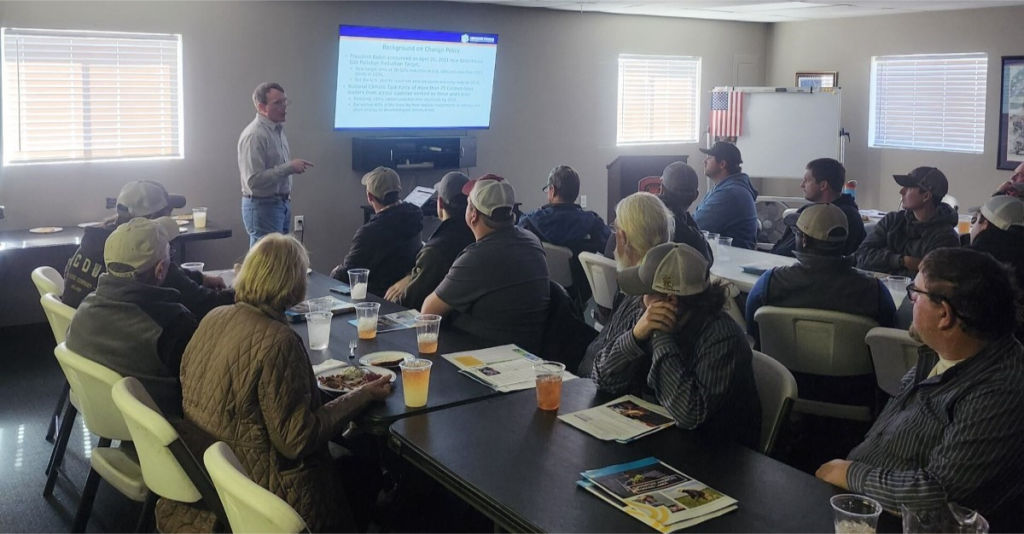
Alabama Technical Specialist Brandon Dillard speaks to the audience about his experience with cover cropping and cover crop seed availability.
To contact an SHI Soil Health Educator, Technical Specialist, or Farmer Mentor, please visit our Contacts page.
The USRCF Soil Health Educators have been full steam ahead as the end of the year approaches!
November Events
In early November, Jessica Kelton enjoyed engaging with attendees at the Southern Region Small Farms Conference in Mobile, Alabama. This conference brought together Black growers in Alabama, Georgia, and Mississippi to discuss topics including heir property, agricultural risk management strategies, the Small Farms Program, and more. During a break-out session, Kelton presented SHI’s Recommended Measurements for Scaling Soil Health Assessment.
A few days later, Jared Conner attended the North Carolina Soil Health Coalition’s second annual meeting at Union Grove Farm in Hillsborough, North Carolina. He was able to network with other attendees and watch as NRCS Midatlantic Soil Health Specialist Nathan Lowder demonstrated a rainfall simulator and aggregate stability columns. The meeting also featured a keynote address from Grant and Dawn Breitkreutz, farmers from Minnesota.
Attendees at North Carolina Soil Health Coalition’s meeting watch the rainfall simulator and learn how different species of cover crops have varying root depths.
In mid-November, Emily Ball attended the Southern Soil Health Conference in Jonesboro, Arkansas, hosted by the Arkansas Soil Health Alliance. She presented a general overview of SHI’s work, including partial budget analyses on cotton farms in Arkansas. Ball enjoyed how interested attendees were in measuring change in soil health on their farms. Speakers from across the country shared their experiences adopting soil health management systems.
Emily Ball discusses SHI’s work, including partial budget analyses on Arkansas cotton farms.
December Events
Recently, Emily Ball and Jessica Kelton attended the Mississippi Row Crop Short Course in Starkville, Mississippi, hosted by Mississippi State University Extension. Key themes of the short course included drone usage, irrigation efficiency, and insect control. Ball and Kelton appreciated the opportunity to network with industry and Extension personnel.
Jessica Kelton also hosted USRCF’s last field day of 2024 at the Wiregrass Research Station in Headland, Alabama. Read more here.
It was a busy few days for the Soil Health Institute team at the 2024 ASA, CSSA, SSSA International Annual Meeting November 10-13! The team had 14 presentations, showcasing their latest research – check out the sessions here.
Dr. Cristine Morgan and Dr. Dianna Bagnall were recognized for their outstanding contributions to the agronomy field during the conference. Dr. Morgan was recognized as an American Society of Agronomy (ASA) Fellow, an award given to individuals based on their significant impact on agronomy through research, education, leadership, and other contributions. Dr. Bagnall received the ASA Early Career Award, which recognizes a scientist who has made an outstanding contribution in agronomy within seven years of completing their final degree. Learn more about Dr. Bagnall in this Q&A and discover how she became interested in soil science.
2024 ASA CSSA SSSA Awards and Fellows Ceremony where Dr. Cristine Morgan and Dr. Dianna Bagnall were honored.
To further their commitment to sharing soil health knowledge, Dr. Ayush Gyawali and Dr. Bagnall organized a Soil Health Tour at Texas A&M University-Kingsville and Texas A&M AgriLife Research and Extension Center at Corpus Cristi. The tour provided a unique picture of soils and soil health in south-central Texas and allowed soil health professionals to communicate and foster relationships for future collaboration. The Corpus Christi Center showcased a unique mixture of soil health-related long-term plots. It presented an opportunity to observe and understand Texas agriculture. Participants also toured state-of-the-art labs focused on Unoccupied Aerial Vehicles and other remote sensor technologies. While at Texas A&M University-Kingsville, soil science faculty and students discussed Texas soils and showed participants soil pits that were prepared and characterized by NRCS employees.
The Soil Health Tour at Texas A&M University-Kingsville.
Dr. Gyawali, Kade Flynn, and Jared Conner also volunteered to moderate and judge various sessions and competitions during the meeting. Dr. Gyawali moderated oral sessions on greenhouse gas and soil health, and in both sessions, he also served as a judge for talks. Additionally, he judged soil health posters. Flynn and Conner were judges for the student competition in one of the soil health sessions, allowing students to showcase their work and enhance their resumes.
“Participating as a judge is a good way to build the community,” Flynn said.
The Soil Health Institute looks forward to continuing this momentum and building on the relationships and insights gained during the meeting.
The October skies above Rich Square, North Carolina, were cloudless, but on Donny Lassiter’s farm, rain poured down.
Eight team members from Ralph Lauren and the Ralph Lauren Corporate Foundation had gathered there to learn how their support of the Soil Health Institute’s U.S. Regenerative Cotton Fund (USRCF) boosts cotton growers’ profitability while eliminating one million metric tons of carbon dioxide equivalent from the atmosphere by 2026.
Nathan Lowder, Southeast Regional Soil Health Specialist with the USDA Natural Resources Conservation Service, uses a rainfall simulator to show the Ralph Lauren team how soil health practices can reduce runoff and improve water infiltration.
The downpour came from a rainfall simulator that showered five different soil samples, some bare, some protected by the leaves and roots of living plants. As the group watched, dark brown runoff poured off the bare samples, taking valuable soil and nutrients with it. The samples protected by plants, however, absorbed the rainfall, showing how living roots, soil cover, and minimal soil disturbance can help store water for crops, mitigate drought and flooding, and reduce erosion.
The demonstration was part of a three-day, hands-on immersion in regenerative agriculture for the team from Ralph Lauren and the Ralph Lauren Corporate Foundation, USRCF’s founding supporter. Launched in 2021 to empower farmers and their trusted advisors with the tools, information, and networks to successfully adopt soil health management systems, USRCF works in Texas, Arkansas, Mississippi, Georgia, North Carolina, South Carolina, Alabama, Missouri, Oklahoma, and California – states representing approximately 85% of U.S. cotton production.
During the visit, the Ralph Lauren team met with farmers, learned more about cotton growing and processing, and explored connections between soil health, environmental outcomes, and human health.
Soil Health Educator Emily Ball, left, and Soil Scientist Helen Boniface show how soils under different management disperse in water. They also demonstrated Slakes, SHI’s free app to measure aggregate stability, an essential indicator of soil health.
After the rainfall simulation, the group heard from Lassiter, who serves as a USRCF Farmer Mentor, offering locally relevant experience to growers in his area.
Lassiter, a third-generation farmer, described the opportunities and challenges of practices including reduced tillage and cover crops, reflecting on how these practices honor the ethos instilled by his grandfather.
“Granddad didn’t call it soil health – he called it looking after the land. You leave it better than you found it,” he said.
Lassiter’s granddad carried a bucket of wheat kernels with him as he harvested peanuts, tossing handfuls into the rows to serve as a cover crop. The younger Lassiter does things differently: As he took questions from the group, a plane flew low over the neighboring field, seeding a cover crop. Instead of tilling the soil for weed control, he’s gone no-till on his cotton fields. His farm was among the first in the area to incorporate soil health management systems, but he’s seeing more growers in the region turning to regenerative practices.
It’s paying off.
Dr. Wayne Honeycutt, SHI’s President and CEO, walked the group through the findings of SHI’s recent partial budget analysis of soil health management systems on five North Carolina cotton farms. The interviewed farmers, all long-term adopters of these systems, saved an average of $65 per acre and increased net income by $149 per acre by implementing these systems. Every farmer interviewed also reported increased crop resilience, better access to their fields, and improved water quality, among other benefits.
While half of North Carolina cotton farmers have switched to no-till, just 11% use cover crops. With support from Walmart Foundation, The VF Foundation, Levi Strauss & Co., Hearst Foundations, and Cotton Incorporated reinforcing the Ralph Lauren Corporate Foundation’s founding grant, USRCF is working to expand regenerative practices in the area and throughout the U.S. Cotton Belt.
The work takes several forms. Three Soil Health Educators host field days, give talks, and spread the word of soil health at regional events. Then there are the Farmer Mentors like Lassiter, as well as state-specific Technical Specialists who offer free, locally relevant assistance to cotton growers, reaching more than 1,300 farmers and advisors across seven states since the fund’s creation. Scientific research from SHI and USRCF continues to push the boundaries of quantifying the benefits of soil health, as does SHI’s economic research, helping growers see that these changes make financial sense in North Carolina and beyond. Analysis of 19 farms representing 108,000 acres in Texas, Georgia, Mississippi, North Carolina, and South Carolina found farms implementing soil health management systems reduced production costs by an average of $53 per acre, increasing net farm income by an average of $150 per acre in their cotton rotations.
After Lassiter’s farm, the group toured Enfield Gin, a local cotton processing facility, before meeting with growers at a dinner and reception.
Back row from left: SHI intern Shakita Holloway; Research Soil Scientist and Program Director Dr. Dianna Bagnall; Enfield Gin owner Tatum Eason; Soil Health Educator Emily Ball; Project Manager Misty Miles; Ralph Lauren Global Logistics Sustainability Manager Jimmy Adames; SHI President and CEO Wayne Honeycutt; Ralph Lauren Head of Global Corporate, Securities & Intellectual Property Andreea Stan; Ralph Lauren Chief Global Impact and Communications Officer Katie Ioanilli. Front row: SHI Communications Director Alisson Clark; Chief Scientific Officer Dr. Cristine Morgan; Soil Scientist Helen Boniface; Ralph Lauren Corporate Foundation Head of Foundation Operations, Strategy & Advancement Alyssa Youngerman; Ralph Lauren Corporate Foundation Senior Associate Margaret Riordan; Ralph Lauren Senior Sustainability Manager – Product Elizabeth Cobarrubias; SHI Inclusive Partnership Lead Sedrick Rowe; Ralph Lauren P&D Business Partnership Lead – South & West Region Tamara Marshall; SHI Chief Impact Officer Byron Rath; Ralph Lauren Chief People Officer and Head of The Ralph Lauren Corporate Foundation Roseann Lynch; USRCF Technical Specialist Will Mann.
On the final day of the visit, USRCF Farmer Mentor Zeb Winslow welcomed the group to his farm, where SHI Chief Scientific Officer Dr. Cristine Morgan took them into a soil pit to show how Winslow’s management has improved his soil’s structure and composition.
“My soils look different than they did 10 years ago,” Winslow said. “There’s life in them.”
After a soil sampling demonstration from Soil Scientist Helen Boniface, the trip ended with a look toward the future, as Research Soil Scientist and Program Director Dr. Dianna Bagnall described next steps for USRCF, including developing and sharing regional fact sheets to show progress made with regenerative practices, launching a producer portal to deliver farmer reports and locally relevant information, and expanding a benchmarking approach that helps farmers understand how healthy their soils can be.
SHI Chief Scientific Officer Dr. Cristine Morgan describes the different horizons in a soil pit to visitors from Ralph Lauren.
For Ralph Lauren Chief Global Impact and Communications Officer Katie Ioanilli, the visit reinforced the importance of supporting cotton growers through efforts like USRCF.
“Soil health is fundamental to so many things we care about. This has given us real perspective, and so much appreciation for farmers,” she said. “Our business doesn’t exist without the materials grown on these farms.”
We’re pleased to highlight presentations from the Soil Health Institute at the 2024 ASA, CSSA, SSSA International Annual Meeting! Throughout the week, team members will present on their research in the Henry B. Gonzalez Convention Center. We invite you to attend their sessions and stop by our booth to find out more about SHI’s work to enhance life by enriching soil.
Monday, November 11
Time
Title
Presenting Author
Co-Authors
10:35‑10:50a.m.
Modeling Contrasting Soil Health Management Systems in Dairy Feed Production Soils: A Comparison between Singular Observations and Comet-Farm Simulations
Christine C. Molling
Mara Cloutier, Daniel Liptzin, Jerry Che-Jen Hsiao, Michael Cope
11:35‑11:50a.m.
Evaluating Soil Health Dynamics across Moisture Gradients in a Wisconsin Dairy Farm
Jerry Che-Jen Hsiao
Mara Cloutier, Daniel Liptzin, Cristine L. S. Morgan
1:35‑1:50p.m.
Domain Labeling for Spectral Library Development: A Case Study in Spectral Calibration Planning.
Ayush Joshi Gyawali
Jason P. Ackerson, Cristine L. S. Morgan
2:55‑3:15p.m.
Scaling GHG Emissions in Space and Time in Dairy Forage Systems
Daniel Liptzin
Mara Cloutier
4‑4:15p.m.
Improving DSSAT’s Representation of Soil Water Balance for Cotton Soil Health Management Systems
Cara Mathers
Dianna K. Bagnall, Christine C. Molling, and Kade Flynn; Ayman Suleiman and Gerrit Hoogenboom (University of Florida)
Tuesday, November 12
Time
Title
Presenting Author
Co-Authors
8a.m.‑12p.m.
Symposium — Land Management and Conservation Megaposium —Climate Smart Cropping Systems: Lessons Learned and Knowledge Gaps
Organized by Dianna K. Bagnall; Adebukola Dada (Purdue University)
10:55‑11:20a.m.
Choosing Soil Health Indicators and a Framework for Interpreting Them
Daniel Liptzin
11:10‑11:25a.m.
Using Soil Health Assessment for Climate Smart Assessment in Agricultural Production Systems
Cristine L. S. Morgan
Mara Cloutier, Daniel Liptzin, Nathaniel Looker
3:30‑3:45p.m.
Piloting “Innovation Cohorts” to Support Adoption of Regenerative Agriculture in Potato Production
Cameron Ogilvie
Mitchel Wright (Agronomy West, McCain Foods Inc.)
Wednesday, November 13
Time
Title
Presenting Author
Co-Authors
8:35‑8:50a.m.
Impact of Management Practices on Soil Health and Carbon Storage in Dairy Forage Systems
Jerry Che-Jen Hsiao
Mara Cloutier, Daniel Liptzin, Cristine L. S. Morgan
9:35‑9:50a.m.
Slakes at Scale: Climate, Pedogenetic, and Management Effects on Aggregate Stability
Jennifer Bower
Daniel Liptzin, Cristine L. S. Morgan, Nathaniel Looker
9:50‑10:05a.m.
Drought Resilience Calculator: Assessing Soil Health’s Impact on Plant Water Availability
Kade Flynn
Dianna K. Bagnall, Christine C. Molling, Cristine L. S. Morgan
11:20‑11:35a.m.
Progress and Potential of Soil Health Improvement in Southern U.S. Row Cropping
Nathaniel Looker
Dianna K. Bagnall, Helen Boniface, Cristine L. S. Morgan
11:35‑11:50a.m.
Assessing the Value of Soil Health to Central TX Farmers Using a Discrete Choice Experiment
Dianna K. Bagnall
Cristine L. S. Morgan; Michael Black and Richard T Woodward (Texas A&M University)