Registration is open now for two free U.S. Regenerative Cotton Fund events in May and June.
Want to improve your soil while reducing the need for conventional fertilizer? Join us for this free session May 29 in Lubbock to explore biosolids as soil amendments and discover new bio-based alternatives.
Speakers include SHI’s Jessica Kelton as well as Texas Tech University/SHI Technical Specialist Dr. Lindsey Slaughter and Dr. Kalavathy Rajan and Dr. Julia Shamshina from TTU’s Fiber Biopolymer Research Institute.
Lunch is provided but space is limited, so please RSVP today by contacting Emily Ball, 919-504-2137 or eball@soilhealthinstitute.org.
Our second upcoming event: Fresno, California, June 4
Join us to discover how integrated pest management and soil health practices can make California cotton operations more resilient. Talks include the Soil Health Institute’s Jessica Kelton and Helen Boniface on soil sampling, California Cotton Ginners and Growers Association’s Roger Isom on supporting California’s growers and ginners, California State University-Fresno’s Dr. Margaret Ellis with a FOV4 research update, and perspectives from California producer and SHI Farmer Mentor Gary Martin.
University of California Agriculture and Natural Resources will have a trio of experts: Dr. Srabani Das will discuss regenerative cotton production in California and experiences from India, Jorge A. Angeles will address herbicide injury symptoms in cotton, and Giuliano Galdi will share information on microbial communities.
As with our Lubbock event, lunch is provided but space is limited, so please RSVP today using the link below or by contacting Jessica Kelton, 334-200-4770 or jkelton@soilhealthinstitute.org.
These in-field indicators of soil health use simple tools and your senses
Soil tells a story — one that reveals itself to those who know how to read it. Next time you’re out in the field, try out some of these simple tests to get an idea of how healthy your soil really is.
Aggregate Stability
Aggregates are small clumps of soil particles that are essential for allowing water, air, and roots to move freely through the soil. When soil is healthy, these aggregates tend to have a rounder shape; when soil has been degraded, aggregates have sharper corners. Another indication of soil health is how these aggregates behave in water. If aggregates stay mostly intact, this is a sign of healthy soil. If the aggregates break apart or “slake,” the soil has been degraded and is likely prone to soil erosion and poor water infiltration. Check out our free smartphone app, Slakes, to measure aggregate stability yourself.
Residue Breakdown
In healthy soil, crop residues steadily break down as organisms cycle the carbon and nutrients into the soil. But if crop residues stick around for months or years without decomposing, it suggests that soil organisms are struggling. This could be for a variety of reasons: excessive tillage, soil compaction, low moisture, or insufficient nitrogen. Use this tool from the USDA-NRCS to evaluate residue cover.
Water Infiltration
How quickly soil absorbs water is a crucial indicator of its ability to support crop growth and prevent erosion. Soil texture plays a big role: sandy soils allow water to move through the soil faster than clay ones. Because of the influence of soil texture, it’s best to compare infiltration rates from a field to an undisturbed reference area like a fencerow on the same type of soil. You can also watch how the water moves after a heavy summer rain. Healthy soils shouldn’t form runoff channels or have standing water on the surface after 24 hours. For instructions on measuring soil infiltration using a metal ring and a timer, see this USDA-NRCS Factsheet.
Surface Crust
If water has ponded in the field after a rain, you’ll likely end up with a hard crust on the soil surface once it dries. A surface crust can make it tough for seedlings to emerge or for water to soak in when the next rain comes. Crusting often happens when soil structure has been degraded through tillage, when the soil lacks organic matter, or when soil organisms are struggling. Healthy soils should provide a nice, mellow seedbed for good seed-to-soil contact, and shouldn’t form cracks when they dry.
Compaction
Healthy soil should let plant roots travel deep and wide. But when soil gets compacted, plant roots are forced to grow sideways or stay shallow. Water follows the same pattern: if it can’t move through, it pools on the surface, leading to runoff and erosion. A simple way to look for compaction is by pushing a metal rod, screwdriver, or shovel into the soil 6 to 12 inches. If you meet resistance within the first few inches, you likely have a compaction problem.
Color
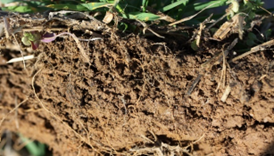
Soil color can tell you a lot about what’s happening underground. Dark, rich soil signals high organic matter and active microbial life. Since soils naturally vary in color, the best way to assess this indicator is by comparing a field to an undisturbed area nearby. Healthy soil usually has a darker topsoil layer that gradually lightens as you go deeper, showing a clear distinction between surface and subsoil. In contrast, when there’s little to no color difference between topsoil and subsoil, this may indicate the soil has been degraded.
Soil Biology
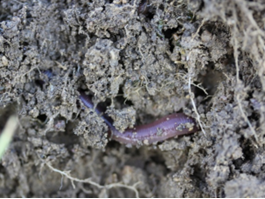
Healthy soil is full of life—not just plants, but an entire underground ecosystem. Dig up a small section of soil and look for signs of life. Can you find earthworms, earthworm channels, or their casts (small, coiled piles of soil)? What about millipedes, centipedes, pill bugs, or springtails? Or can you spot white fungal threads (hyphae) holding soil aggregates together? Each of these organisms play an important role in breaking down crop residues, cycling nutrients, and improving soil structure. Check out this factsheet from Xerces Society for help identifying soil dwellers.
Beyond In-Field Assessments
While in-field tests are useful, laboratory measurements offer a deeper look at how soil functions beneath the surface. The Soil Health Institute teamed up with scientists across North America to identify a few simple, affordable ways to measure soil health. They landed on four essential indicators: soil organic carbon, carbon mineralization potential, aggregate stability, and available water holding capacity. Together, these measurements provide a science-based, scalable approach to assessing soil function across a wide range of soils and cropping systems.
From Insights to Impact
When using any of these in-field soil health assessments, remember that soils are incredibly diverse and these indicators can present differently on different soil types. To best understand how healthy a field is, compare it to an undisturbed area with a similar soil texture.
Native, undisturbed soils show us how the soil functions at its best. As our managed soils become more like undisturbed soils, they cycle water and nutrients more effectively, are more resilient to extreme weather, are more resistant to disease outbreaks, and are ultimately more profitable to farm.
Leaders in regenerative agriculture will convene to exchange ideas, spark collaboration, and shape the future of the soil health movement at the Soil Health Institute’s virtual 10th Anniversary Meeting December 3-4, 2025.
Farmers, ranchers, landowners, and those in academia, industry, government, nonprofit, philanthropy, CPG, and other sectors will benefit from a wide-ranging agenda sharing farmers’ experiences, cutting-edge research, and actionable information on soil health, the foundation for regenerative agriculture.
Plenary sessions will cover:
Farmers’ Experiences with Regenerative Soil Health Systems
Qualities of Effective Soil Health Education Programs
Engaging Global Brands for Scaling Soil Health Systems
A new handheld tool shows promise for measuring soil carbon stocks at scale, a crucial step in quantifying regenerative agriculture’s capacity for carbon sequestration.
Current methods for measuring carbon stored in soil involve collecting samples and shipping them to a lab for analysis. A new study from the Soil Health Institute and Yard Stick PBC shows a handheld probe can accurately measure soil carbon stocks up to 45 cm (nearly 18 inches) deep right in the field, saving time and money.
The probe uses visible and near-infrared spectroscopy to reveal soil’s molecular composition based on how different components in the soil reflect the wavelengths emitted by the probe.
In the ARPA-E-funded study, the researchers took handheld probe measurements and corresponding soil core samples from six farms across Illinois. By comparing the probe’s readings to lab analysis of the soil cores, they confirmed that the probe performed well for estimating soil organic carbon stocks.
“This probe presents an inexpensive yet accurate avenue for measurement-based carbon markets,” says Dr. Ayush Joshi Gyawali, a Research Soil Scientist at the Soil Health Institute and the study’s lead author.
Co-authors of the study in the journal Geoderma include Marissa Wiseman, Sarah Coffman, and Kevin Meissner of Yard Stick PBC; SHI Research Soil Scientist and Program Director Dr. Jason Ackerson; and SHI Chief Scientific Officer Dr. Cristine Morgan.
When more than 1,000 industry leaders, scientists, and sustainability professionals gathered in Minneapolis for the tenth annual Sustainable Agriculture Summit, they heard from the Soil Health Institute in both main stage and breakout sessions.
On the first day of the sold-out event organized by Field to Market and The Innovation Center for U.S. Dairy, the breakout session “Open Access Tools to Measure Soil Health, the Foundation of Regenerative Agriculture” also reached capacity as attendees packed the room.
SHI Soil Microbiome Scientist and Program Director Dr. Liz Rieke (pictured above) showed a rainfall simulation and a live demonstration of the free Slakes app to measure aggregate stability, an essential indicator of soil health. Iowa farmer Levi Lyle described his experiences with regenerative practices, and Walmart Director of Natural Capital Gregory Bohrer relayed why Walmart and the Walmart Foundation are investing in regenerative agriculture, including work with SHI. Taryn Davis, Senior Director for Strategic Partnerships and Stakeholder Engagement for Cargill, described Cargill’s partnership with SHI and gave a glimpse at the next frontier, a drought resilience calculator SHI is developing to help growers understand how soil health management can influence water availability on their farms.
From left: Walmart’s Gregory Bohrer, farmer Levi Lyle, and Cargill’s Taryn Davis at the breakout session.
The following day, SHI President and CEO Dr. Wayne Honeycutt led the mainstage session “Healthy Soils. Healthy Planet.”
After introducing recent advances in soil health, Dr. Honeycutt moderated a panel discussion with (from left) RegenScore President and Lead Scientist Dr. Jessica Chiartas; Levi Lyle; and USDA-ARS Soil Scientist Dr. Kalyn Taylor, covering the benefits of soil health management systems in conventional and organic agriculture.
At the main stage session, Dr. Wayne Honeycutt (left) led a panel discussion with Dr. Jessica Chiartas; Levi Lyle; and Dr. Kalyn Taylor.
“Soil health is the very foundation of regenerative agriculture,” Dr. Honeycutt told the crowd.
The event, held Nov. 20-21, convened farmers, suppliers, researchers, brands, organizations, and governmental representatives invested in building and sustaining resilient food systems.
The Farmers for Soil Health (FSH) State Partner Education Meeting in Grand Rapids, Michigan, October 1-2, 2024, brought together Technical Assistance (TA) providers and Program Leaders to enhance understanding of FSH and sustainable agriculture practices.
More than two dozen attendees from 13 states and Washington, D.C., gathered at the event, presented by the Soil Health Institute (SHI) and the University of Missouri’s Center for Regenerative Agriculture (CRA) as part of the FSH Climate-Smart Commodities Partnership.
The FSH collaboration, covering 20 states across the Midwest, Great Lakes, and Chesapeake Bay, aims to boost cover crop adoption on 30 million corn and soy acres by 2030. SHI and CRA lead the FSH education team, collaborating with technical assistance leads in each state to offer education and resources for successful adoption of soil health management systems.
Day 1 Highlights
The session began with Jack Cornell from the U.S. Soybean Board and Greg Pilchak from the National Fish and Wildlife Foundation, who provided insights and updates on FSH-related programs and initiatives. Cornell highlighted the importance of soil health in sustainable farming and the collective efforts being made by the commodity organizations to promote these practices through the FSH Initiative, while Pilchak provided programmatic information and updates.
Blake Sullivan and TJ Flax from DTN showcased the FSH Enrollment and Sustainability Marketplace Platforms. Sullivan provided hands-on demonstrations including enrollment procedures and the State TA Portal, and Flax presented the Marketplace portion of the session. These tools are designed to empower TAs and farmers by providing them with the resources needed to engage with various FSH opportunities.
During the break, attendees networked and shared ideas with fellow participants, followed by a wrap up of the Marketplace and a Q&A session. The open session promoted engaging dialogue among TAs and other project partners while attendees could also seek hands-on support from the day’s guest speakers, fostering collaboration and knowledge sharing.
Day 2 Highlights
Michigan State University Extension educator Christine Charles presented data comparing economic outcomes and yields from different farming practices.
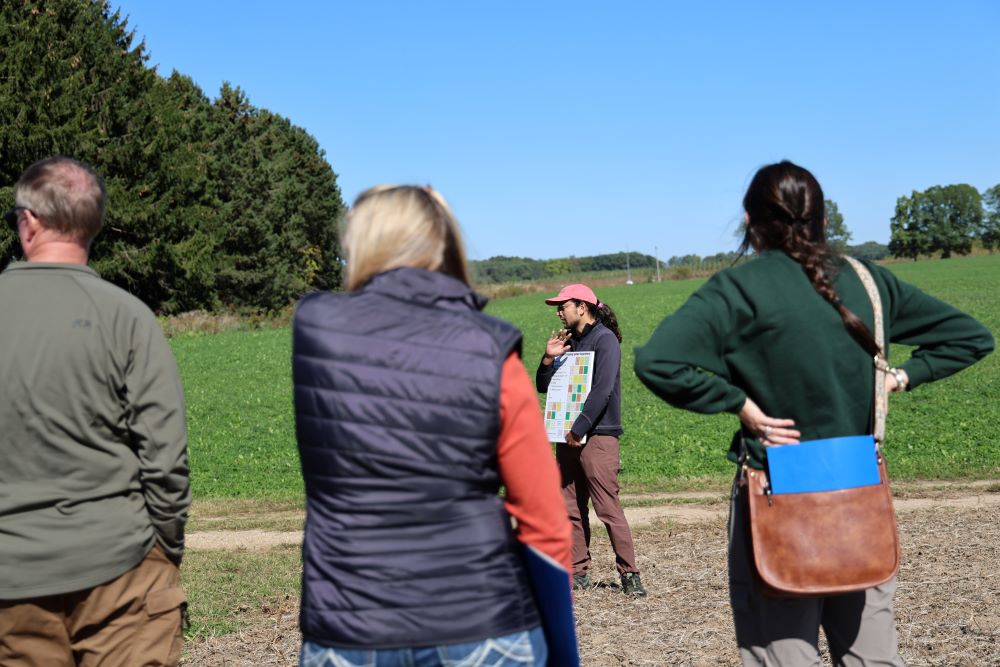
At the W.K. Kellogg Biological Station (KBS) Long-Term Agroecosystem Research (LTAR) Pavilion, attendees were greeted by researchers from Michigan State University (MSU) to share their work to promote sustainable farming and soil health.
Dr. Phil Robertson opened the session with a brief introduction to the LTAR, outlining its mission and significance in advancing sustainable agricultural practices. Dr. Brook Wilke shared critical insights into the successes and challenges faced by the LTAR, highlighting the importance of long-term research in shaping effective agricultural strategies.
Christine Charles presented compelling data comparing economic outcomes and yields from various farming practices, providing participants with valuable metrics to consider for their operations.
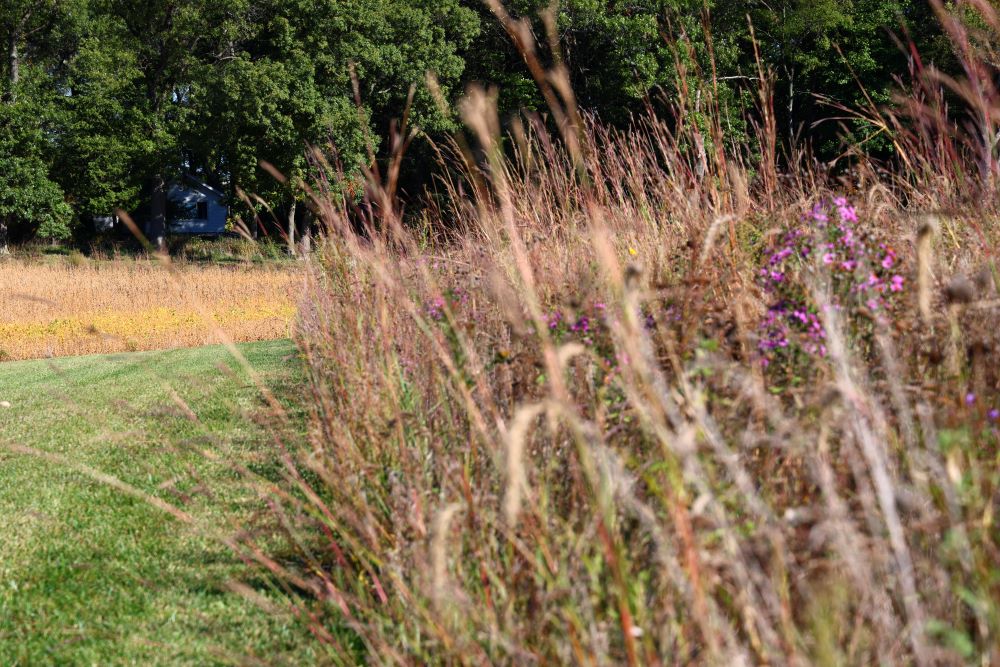
Rachel Drobnak discussed the benefits of integrating prairie strips into farming systems, emphasizing their role in enhancing soil health and biodiversity.
Integrating prairie strips into farming systems can enhance soil health and biodiversity.
Kristin Poley of Michigan Corn Growers Association and the Corn Marketing Program of Michigan provided an overview of the organization’s support to KBS and the impact of LTAR research on Michigan’s grain commodities, illustrating how research translates into practical benefits for local farmers.
Soil health practices explored included cover crops, with Drs. Etienne Herrick and Dean Baas leading a session sharing practical tips for implementation and management. Dr. Kim Cassida discussed innovative strategies for integrating livestock into cropping systems, highlighting the synergies that can enhance soil health and farm productivity while inviting attendees to congregate in the field and test their skills identifying cover crop species.
Drs. Manni Singh, alongside Brook Wilke, introduced cutting-edge crop innovations that are reshaping agricultural practices. Rich Price shared insights into the role of precision technology in modern agriculture, demonstrating how data-driven approaches can optimize soil management. Christine Charles and Dr. Nameer Baker wrapped up the session by discussing the significant findings from the Long-Term Ecological Research (LTER) on no-till farming and cover crops, reinforcing the benefits of these practices for sustainable agriculture.
Dr. Nameer Baker, science coordinator for Kellogg Biological Station Long Term Ecological Research, shared findings on no-till farming and cover crops.
After an engaging morning, participants took a wagon ride back to the buses for lunch at KBS’ McCrary Dining Hall. This provided an opportunity for networking and discussions among peers and speakers.
The day continued with a visit to Third Leaf Farm, a 140-acre third-generation apple orchard located about 30 miles northeast of Grand Rapids. Participants learned how soil health, including the use of cover crops, are being implemented to promote farm resilience. Day 2 wrapped up with tasting a wide variety of apples and learning about the process of preparing the beehives for winter.
The FSH team thanks all the speakers, attendees, and partners who made this event possible. Their commitment to advancing soil health is vital for sustainable agriculture and the health of our environment.
For updates, future events, and resources, follow Farmers for Soil Health on Facebook, Instagram, and YouTube and check out the FSH website.
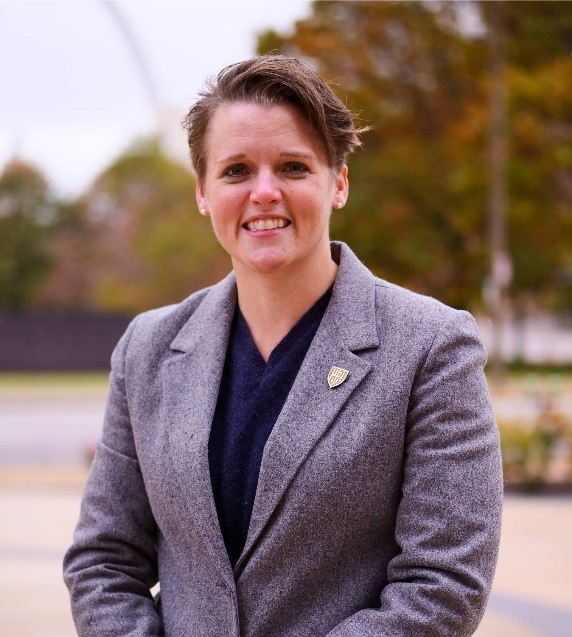
Each year, the American Society of Agronomy gives its Early Career Award to a scientist who has made an outstanding contribution in agronomy within seven years of completing their final degree. This year’s winner is Dr. Dianna Bagnall, SHI Research Soil Scientist and Program Director, who will receive the award at the ASA, CSSA, and SSSA International Annual Meeting in San Antonio November 11.
Here, Dr. Bagnall shares what drew her to soil science, life lessons from mules and afterschool jobs, and learning to see “landscapes underneath landscapes.”
When people outside the field ask what you do, how do you answer?
I say I’m a soil scientist, and then I say the word “dirt” so that they know I didn’t say I was a soul scientist. My Ph.D. did not cover anything metaphysical.
How do people react?
Increasingly over the last 10 years or so, people know what soil is and say, “That’s really cool.” A lot of people link it to food production and some think about soil contamination. Then they ask me what to do about a problem with their tomatoes.
How did you first become interested in soil science?
I had a friend who worked with cattle at a research station and thought, “Oh, that’s with animals, maybe I can do that.” There were no openings on that side of the research, but they needed help in a soil chemistry lab. And the rest is history.
What did you like about soil science?
I initially did not enjoy soil science because I was in a lab. What was really transformational was when I was out doing field work. The scientist I worked for was telling me about these really sandy soils in East Texas where I grew up. They wanted to better understand phosphorus runoff, so they did a rainfall simulation for hours and hours and hours and nothing ran off. These sandy soils just took all of the water. They finally gave up and they packed up their equipment and drove away. When they got to where there was a cutout in the hill, they could see the clay soil exposed with the sand on top of it, and there was all that water that they had been irrigating. It was the first time I could visualize in my head that there were landscapes underneath landscapes. That was a really formative moment.
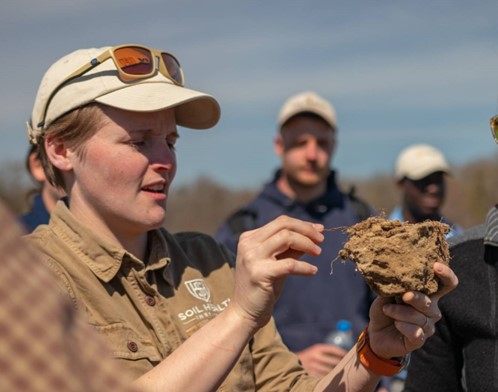
Leading a training session for soil samplers.
After getting your master’s and working as a research project manager, what led you to pursue an interdisciplinary Ph.D.?
I just kept realizing how much research was so far away from what companies or organizations were ready to act on. And I thought of my own research, how I used to say, “I’m running this hydrology model that farmers could use,” but it was written in Fortran and there was no graphical user interface. I realized that not only will farmers not use it, other researchers don’t even want to put up with this. It was that desire to take knowledge from our academic systems and move it into actionable outcomes for society and the environment that led me to want to pursue natural resource economics – so, rural sociology and soil science – which is what I did my Ph.D. in.
You did a lot of farmer interviews as part of your Ph.D. What were some of your big takeaways?
A big one was humility in the number of things that growers have to juggle. When we start our conversations without knowing where that person is coming from, not only is it not going to be successful, but it can be offensive and lead to them having a bad interaction with scientists and then saying, “Well, these folks don’t really care about me.” People sometimes characterize farmers as risk-averse, but for the growers I’ve been able to work with, that’s really not been true. They’re not going to change over everything in the operation tomorrow, but they’re probably more willing to experiment than the average person.
How does that experience inform your work at SHI?
It’s about really trying to keep the end user in mind. That posture of humility has really carried over in saying, “Here’s what we’re able to say. We hope that it’s helpful to you, but we don’t want to be prescriptive and overstate what we know about your operation.”
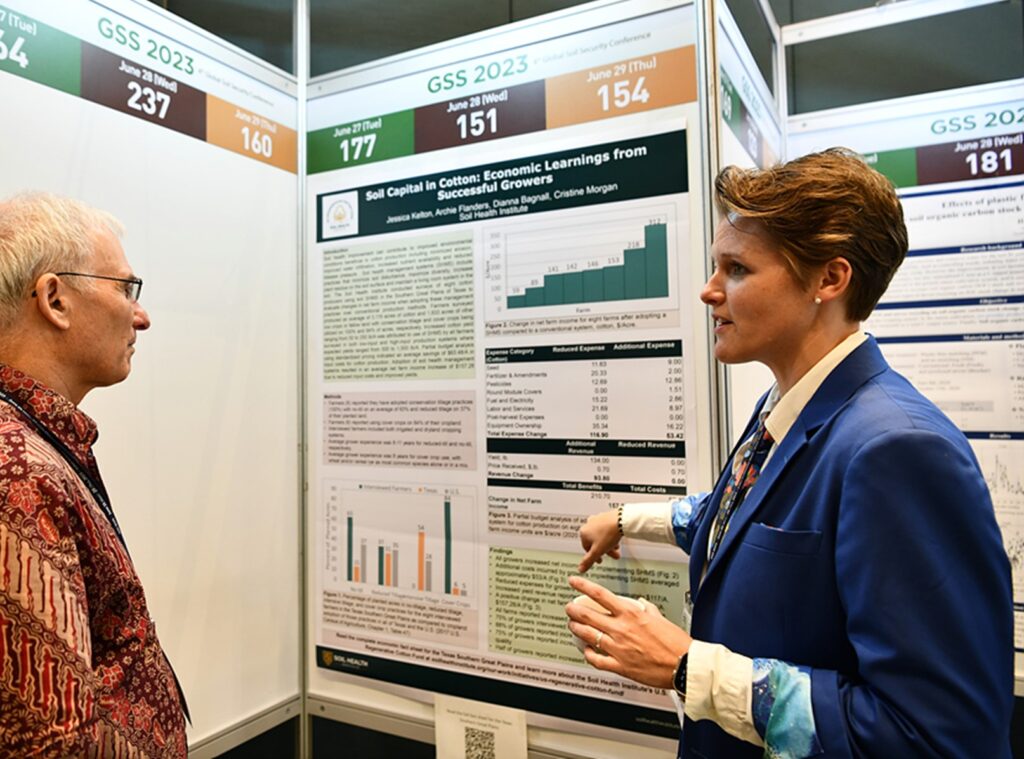
At the 2023 Global Soil Security Conference in Seoul, South Korea, presenting findings on the economics of cotton farming in the Texas Southern High Plains.
What has been some of your most rewarding work at SHI?
Getting to be part of the development of a new set of pedotransfer functions for plant available water. While right now it’s primarily out there for soil scientists to use, we’re leveraging that work to be able to inform growers all across the continent about how much water they might be able to save in their operations for their crops if they were to adopt soil health management practices. And that’s only possible because we have that strong link to the data collected in the North American Project to Evaluate Soil Health Measurements. It’s really consistent with the philosophy of doing good science and applying it to help people see what could happen if they change their management practice. I don’t know of any place I could be doing such interdisciplinary research with such a strong soil science emphasis and also be able to focus on the outreach component too.
Did you grow up farming?
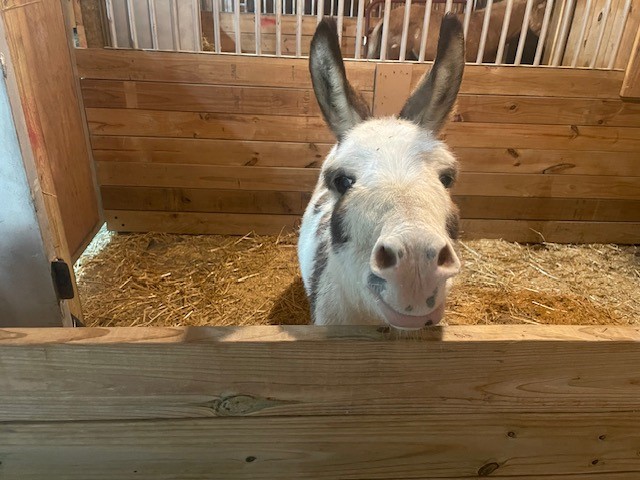
I did not, but I did grow up gardening about two acres and raising livestock. Today I’m kind of a hobby farmer. I have two mules, one miniature donkey, one horse, three German Shepherds, two cats, and a couple of fish.
Gary the miniature donkey.
What are you passionate about outside of work, and how does it inform the work that you do at SHI?
Mules. Mules are incredibly important. My love of agriculture and being on the land ties in really strongly with my work at SHI. It’s very humbling as a land manager, even of only six or seven acres, to think about some egghead Ph.D. wanting me to not have any erosion in a spot that I have to get across with a manure spreader every day. Sometimes we have to put things in that human context.
Your teen job “Stock Worker and Cashier at Nick’s Deli” appears on your CV. What life lessons did you learn there?
I had three hours to clean and stock the store, and that was so incredibly hard. The intensity that was needed to get that done was not something I had experienced in my life before and it seemed absolutely impossible. I remember going home from my first day of work thinking, “There’s no way this amount of work can get done.” But it did. When we’re confronted with something that does not seem doable, if we stick with it, we can do it, whether it’s stocking a store or publishing a paper. It’s about not letting that initial moment of uncertainty or concern convince you that it’s impossible.
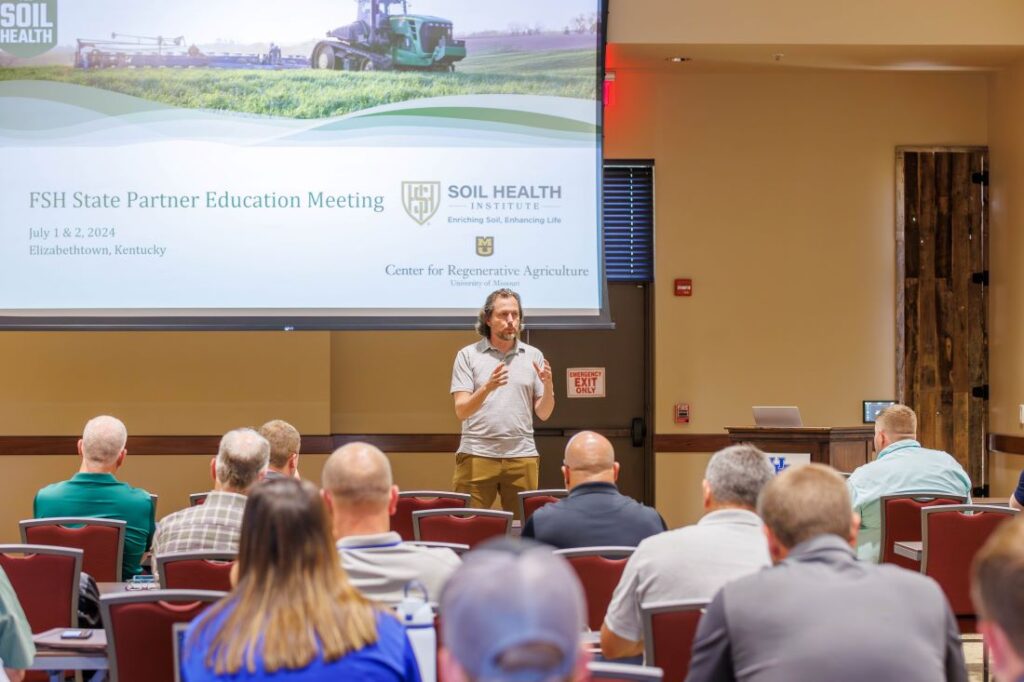
Attendees from 12 states and Washington, D.C., gathered in Elizabethtown, Kentucky, July 1-2 for a Farmers for Soil Health State Partner Education Meeting.
The 48 conservation professionals, local and national partners, commodity organization representatives and guest speakers shared information and expanded their networks at the event, presented by the Soil Health Institute (SHI), and the University of Missouri’s Center for Regenerative Agriculture (CRA) as part of the Farmers for Soil Health (FSH) Climate-Smart Commodities Partnership. The FSH collaboration, covering 20 states across the Midwest, Great Lakes, and Chesapeake Bay, aims to boost cover crop adoption on 30 million corn and soy acres by 2030. SHI and CRA lead the FSH education team, collaborating with technical assistance leads in each state to offer education and resources for successful adoption of soil health management systems.
Farmers for Soil Health Executive Director Dr. Ben West at the Kentucky training event.
The first day’s talks included updates from FSH Executive Director Dr. Ben West and Greg Pilchak, the National Fish and Wildlife Federation’s Program Director for Central Region Working Lands; and an overview of cover crop seeding and establishment with CRA Director Dr. Rob Myers, also a member of SHI’s Board of Directors. Farmer and consultant Barry Fisher discussed managing nutrients and cover crops, while University of Kentucky Associate Professor Dr. Erin Haramoto spoke about successful herbicide use in cover crop systems. Kentucky farmer and Leopold Conservation Award winner Joel Reddick explained his family’s strategy and purpose for incorporating soil health management practices on their farm, including grazing cover crops. The final session was a farmer panel moderated by Kentucky farmer and consultant Jesse Horn. Local farmers experienced with implementing cover crops discussed how they got started with the practice and why, and what opportunities they see for continuing using cover crops in the future. The day concluded with dinner and networking.
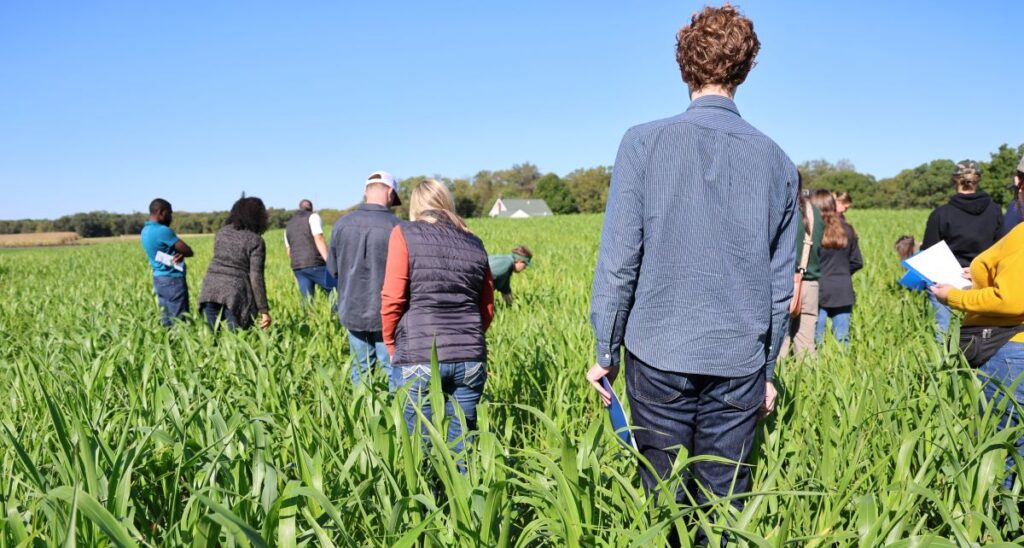
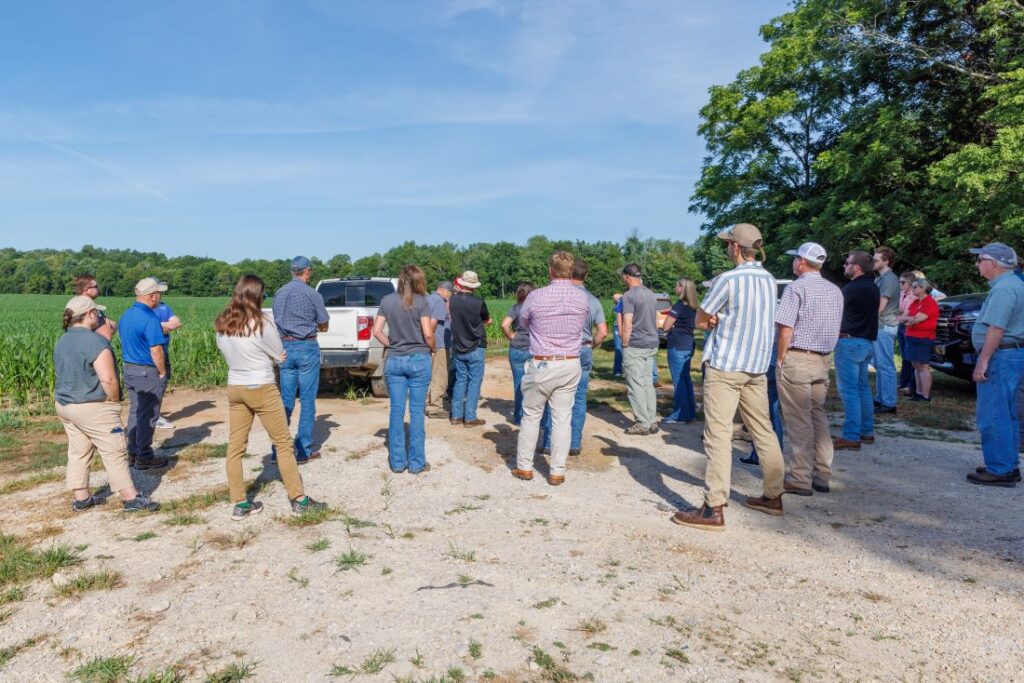
On the second day, participants gained experience in planning and facilitating events from the FSH Education Team and B3 Creative Agency, then visited Dr. Richard Preston’s farm in Glendale, Kentucky, where Dr. Preston and Paul Howlett led a tour of their corn fields, highlighting the importance of cover crop residue in row crops in their area.
Participants visiting Dr. Richard Preston’s farm in Glendale, Kentucky.
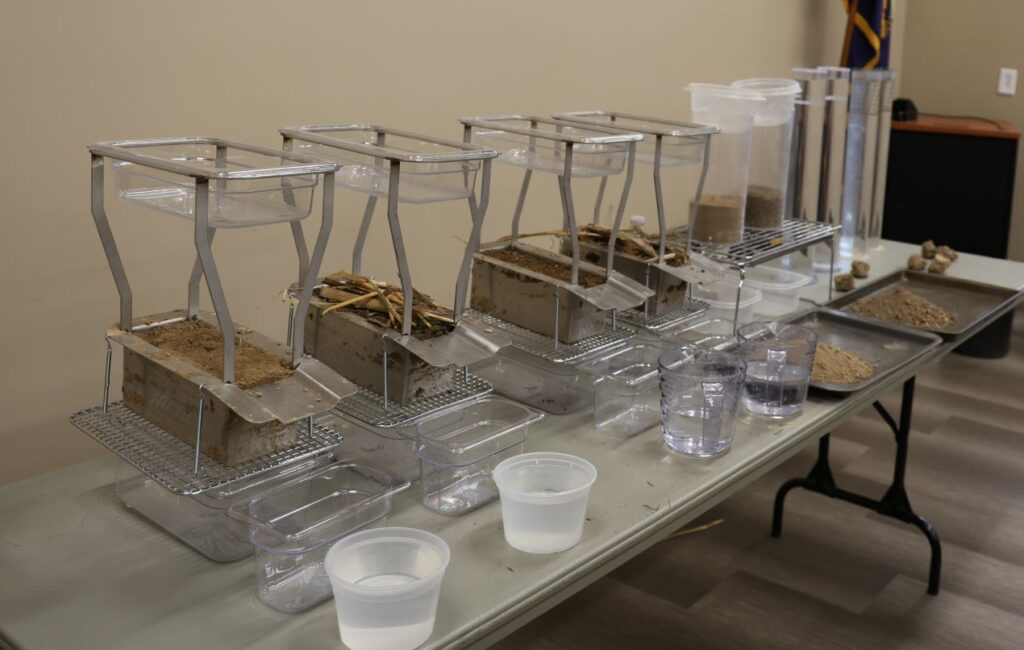
The event also featured a hands-on workshop on SHI’s free Slakes app, which measures aggregate stability, by SHI Program Manager and Soil Health Educator Ann Marie Calabro. Soil health demonstrations by Fisher included a tabletop rainfall simulation, slump test, infiltration test and slake test in columns.
Fisher and Myers wrapped up the day’s sessions debunking cover crop myths and discussing timeline considerations for cover crop transition.
Demonstrations included a tabletop rainfall simulation showing the benefits of soil health management practices.
Learn More, Stay Connected
Farmers and landowners can find more information and connect with local technical assistants as well as find tools and resources at www.farmersforsoilhealth.com
SHI and CRA will continue to host virtual and in-person education events over the next two years to support the FSH Climate Smart Project. Virtual webinars will be open to everyone and geared towards farmers, landowners, and technical assistants.
If you have questions, SHI staff members are here to help! Please reach out to Erin Gundy, Soil Health Educator, at egundy@soilhealthinstitute.org, or Ann Marie Calabro, Program Manager and Soil Health Educator, at acalabro@soilhealthinstitute.org.