Improving soil health has been described as a journey more than a destination as each new cropping season brings a different set of challenges to address. Where can producers go to get answers to their questions about cover cropping, no-till equipment, and other soil health related activities? Fortunately, the soil health community is a very generous and supporting group, willing to share their successes and failures with any producer willing to listen. With this in mind, the U.S. Regenerative Cotton Fund (USRCF) is working to establish a “soil health farmer network” that will serve as a foundation for this information exchange.
“…the soil health community is a very generous and supporting group, willing to share their successes and failures with any producer willing to listen.”
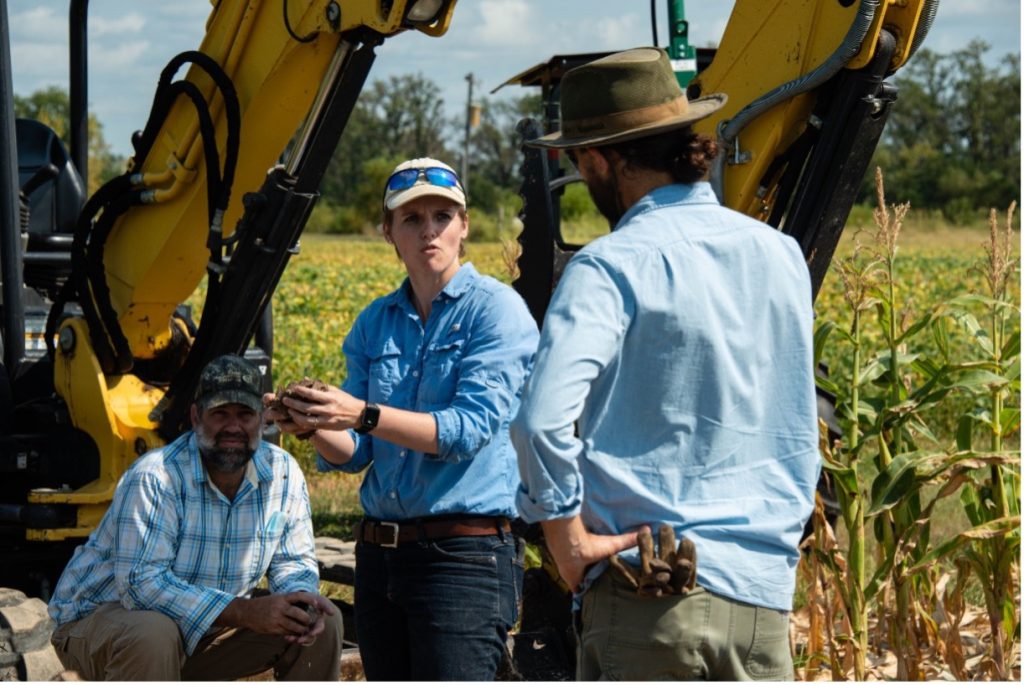
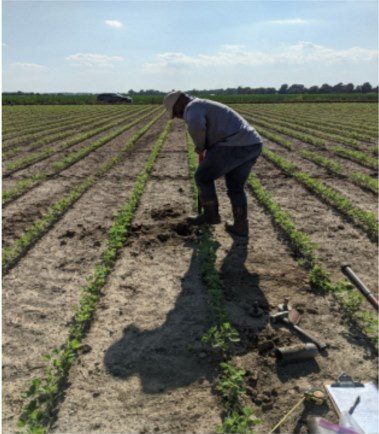
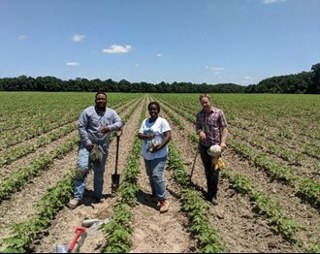
Soil Health Farmers Burton Heatwole (left), Sonny Price (center), and Zeb Winslow (right) discuss their soil health journeys.Soil Health Farmers inspect soil structure development under a cover crop
The many benefits of soil health can only be manifested if farmers choose to adopt soil health management practices, hence the USRCF makes empowering farmers one of its core components. SHI’s past work with farmers (https://soilhealthinstitute.org/our-work/initiatives/the-healthy-soils-for-sustainable-cotton-project/) includes Healthy Soils for Sustainable Cotton – Virtual Field Days (13-part series), Healthy Soils for Sustainable Cotton Webinar Series (7-part series) for farmers, and training that SHI has provided to 13,000 Certified Crop Advisors who advise on more than 205M acres (https://www.soils.org/education/online-courses/webinar-series-soil-health/ ). With learnings from these programs, the USRCF will establish and support existing and new producer-led mentoring networks comprised of producers, their advisors, local technical specialists, and SHI trainers. SHI will provide these networks with the knowledge, tools, resources, training, and continuous support they need to profitably transition to regenerative soil health management systems.
Benefits of the USRCF farmer network include:
Participation in a soil health mentoring group that will provide a platform to ask questions or have a discussion with other producers, agronomists, and soil health technical specialists. The USRCF is identifying soil health mentors in each state who have the experience and desire to mentor new producers along their soil health journey.
Opportunity to work with a soil health technical specialist to design a soil health management system on-farm and receive advice on cover crop selection, seeding and termination methods, and planter adjustments to ensure seeding success.
Access to soil health assessment using in-field and lab analysis to establish current soil health status and where soil health can be improved upon.
Participation in discussions to influence the future of regenerative cotton production and develop ideas on how the cotton industry might benefit.
If you are interested in joining the farmer mentor network as a farmer mentor, farmer participant, local technical specialist, or soil health advocate, click here.
Most folks involved with agriculture have had some basic training in soils. We’ve been taught that soil is the upper layer of earth in which plants grow. It is a black or dark brown material typically consisting of a mixture of sand, silt, clay, and rock particles along with various amounts of organic material. We learn that the ideal soil consists of 50% solids (primarily sand, silt, clay, and organic matter) along with 50% pore space, which can be occupied by water and/or air. Most mineral soils have less 8% organic matter – the more, the better. Finally, soil has physical, chemical, and biological components that vary depending on how and where the soils were formed.
SHI scientist Dianna Bagnall discusses soil health practices with farm managers.
This view of soil has led to an accumulation of knowledge related to the physical (e.g. soil texture, structure, compaction) and chemical (e.g. cation exchange capacity, nutrient availability, pH) components as related to agricultural purposes. These components can be manipulated by modern farming techniques. Tillage is used to eliminate compaction or to create a friable seedbed while synthetic fertilizers are applied to offset nutrient deficiencies. These activities have become commonplace practices used in the highly productive agricultural systems that we enjoy here in the US.
The biological component, and its interaction with the soil physical and chemical environment, is the least understood soil component in terms of farmers’ capability to manage it to improve soil conditions and agricultural production. We know the role that soil microbes play in nutrient cycling, improving soil structure and carbon cycling, but up until recently, we have not widely considered how modern agricultural activities impact them in a negative way, nor that farmers can change management strategies to encourage a more positive outcome for the soil organisms and their environment.
Soil health is defined as the continuous capacity of a soil to function as a vital living ecosystem that sustains plants, animals, and humans. To improve the health and function of agricultural soils, we need to adopt a new view of soil that looks beyond manipulation of the physical and chemical components of a soil substrate and recognizes the important role that soil conditions, particularly soil structure and biology, can play in agricultural production. Soil health requires that we look at soil as a habitat that supports microorganisms that are beneficial for crop production, and that soil is part of a broader hydrology, mass, and energy cycle. We must also recognize that various farming practices can have either a positive or negative impact on microorganism habitats and populations.
“Soil health is defined as the continuous capacity of a soil to function as a vital living ecosystem that sustains plants, animals, and humans.”
By implementing soil health management systems, producers can change the habitat that they are creating from one that favors non-beneficial soil microbes, e.g. Pythium or phytophthora, to one that supports a balanced soil foodweb, which drives a robust nutrient cycle and aids in controlling pests. This is accomplished by following four basic principles: minimize soil disturbance, maximize diversity, maintain living roots year-round, and keep the soil covered.
Improving soil health can have many benefits to crop production, including improving the soil structure which improves rainfall capture, improves moisture retention, improves drainage, reduces erosion, and reduces compaction. Soil structure thereby also enhances microbial activity. Over time, improving soil health can reduce input costs and improve crop yields. While there are many benefits to improving soil health, it can be challenging for farmers to implement changes in soil management systems on a large scale. SHI is working to produce training, resources, and farmer mentor networks to support producers interesting in taking practical steps to improve soil health on their farms and measure the impact on crop yield and farm profitability. These trainings and resources will be a key component of the U.S. Regenerative Cotton Fund, which will work with cotton producers in a Soil Health for Sustainable Cotton training program, starting in 2022.
“By implementing soil health management systems, producers can change the habitat that they are creating from one that favors non-beneficial soil microbes… to one that supports a balanced soil food web.”
According to USDA Labor and Statistics, minorities make up about 9% of the jobs in the agricultural and biological sciences (Bailey et al., 2017; Horst and Marion, 2019). With the ethnic population in the U.S. expected to double in the next 40 years, our workforce needs to reflect the diversity, values, and contributions of people from various ethnicities and cultures (Vespa et al., 2018). As interest in regenerative agriculture and soil health grows, growing an agricultural workforce and leadership with experience in soil health and a variety of cultural work settings is vital for greater adoption of soil health practices among U.S. farmers.
In an effort to increase diversity in agriculture and provide opportunities for minority students to develop skills that will assist them in their career choice, the Soil Health Institute’s Diversity, Equity, and Inclusion Internship Program is geared toward students at Historically Black Colleges and Universities, Native American Organizations and Hispanic Student Associations to improve access and opportunity and provide real world experiences for minority students. We realize that exposing students early in their academic careers to professional working environments in agriculture is one way to expand a student’s global view in a deliberate way. This internship program contributes to SHI’s goals by allowing students to work alongside an expert team of scientists to assist in catalyzing soil regeneration through scientific discovery, and by engaging farmers about the benefits of regenerative soil health systems.
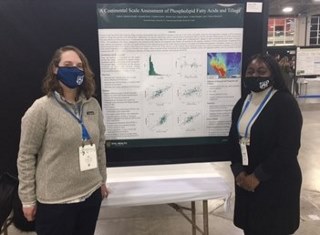
Quanteria Randle, SHI Summer Intern (right) with her scientist mentor Dr. Elizabeth Rieke (left) at the ASA, CSSA, SSSA International Annual Meeting in Salt Lake City, Utah.
In 2021, SHI recruited three undergraduate students from Prairie View A&M University (PVAMU) and University of Arkansas at Pine Bluff (UAPB) to participate in all aspects of experimental research including sampling, lab analysis, data preparation, and scientific communication.(https://soilhealthinstitute.org/news-events/the-soil-health-institute-welcomes-new-scientists-and-interns-to-its-growing-team/) This past summer the internship began with a one- to three-week field experience, during which interns worked alongside Dr. Vance Almquist, SHI Project Scientist, and Dr. Nate Looker, SHI Research Soil Scientist, to collect soil samples for establishment of Soil Health Benchmarks. This in-field experience gave SHI interns the opportunity to discuss the benefits and challenges of adopting soil health management systems with farmers across diverse geographies.
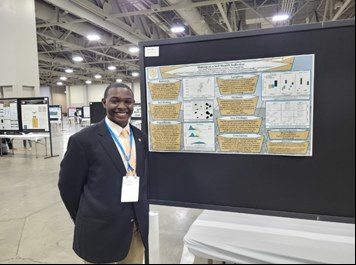
Robert Thomas, SHI Summer Intern presenting at the ASA, CSSA, SSSA International Annual Meeting in Salt Lake City, Utah.
According to USDA Labor and Statistics, minorities make up about 9% of the jobs in the agricultural and biological sciences.
For the rest of the summer, each intern pursued a different aspect of soil health through an independent project. Quanteria Randle, a sophomore in Biology at PVAMU, worked with Dr. Liz Rieke, SHI Soil Microbiome Scientist, to analyze trends in phospholipid fatty acids across climate gradients and management systems. She also combined her artistic and scientific interests in soil by learning to paint with soils that she collected while in the field. Brent Thomas, a junior in Agricultural Engineering at UAPB, developed strategies for farmer outreach, including an assessment of barriers to adoption of soil health management systems. And Robert Thomas, a sophomore in Agricultural Science at PVAMU, led a study on the repeatability of slaking measurements as a soil health indicator, to which the other interns also contributed. At the end of the summer, the interns traveled to SHI headquarters in Morrisville, NC, to present their projects, learn more about SHI’s day-to-day operations, and visit other NC-based institutions developing innovative agricultural solutions.
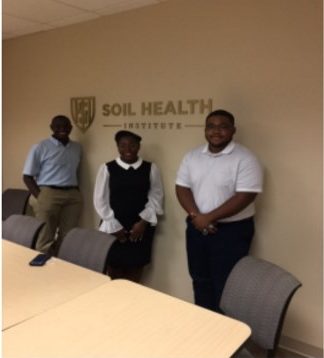
SHI Interns visiting for Intern Week. From left to right, Robert Thomas, Quanteria Randal, and Brent Thomas.
The interns successfully completed independent projects related to their interests and complementary to SHI’s broader Soil Health Benchmarks program. At the conclusion of the internship program, students traveled to the American Society of Agronomy, Crop Science Society of America, and Soil Science Society of America International Annual Meeting in Salt Lake City, Utah to present their research in the form of a poster presentation. Since this experience, Brent, Robert, and Quanteria have set their sights on a career in agriculture.
“Prior to working with SHI, I knew nothing about how important the soil beneath us was. The experience taught me more about it not just on a molecular level, but an artistic level and now I am a proponent of soil health”
Quanteria Randle, SHI Summer Intern
Quanteria, the Biology major from PVAMU, said that “soil was not on her radar until working with SHI”. She now plans to further develop her research on the effects of management on soil microbial communities with the mentorship of Dr. Liz Rieke, SHI Soil Microbiome Scientist, and plans to pursue a graduate degree in a related field. Robert, the Agricultural Science major from PVAMU, had planned to work for another employer prior to his internship with SHI. However, after interacting with different academic, nonprofit, and commercial institutions, he is now exploring a wider range of career opportunities in agriculture while continuing to gain experience in management-relevant research through his work on aggregate stability with Dr. Nate Looker, SHI Research Soil Scientist.
“I couldn’t have imagined how much I would learn working with such amazing people before this summer, not only did I get research experience, but I was exposed to areas of agriculture and professionalism that were completely new to me.”
Robert Thomas, SHI Summer Intern
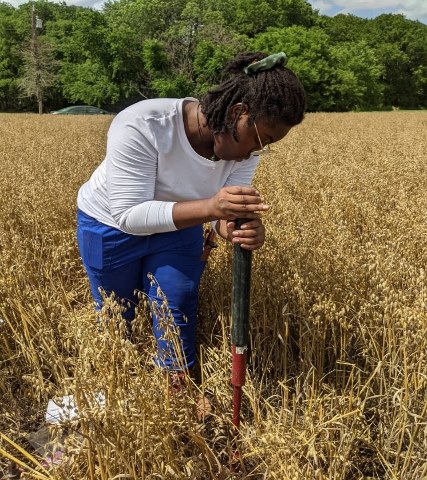
Brent Thomas, SHI Intern sampling soils.
Through this experience, all three interns gained field experience in soil science and learned directly from farmer participants about the benefits and challenges of adopting soil health management systems. These experiences help expose students to examples of professional workplace norms, leadership, and the variety of employment opportunities in science, engineering, and business as applied to agriculture. A new cohort of interns will join SHI in 2022 supported by the U.S. Regenerative Cotton Fund.
Quanteria Randal, SHI Intern sampling soils.
Soil Painting by: Quanteria Randal
SHI Interns Brent Thomas and Quanteria Randal with Dr. Vance Almquist, SHI Project Scientist.
References:
Bailey, Z. D., Krieger, N., Agénor, M., Graves, J., Linos, N., & Bassett, M. T. (2017). Structural racism and health inequities in the USA: evidence and interventions. The Lancet, 389(10077), 1453-1463.
Horst, M., & Marion, A. (2019). Racial, ethnic and gender inequities in farmland ownership and farming in the US. Agriculture and Human Values, 36(1), 1-16.
Vespa, J., Armstrong, D. M., & Medina, L. (2018). Demographic turning points for the United States: Population projections for 2020 to 2060. Washington, DC: US Department of Commerce, Economics and Statistics Administration, US Census Bureau.
The Gadfly Project is proud to announce it has awarded a Q4 2021 in-kind climate grant to the Soil Health Institute to develop an application called the Drought Resilience Calculator. This free, web-based decision support tool will enable growers, advisors, consultants, and other agricultural stakeholders to calculate how much more water their soil can store by increasing the carbon in it. This application is based on a novel algorithm developed by the Soil Health Institute and is planned to be released in June 2022.
About The Gadfly Project
The Gadfly Project‘s actions are guided by values. We believe in the importance of a sustainable future and environmental responsibility. Through technology, we are dedicated to protecting the environment and our people. We are steadfast in the belief that we can combat global climate change while simultaneously encouraging job growth. As technological advances are made daily, it becomes more and more apparent that technology can and will be a vital instrument for saving our planet. Our organization is committed to being a part of that movement. We are making available in-kind grants for organizations seeking to implement a software initiative in the fields of environmental protection and climate change mitigation. This grant is available to organizations both international and domestic with a focus on environmental protection and sustainability. The project should be used to either benefit the environment or advance the organization’s capacity to do so.
About the Soil Health Institute
The Soil Health Institute is a global 501(c)(3) non-profit with a mission to safeguard and enhance the vitality and productivity of soil through scientific research and advancement. We bring together leaders in soil health science and the industry to help farmers, ranchers, and landowners adopt soil health systems that build drought resilience, stabilize yield, and benefit their bottom line. The Institute’s team of scientists, holding doctorates in various soil science and related disciplines, has developed highly effective soil health targets and standardized measurements to quantify progress at achieving regenerative and sustainable agricultural systems, and leads the cutting-edge fields of carbon sequestration and decoding the soil microbiome. Healthy soils are the foundation for rejuvenating our land. Together, we can create a secure future for all, mitigate the effects of climate change, and help agriculture and organizations meet production and environmental goals at scale. Visit Soil Health Institute to learn more and follow us on LinkedIn, Twitter, and Facebook
FEBRUARY 15, 2022 – MORRISVILLE, NC – The Soil Health Institute (SHI), the non-profit charged with safeguarding and enhancing the vitality and productivity of soils, announced funding today from Wells Fargo to identify microbial indicators of optimal carbon cycling and storage in soil.
“Increases in carbon storage following adoption of regenerative soil health systems can take years to distinguish,” Dr. Elizabeth Rieke, Soil Microbiome Scientist for the Soil Health Institute said. “Our goal is to develop microbial indicators that allow stakeholders to observe how management decisions impact their potential to transform and build soil organic carbon stocks.”
The work will utilize metagenomic and carbon data collected as part of the North American Project to Evaluate Soil Health Measurements. “Most carbon inputs from crop residues and root exudates must be transformed by microbial community members prior to stabilizing in the soil profile,” explained Dr. Rieke. “However, currently adopted indicators of carbon cycling in soil rely on disturbed soil samples, whose measures are difficult to relate back to in-field dynamics. Development of DNA based indicators will provide an opportunity to directly describe a soil’s functional potential to cycle carbon.”
Establishing genomic indicators of carbon cycling is the first step in the Institute’s goal of creating a suite of DNA based soil health indicators capable of describing a multitude of different soil functions. “Most currently utilized soil health indicators only relate to a single function, which has led to the development of numerous indicators. We believe that several soil functions can be tracked through analysis of a single DNA extract. Our goal is to identify genes of interest through metagenomic sequencing and then optimize direct quantification of the genes using high throughput qPCR performed on DNA we extracted from soils with known management histories across North America.”
Providing farmers low cost, easily interoperable indicators aids in the Institute’s goal of establishing regional soil health and carbon targets. “To measure soil health at scale, we must consider indicator return on investment. Defining a core suite of genes related to different, currently unreported, soil functions is a cost-effective approach for measuring soil health at scale,” said Rieke.
“In addition to benefits related to improving crop yields and the nutritional quality of the food we grow, soil health is a critical factor in sequestering greenhouse gases like carbon dioxide from the atmosphere,” said Jennivine Kwan, Sustainability Strategist for Wells Fargo’s Institute of Sustainable Finance. “As one of the top lenders to the agriculture sector, we are proud to support the efforts of the Soil Health Institute to develop easy-to-use, easy-to-understand techniques for measuring soil health to benefit famers and their communities, increase carbon storage by the sector, and reduce its environmental impact.”
About the Soil Health Institute
The Soil Health Institute is a global 501(c)(3) non-profit with a mission to safeguard and enhance the vitality and productivity of soil through scientific research and advancement. We bring together leaders in soil health science and the industry to help farmers, ranchers, and landowners adopt soil health systems that build drought resilience, stabilize yield, and benefit their bottom line. The Institute’s team of scientists, holding doctorates in various soil science and related disciplines, has developed highly effective soil health targets and standardized measurements to quantify progress at achieving regenerative and sustainable agricultural systems, and leads the cutting-edge fields of carbon sequestration and decoding the soil microbiome. Healthy soils are the foundation for rejuvenating our land. Together, we can create a secure future for all, mitigate the effects of climate change, and help agriculture and organizations meet production and environmental goals at scale.
Wells Fargo & Company (NYSE: WFC) is a leading financial services company that has approximately $1.9 trillion in assets, proudly serves one in three U.S. households and more than 10% of small businesses in the U.S., and is the leading middle market banking provider in the U.S. We provide a diversified set of banking, investment and mortgage products and services, as well as consumer and commercial finance, through our four reportable operating segments: Consumer Banking and Lending, Commercial Banking, Corporate and Investment Banking, and Wealth & Investment Management. Wells Fargo ranked No. 37 on Fortune’s 2021 rankings of America’s largest corporations. In the communities we serve, the company focuses its social impact on building a sustainable, inclusive future for all by supporting housing affordability, small business growth, financial health, and a low-carbon economy. News, insights, and perspectives from Wells Fargo are also available at Wells Fargo Stories.
Additional information may be found at www.wellsfargo.com | Twitter: @WellsFargo
FEBRUARY 3, 2022 – MORRISVILLE, NC – The Soil Health Institute (SHI), the non-profit charged with safeguarding and enhancing the vitality and productivity of soils, has released “Exploring the Relationship Between Soil Health and Food Nutritional Quality: A Summary of Research Literature.”
Many on-farm and environmental benefits are associated with improving soil health. However, less is known about the relationship between soil health and food nutritional quality. Such a relationship would conceivably drive more demand for food grown using soil health practices, thereby bringing more environmental benefits to scale.
Supported by a grant from Hellmann’s, the Soil Health Institute partnered with the Friedman School of Nutrition Science and Policy at Tufts University to explore these relationships using data published in the peer-reviewed scientific literature. The team found that very few studies reported sufficient data on the full breadth of crop and soil management, soil health measurements, and food nutritional quality required for thoroughly evaluating those relationships. For example, studies demonstrating differences in nutritional composition of food under different management practices often did not measure key parameters needed for assessing soil health.
Based on these findings, the team recommended that future studies be designed and conducted on this topic that include:
well-defined and consistently applied management practices;
standardized, uniformly applied measurements of soil health, inherent soil properties (beyond those changed by management), crop growth, crop nutrient concentration, and total crop nutrient content; and
interdisciplinary teams consisting of agronomists, soil health scientists, human nutritionists, and others that are needed to interpret the connections among management practices, soil health, and nutritional quality of the food produced.
Authors of the report are Dana Bourne, former graduate student at the Friedman School of Nutrition Science and Policy, Tufts University, and current Sustainable Agriculture Manager at Stonyfield Organic; Timothy Griffin, Ph.D., Division Chair for Agriculture, Food, and the Environment at the Friedman School of Nutrition Science and Policy, Tufts University; and Wayne Honeycutt, Ph.D., President and CEO of the Soil Health Institute.
“Little research of this nature has been conducted,” said Dr. Honeycutt. “However, everything we know about how improving soil health increases nutrient availability in soils and nutrient uptake by plants points to the likelihood of increasing food nutritional quality using soil health management systems. Consequently, I do not find these results discouraging, but only a reflection of the fact that we were limited to evaluating data from studies not really designed to address the question we wanted to answer. It is our hope that the guidance provided in this publication can serve the broader community in designing specific experiments that may lead to discovering causal relationships between soil health and human health through the crop nutrition pathway. In the meantime, we will continue advancing adoption of regenerative soil health systems knowing that their benefits to water quality, climate change mitigation, and other connections to human health are already well established.”
The Soil Health Institute is a global 501(c)(3) non-profit with a mission to safeguard and enhance the vitality and productivity of soil through scientific research and advancement. We bring together leaders in soil health science and the industry to help farmers, ranchers, and landowners adopt soil health systems that build drought resilience, stabilize yield, and benefit their bottom line. The Institute’s team of scientists, holding doctorates in various soil science and related disciplines, has developed highly effective soil health targets and standardized measurements to quantify progress at achieving regenerative and sustainable agricultural systems, and leads the cutting-edge fields of carbon sequestration and decoding the soil microbiome. Healthy soils are the foundation for rejuvenating our land. Together, we can create a secure future for all, mitigate the effects of climate change, and help agriculture and organizations meet production and environmental goals at scale.
January 25, 2022, Morrisville, North Carolina — The Soil Health Institute (SHI), the non-profit charged with safeguarding and enhancing the vitality and productivity of soils, has announced the addition of three new team members.
“We’re excited to add Adebukola Dada, Mary Griffith, and Cameron Ogilvie to our team,” said Dr. Wayne Honeycutt, SHI’s President & CEO. “Each of these individuals brings expertise in soil health and passion for supporting farmers as they adopt regenerative soil health systems. With the international experience of both Dr. Dada and Mr. Ogilvie, we will reach even more farmers around the world.”
Learn more about our newest team members:
Adebukola Dada, Ph.D., is a Research Soil Scientist leading the design, creation, and testing of digital tools for farmers. Her work includes developing a dashboard to monitor changes in soil health and tools to link management practices with Soil Health Targets. Dr. Dada received a B.S. in Agriculture from Olabisi Onabanjo University, M.S. in Agronomy from the University of Ibadan, both in Nigeria, and Ph.D. in Ecological Science and Engineering with a major focus on Agronomy (Soil Science) from Purdue University.
Mary Griffith, M.S., is a Soil Health Systems Extension Specialist at SHI, where she is leading the soil health education program for farmers participating in the U.S. Regenerative Cotton Fund. Prior to this role she served as an Extension Educator in Agriculture and Natural Resources at the Ohio State University for eight years, specializing in agronomic crop production and farm management. She received a B.S. in English, M.S. in Agricultural Economics, MPA, and Master’s in Plant Health Management all from the Ohio State University.
Cameron Ogilvie, M.S., is a Soil Health Educator for SHI, where he is leading a soil health education program for farmers and agronomists in Canada. He previously served as the Knowledge Mobilization Coordinator for Soils at Guelph, which is a University of Guelph initiative to mobilize the results of soil health research and bridge gaps among farmers, researchers, and the public. He received a B.S. in Agricultural Science and an M.S. in Cropping Systems & Agronomy from the University of Guelph, where he studied the on-farm impacts of cover crops (he prefers to call them “service crops”) on water and nutrient cycling.
About the Soil Health Institute
The Soil Health Institute is a global non-profit with a mission to safeguard and enhance the vitality and productivity of soil through scientific research and advancement. We bring together leaders in soil health science and the industry to help farmers, ranchers, and landowners adopt soil health systems that build drought resilience, stabilize yield, and benefit their bottom line. The Institute’s team of scientists, holding doctorates in various soil science and related disciplines, has developed highly effective soil health targets and standardized measurements to quantify progress at achieving regenerative and sustainable agricultural systems, and leads the cutting-edge fields of carbon sequestration and decoding the soil microbiome. Healthy soils are the foundation for rejuvenating our land. Together, we can create a secure future for all, mitigate the effects of climate change, and help agriculture and organizations meet production and environmental goals at scale.
DECEMBER 2, 2021 – MORRISVILLE, NC – The Soil Health Institute (SHI), the non-profit charged with safeguarding and enhancing the vitality and productivity of soils, announced today that the U.S. Regenerative Cotton Fund (USRCF) has been recognized as an Agriculture Innovation Mission for Climate (AIM for Climate) Innovation Sprint Partner. USRCF is an initiative of the Soil Health Institute, made possible with the generous support of the Ralph Lauren Corporate Foundation as the founding partner.
AIM for Climate is a joint initiative by the United States and the United Arab Emirates that seeks to address the climate crisis by accelerating investments in climate-smart agriculture. The selection of SHI’s fund was announced during the United Nations Climate Change Conference (COP26) in Glasgow, Scotland on November 2, 2021.
“Being recognized on the global stage with a cohort of climate-smart initiatives raises awareness of this critical work and helps to accelerate adoption of regenerative agricultural systems,” said SHI CEO and President Wayne Honeycutt. “This will help advance our goal of drawing down one million metric tons of carbon dioxide equivalent from the atmosphere by 2026. We are excited to be conducting this work that benefits farmers while simultaneously contributing to transformative climate action in the agricultural sector.”
About the Soil Health Institute
The Soil Health Institute is a global 501(c)(3) non-profit with a mission to safeguard and enhance the vitality and productivity of soil through scientific research and advancement. We bring together leaders in soil health science and the industry to help farmers, ranchers, and landowners adopt soil health systems that build drought resilience, stabilize yield, and benefit their bottom line. The Institute’s team of scientists, holding doctorates in various soil science and related disciplines, has developed highly effective soil health targets and standardized measurements to quantify progress at achieving regenerative and sustainable agricultural systems, and leads the cutting-edge fields of carbon sequestration and decoding the soil microbiome. Healthy soils are the foundation for rejuvenating our land. Together, we can create a secure future for all, mitigate the effects of climate change, and help agriculture and organizations meet production and environmental goals at scale.
About the U.S. Regenerative Cotton Fund
The USRCF is a unique, farmer-facing, science-based initiative that will support long-term, sustainable cotton production in the United States, with the goal of eliminating one million metric tons of carbon dioxide equivalent from the atmosphere by 2026. The Fund is supported by a $5 million grant from the Ralph Lauren Corporate Foundation. Participating partners of the Fund currently include Cotton Incorporated, National Cotton Council, and Field to Market.
About AIM for Climate
The Agriculture Innovation Mission for Climate (AIM for Climate / AIM4C) is a joint initiative created by the United States and the United Arab Emirates. AIM for Climate seeks to address the climate crisis by uniting participants to significantly increase and accelerate investment in, and/or other support for, climate-smart agriculture and food systems innovation over the next five years (2021 – 2025). AIM for Climate seeks to drive more rapid and transformative climate action in the agricultural sector, empowering agriculture to be part of the solution to address the climate crisis, build resilience to its impacts, and create co-benefits of climate action. Diversity, gender equity, and inclusion are critical to the success of the mission. AIM for Climate recognizes the wide range of participants necessary to achieve its goal and seeks to draw on diverse knowledge, experiences, and cultures. Participation in AIM for Climate is voluntary.