An SHI field day was held at Quarterway Cotton Growers in Plainview, Texas, on February 21, 2023. Despite the challenging conditions marked by high winds and blowing dust, the presence of ground cover effectively demonstrated the benefits of soil health management in minimizing soil erosion — an example of an effective soil health management system. The event included speakers from Texas A&M AgriLife Extension and the Natural Resources Conservation Service. Assistant Professor of Soil Microbial Ecology and Biochemistry at Texas Tech University and SHI Technical Specialist Dr. Lindsey Slaughter also spoke on identifying soil characteristics indicative of soil health. These dynamic presentations resulted in significant engagement among the 50 participants, 35 of whom were growers representing large cotton acreage. Questions also centered on the fungal-to-bacteria ratio and its influence on crop yields, highlighting the growers’ keen interest in adopting practices that contribute to healthier soils and potentially better yields. Thank you to SHI Soil Health Educator Jessica Kelton for organizing this field day.
Assistant Professor of Soil Microbial Ecology and Biochemistry at Texas Tech University and SHI Technical Specialist Dr. Lindsey Slaughter describes soil texture to growers from a soil pit in Plainview, Texas, during SHI’s Soil Health Field Day in coordination with Texas A&M University Extension, Texas Tech University, and Better Cotton Initiative at Quarterway Cotton Growers’ facility. Photo credit: Jessica Kelton, SHI Soil Health Educator.
If you would like to get in contact with an SHI Soil Health Educator, Technical Specialist, or Farmer Mentor, please visit our Contacts page.
“A minimum suite of soil health indicators for North American agriculture”
The concept of soil health is appropriately receiving increased attention from farmers, ranchers, corporations, governments, and others because of the many ways that healthy soils benefit farmers and the environment. Soil scientists use many types of measurements to assess how agricultural management impacts soil health; however, a uniform set of effective measurements is needed that can be widely used across different soils, climates, cropping systems, and management practices.
To address this need, the Soil Health Institute partnered with approximately 100 scientists to evaluate over 30 soil health measurements at 124 long-term agricultural research sites across North America. We found that many indicators are effective for assessing soil health from a research perspective. While this is good news for the science, we also wanted to identify a minimum suite of measurements that is practical and affordable for all land managers. Therefore, we also evaluated each measurement through additional filters, namely, that the indicator 1) primarily reflects soil health rather than inherent soil properties or fertility, 2) responds to agricultural management practices that exemplify soil health principles, 3) is conducive to measuring soil health at scale in terms of cost and availability, and 4) is not redundant with other measurements.
As a result of these assessments, the following minimum suite of soil health indicators is recommended for agricultural soils across North America: 1) soil organic carbon concentration, 2) carbon mineralization potential, 3) aggregate stability, and 4) predicted available water holding capacity. This minimum suite of soil health indicators is expected to increase the number of stakeholders capable of quantitatively testing their soil, which may increase adoption of management practices that result in healthier soils. Greater adoption of soil health-improving management systems will benefit farmers and the environment. Learn more about this project by reading the peer-reviewed manuscript here: https://www.sciencedirect.com/science/article/pii/S2667006223000011#bib0013
MORRISVILLE, N.C., Feb. 9, 2023 /PRNewswire/ — The Soil Health Institute (SHI), a global non-profit with a mission to safeguard and enhance the vitality and productivity of soils, announced a $300,000 grant today from Wells Fargo to establish achievable levels of soil health and soil carbon (“Soil Health Targets”) for the Des Moines Lobe Region in Iowa. The agriculturally important region spans 7.75 million acres, including approximately 3.4 million acres in corn and 2.6 million acres in soybean production.
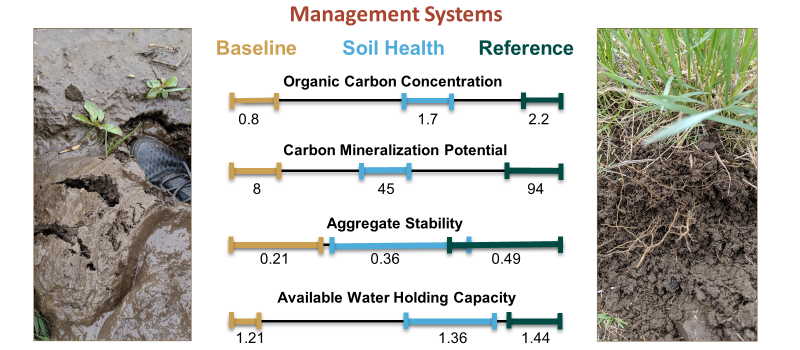
Example application of Soil Health Targets by the Soil Health Institute. Pictures are of the same soil on the same day but under different management systems separated by a fence.
“Supporting soil health is critically important for our customers and communities as we continue to work toward a resilient, equitable, and sustainable future,” said Robyn Luhning, Chief Sustainability Officer at Wells Fargo. “Wells Fargo is pleased to support the Soil Health Institute’s work to deliver locally-relevant, actionable, and practical soil health information for growers and landowners in Iowa.”
“Soil health benefits growers, the environment, and society in many ways,” said Dr. Minerva Dorantes, Project Soil Scientist at SHI. “These include improved nutrient use efficiency, drought resilience, downstream water quality, greenhouse gas mitigation, carbon sequestration, and ultimately, profitability. At SHI, we are advancing the science and application of soil health. Determining achievable levels of soil organic carbon concentration, carbon mineralization potential, aggregate stability, and available water holding capacity for different soil types is foundational to our efforts and those of growers and landowners who manage this precious resource.”
“Because soils vary across a landscape in terms of their functional capacity to cycle water, nutrients, and carbon, SHI is grouping soils across the United States based on their inherent soil properties. Then, within those groups, SHI is sampling baseline production systems, soil health systems, and perennial reference systems to determine the effect of management on soil health status. By comparing their current soil health status to reference values, growers and their advisors can set achievable Soil Health Targets,” said Dr. Dorantes. “Our goal is to provide a standardized, science-based framework to measure and monitor soil health: the foundation of regenerative agriculture.”
About the Soil Health Institute
The Soil Health Institute is a global 501(c)(3) non-profit with a mission to safeguard and enhance the vitality and productivity of soil through scientific research and advancement. We bring together leaders in soil health science and the industry to help farmers, ranchers, and landowners adopt soil health systems that build drought resilience, stabilize yield, and benefit their bottom line. The Institute’s team of scientists, holding doctorates in various soil science and related disciplines, has developed highly effective soil health targets and standardized measurements to quantify progress at achieving regenerative and sustainable agricultural systems, and leads the cutting-edge fields of carbon sequestration and decoding the soil microbiome. Healthy soils are the foundation for rejuvenating our land. Together, we can create a secure future for all, mitigate the effects of climate change, and help agriculture and organizations meet production and environmental goals at scale.
The Better Cotton Initiative (BCI) Soil Health Field Day was hosted by Matagorda County Soil and Water Conservation District and BCI in El Maton, Texas, on October 19, 2022. The event, attended by SHI Soil Health Educator Jessica Kelton and Soil Scientist Dianna Bagnall, and around 25 growers and consultants, focused on the region’s significant cotton production, an opportunity to expand utilization of cover crops, and minimal tillage practices. The field day highlighted a grower who has been successful in incorporating reduced tillage and cover crops into his operation. The grower also planted carinata as a winter cash crop on 80 acres. Known for its high residue, carinata presents a viable option for regional growers to maintain continuous living roots in their soil, potentially offering an additional revenue stream.
Dennis Brezina, Natural Resources Conservation Service Soil Health Specialist for Texas, demonstrates differences in soil aggregate stability between tilled fields (right two jars) and a no-till field (left jar) at the soil health field day coordinated by Better Cotton Initiative and Matagorda County Soil and Water Conservation District in El Maton, Texas. Photo credit: Jessica Kelton, SHI Soil Health Educator.
If you would like to get in contact with an SHI Soil Health Educator, Technical Specialist, or Farmer Mentor, please visit our Contacts page.
“Linking soil microbial community structure to potential carbon mineralization: A continental scale assessment of reduced tillage”
Carbon mineralization potential is a commonly used indicator of soil health and is recommended by the Soil Health Institute. Some may be more familiar with the indicator when described as “CO2 burst” or “soil respiration.” The terminology associated with the indicator reflects the methodology used, where a burst of carbon dioxide (CO2) released from microbial activity is measured upon rewetting an air-dried, sieved soil. Reported measurement values are often greater in no-till systems when compared to conventionally tilled systems. While the measurement is known to be driven by soil microbes, little is known about which microbes are responsible for creating the burst of CO2. Understanding which microbes drive these differences will strengthen interpretation of this widely used indicator of soil health.
To better understand the microbes associated with greater carbon mineralization potential in reduced tillage systems, scientists at the Soil Health Institute analyzed soil DNA sequences, collected as part of the North American Project to Evaluate Soil Health Measurements. Soils used in the study were collected from 124 long-term agricultural research sites across the U.S., Canada, and Mexico. Specific DNA sequences were used to identify different microbes found in each soil and research treatment. First, we determined how tillage impacted the abundances of different microbes. Next, we identified groups of soil microbes that flourished in no-till systems and were influential drivers of 24-hour carbon mineralization measurements.
Results indicated that switching from intensive tillage practices (moldboard, chisel plow, etc.) to no-till management consistently changed the abundance of certain microbes, except in systems with wheat-based rotations. We hypothesized that the greater belowground biomass produced in wheat systems may mimic residue incorporation from tillage, resulting in similar microbe populations between the treatments. Results from less intense tillage comparisons (no-till vs. reduced tillage and reduced tillage vs. intense tillage) were mixed. Less intense tillage comparisons at approximately half of long-term sites contained similar microbial fingerprints. However, when grouped by soil pH, we found only soil microbes at sites with slightly acidic soils were unaffected by differences in tillage.
Next, we identified microbes that influenced greater carbon mineralization potential measurements. We found that many of the microbes that influenced greater CO2 bursts were also more abundant in reduced tillage systems. These organisms were often slower growing and adaptive to lower, but consistent nutrient concentrations. This means that the organisms are not reliant on additional outside inputs (organic residues, manures, etc.), but are capable of cycling nutrients from residues contained within stable aggregates and from root exudates when available. Additionally, several of the organisms could produce extracellular polymeric substances, commonly referred to as, “microbial glues.” Many of these substances form biofilms, which help microbes deal with changes in soil moisture over time. Additionally, these “glues” have been shown to enhance aggregation in the soil profile. This study demonstrated how understanding the microbial drivers of carbon mineralization potential strengthens our ability to interpret this widely used measurement. In this particular case, we discovered that reducing tillage resulted in soil microbial communities more capable of thriving under diverse environmental conditions. This means that as more climate extremes are experienced, those microbial
communities present in reduced tillage systems are more resilient to those extremes and can therefore carry on their important functions of building soil aggregates, cycling nutrients, and others.
“An evaluation of carbon indicators of soil health in long-term agricultural experiments”
Organic carbon is the basis of the soil food web. When soil microbes feed on carbon as a source of energy, it affects nutrient cycling, water cycling, and greenhouse gas emissions. These biological processes provide nutrients for plants and create aggregates in the soil that help increase water infiltration and reduce erosion. A wide variety of measurements have been suggested to assess important aspects of carbon cycling in soils, yet selecting the right indicator has been difficult because:
There are many measurements to choose from, and it is hard to compare different measurement methods;
The measurements can be highly variable across landscapes and time; and
Local climate and soil characteristics affect the measurements.
To address these issues, the Soil Health Institute collaborated with approximately 100 partners to assess soil health measurements for a range of management practices at 124 research sites across North America. We compared seven measurements (soil organic carbon, loss on ignition, 24- and 96-hour potentially mineralizable carbon, water extractable organic carbon, permanganate oxidizable carbon, and beta-glucosidase enzyme activity) to understand which ones best characterize soil health. These measurements quantify the amount of different types of carbon or the potential for microbes to cycle that carbon. We assessed:
The relationship of each measurement to a suite of soil inherent properties and climate variables;
The response of each measurement to management practice;
The effect of soil type and climate on response to management; and
The relationship among indicators in their response to management practices.
Across North America, all C measurements responded to reducing tillage, cover cropping, utilizing organic sources of nutrients, and retaining crop residue, but did not respond to changing a cropping system’s diversity. We examined the effect of tillage in more detail because many research sites had tillage experiments. We found that reducing tillage generally resulted in higher levels of all C measurements regardless of soil texture, and this response was generally greater in wetter climates. We concluded that, while many of these C measurements provide insight into soil health, soil organic carbon and 24-hour potentially mineralizable carbon are recommended based on their ease of interpretation, availability, and relative low cost.
“Introducing the North American project to evaluate soil health measurements”
Soils play an essential role in provisioning ecosystem services including food, fiber, and fuel, being an integral part of water and nutrient cycles, mitigating and adapting to climate change, and supporting biodiversity. Ensuring the continued and enhanced delivery of these ecosystem services requires stewardship of our soil resource through the promotion and maintenance of soil health.
The North American Project to Evaluate Soil Health Measurements (NAPESHM) was initiated and led by the Soil Health Institute to identify widely applicable soil health measurements for assessing soil health. To address this objective, we evaluated over 30 soil health indicators at 124 long-term agricultural research sites across North America where conventional systems were compared with regenerative soil health systems. Sites were selected to enable statistical assessment of each soil measurement across a continental range in climates, soils, cropping systems, and management practices. A summary of the study design and approach are below.
Soil health measurements for evaluation were identified via a committee of scientists from public and private sectors, farmers, field conservationists, and soil test laboratories based on the criteria that the measurement could (a) be applied both regionally and continentally; (b) have a clear range of responses based on desired agricultural goals; and (c) be responsive to varying management practices. Based upon these criteria, measures of soil physical, chemical, and biological properties were selected along with three existing soil health evaluation programs.
SHI partnered with over 100 investigators at long-term agricultural field experiments across North America to identify sampling sites under continuous, monitored, replicated management for 10 years or more. Sites were selected to provide a range in soil health due to differences in: (a) physical disturbance (e.g., tillage, erosion, or grazing); (b) cover crops (e.g., grains, legumes, or combinations); (c) crop diversity (e.g., crop rotation or pasture species diversity); (d) nutrient management (e.g., addition of different amendments); (e) water management; and (f) geographical location and diversity.
At each site, plots were selected based on alignment with project criteria, regional relevance, and resource constraints. Avoidance of tillage, fertilization, seeding, or any other plot level disturbance directly before sampling was a priority in collection of all samples which drove timely sample collection between spring thaw and summer planting at northern sites and during the dormant period between crops at southern sites.
The NAPESHM soil archive is comprised of 2029 soil samples from long-term experimental sites which captured a range of climates, management practices, and inherent soil properties. Sampling sites were spread across a large geographic area representing spatially diverse growing conditions with mean annual temperature ranging from 5.8-17.5 °C and mean annual precipitation ranging from 384- 827 mm. This unique dataset has allowed SHI to identify and recommend a minimal suite of soil health measurements that can be widely applied across North America and likely beyond. The peer-reviewed publication summarizing the NAPESHM study design can be found here.
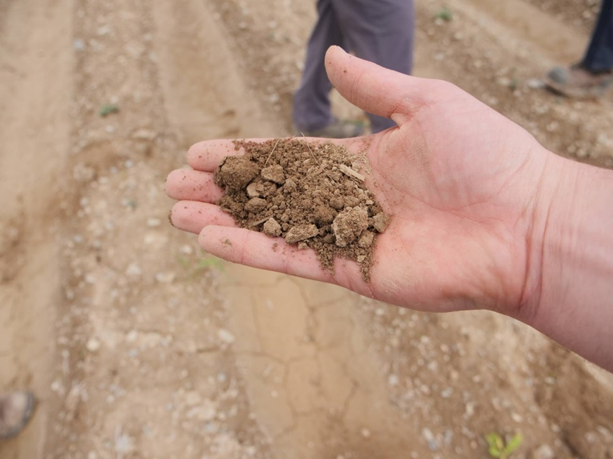
A person holds soil aggregates collected from a tilled field.
Soil structure is the backbone of a soil’s ability to support processes vital to the health and productivity of plants, animals, and ecosystems. Soil structural units, or aggregates, form when fresh organic matter is decomposed and transformed by soil microbes into binding agents among mineral soil particles. Because soil structure is difficult to measure, aggregate stability is often used as an indicator. Wet aggregate stability is a measure of a dry soil aggregate’s ability to resist dispersion when rewetted. Increases in aggregate stability are linked to improved water infiltration and reduced erodibility.
The popularity of the measurement in soil health over the past few decades has spurred the creation of numerous methods designed to assess aggregate stability. While most methods appear responsive to management practices, few studies have directly compared the methods. Those studies that have been conducted found that different aggregate stability methods responded differently to management, making comparison among the indicators difficult. This has left stakeholders wondering, “Is any specific aggregate stability indicator advantageous to use over another?”
To address this and other questions, Soil Health Institute scientists and partners conducted a study to evaluate over 30 soil health measurements at 124 long-term agricultural research sites across the U.S., Canada, and Mexico. We compared four common methods of measuring aggregate stability: water stable aggregates using the Cornell Rainfall Simulator, wet sieved water stable aggregates (Yoder method), slaking captured and adapted from SLAKES smart-phone image recognition software, and the mean weight diameter of water stable aggregates. We evaluated each indicator’s sensitivity to climate and inherent soil properties. Additionally, we explored each indicator’s sensitivity to long-term adoption of soil health management practices, including rotation diversity, number of cash crops, residue management, organic nutrient amendments, cover crops, and tillage. Finally, we examined the cost and availability of each indicator to determine its scalability.
All four indicators were sensitive to climate and inherent soil properties to a certain extent. This means that the indicators should only be compared among similar soils within similar climates. None of the indicators detected differences between diverse and monoculture rotations or increases in the number of different cash crops included in the rotation. All four methods, to a certain degree, were sensitive to organic nutrient amendments, cover crops, and tillage. Considering these results, no single method was clearly superior and all four are viable options for measuring aggregate stability. Although all measurements responded to management, SLAKES was the most practical in terms of time and cost. Therefore, we concluded that slaking via image recognition measured on intact 4-10 mm diameter aggregates was the most suitable method for scaling up assessments of aggregate stability as a soil health indicator.