2021 Virtual Annual Meeting | View the Recorded Sessions Online

Our 6th Annual Meeting, “Enriching Soil, Enhancing Life”, was held on August 11th and 12th, 2021.

Over two engaging days, we brought together leading voices in soil science and the agriculture industry to share research and insights for advancing adoption of soil health systems that are foundational for regenerative agriculture.

More than 2,300 people from 67 countries registered to attend the Annual Meeting with 1,500 organizations represented, covering agribusiness, consultants, scientists, field conservationists, government, and non-governmental organization professionals around the world. We were proud to have an unprecedented number of farmers register, representing over 685,000 crop acres.

The feedback we’ve received has been overwhelmingly positive with 92% rating the Annual Meeting as either ” Very Good” or “Excellent”, 86% said they were “Very Likely” to “Extremely Likely” to recommend a colleague to attend the next Annual Meeting.

The agenda was designed to connect the science of soil health with the information farmers request when adopting soil health practices, and the environmental benefits that follow.  A wide array of practical information, research, and actionable takeaways were shared through the following sessions:

Day 1

2021 ANNUAL MEETING | WELCOME AND DR. MOIRA MCDONALD KEYNOTE

2021 ANNUAL MEETING | PANEL: FARMERS’ EXPERIENCES WITH ADOPTING SOIL HEALTH SYSTEMS

2021 ANNUAL MEETING | SESSION: BUSINESS CASE FOR REGENERATIVE SOIL HEALTH SYSTEMS

2021 ANNUAL MEETING | SESSION: UNDERSTANDING AND MANAGING THE SOIL MICROBIOME

2021 ANNUAL MEETING | SESSION: IMPACTS OF AGRICULTURAL INPUTS ON SOIL HEALTH

Day 2

2021 ANNUAL MEETING | SESSION: CLIMATE CHANGE MITIGATION AND ADAPTATION THROUGH SOIL HEALTH

SESSION: ESTABLISHING SOIL HEALTH INTERPRETATIONS FOR FARMERS AND CONSERVATION PLANNERS

2021 ANNUAL MEETING | OPEN DISCUSSION AND CLOSING REMARKS

You can also view these recordings on our YouTube page. Here

Once again, thank you to our presenters, panelists, and sponsors. Our Annual Meeting would not have been possible without your valuable time and commitment.

We look forward to getting together again in 2022!


The Soil Health Institute Welcomes New Scientists and Interns to Its Growing Team

August 2, 2021, Morrisville, North Carolina — The Soil Health Institute (SHI), the non-profit charged with safeguarding and enhancing the vitality and productivity of soils, has announced that six new scientists and three interns have joined the Institute.

“We welcome this diverse cohort to our growing team who hail from a variety of educational and professional backgrounds,” explained Dr. Wayne Honeycutt, SHI’s President & CEO. “We’re very pleased with the caliber of talent that SHI draws. Adding depth to our team means we can broaden our impact on scaling adoption of regenerative soil health systems to benefit farmers, the environment, and society.”

Meet SHI’s nine newest team members:

Loutrina Staley, Ph.D., joins SHI’s leadership team as a Soil Scientist, where she will help develop grant proposals, manage stakeholder relations, and communicate project results to end users.  Dr. Staley has experience as an Advance Science teacher in the Decatur City Schools where she implemented an innovative STEM program in Agriculture and Food Science. Her previous post-doctoral research focused on the efficacy of plant botanicals and fatty acids as antimicrobials against food-borne pathogens.

Christine Molling joins from the University of Wisconsin Space Science and Engineering Center’s Cooperative Institute for Meteorological Satellite Studies, where she created models and data sets to assist decision makers in agriculture, environmental resources, and renewable energy. At the Soil Health Institute, Ms. Molling is a Modeling Specialist for the Dairy Soil and Water Regeneration project.  She evaluates and works to improve the ability of agroecosystem models to capture the effects of soil health practices on greenhouse gas emissions and water quality.

Brent Thomas is an undergraduate student at the University of Arkansas at Pine Bluff where he is earning a B.S. degree in Agricultural Engineering. Mr. Thomas is a 2021 Intern working with SHI scientists to collect and analyze soil samples for establishing Soil Health Targets. He is particularly interested in identifying and addressing challenges that growers face when adopting soil health systems.

Jason Ackerson, Ph.D., joins from the Department of Agronomy at Purdue University where he was an Assistant Professor and Extension Specialist. His research focused on developing promixal sensors to quantify soil properties and develop digital soil maps. Dr. Ackerson is a Project Scientist for soil carbon measurement and technology discovery projects.

Quanteria Randle is a sophomore undergraduate student at Prairie View A&M University where she is earning her B.S. in Biology. Ms. Randle is a 2021 Intern working with SHI’s Soil Microbiome Scientist, Dr. Elizabeth Rieke, in analyzing phospholipid fatty acid (PLFA) data from soils sampled across North America. She is also gaining experience in sampling soils for establishing Soil Health Targets.

Nate Looker, Ph.D., joins from the University of Minnesota-Twin Cities, where he studied the impact of tropical forest succession on soil-based ecosystem services. Dr. Looker is a Project Scientist for field-based establishment of Soil Health Targets for farmers and field conservationists.

Mara Cloutier, Ph.D., joins us from Pennsylvania State University where she conducted research aimed at assessing how conservation management practices that improve soil health also influence soil microbial nitrogen dynamics and nitrous oxide emissions (a potent greenhouse gas). Dr. Cloutier is a Project Manager for the Dairy Soil and Water Regeneration project in partnership with Dairy Management, Inc.

Robert Jeremiah Fredrick Thomas is an undergraduate student attending Prairie View A&M University where he is majoring in Agriculture with a concentration in Plant and Soil Science. Mr. Thomas is a 2021 Intern assisting with soil sample collection and data analysis on various projects. He is in the Prairie View A&M University Honors Program, an Eagle Scout, and plans to become an Environmental Research Scientist.

Vance Almquist, Ph.D., joins from the Pacific Ecological Systems Division of the United States Environmental Protection Agency’s Office of Research and Development where he worked on developing tools for addressing aquatic ecosystem vulnerability to wildfire in the Pacific Northwest. Dr. Almquist is developing quantitative strategies for grouping similar soils to aid in establishing and mapping Soil Health Targets for farmers and field conservationists.

About the Soil Health Institute

The Soil Health Institute is a global non-profit with a mission to safeguard and enhance the vitality and productivity of soil through scientific research and advancement. We bring together leaders in soil health science and the industry to help farmers, ranchers, and landowners adopt soil health systems that build drought resilience, stabilize yield, and benefit their bottom line. The Institute’s team of scientists, holding doctorates in various soil science and related disciplines, has developed highly effective soil health targets and standardized measurements to quantify progress at achieving regenerative and sustainable agricultural systems, and leads the cutting-edge fields of carbon sequestration and decoding the soil microbiome. Healthy soils are the foundation for rejuvenating our land. Together, we can create a secure future for all, mitigate the effects of climate change, and help agriculture and organizations meet production and environmental goals at scale. Visit www.soilhealthinstitute.org to learn more and follow us on LinkedIn, Twitter, and Facebook.

For media inquiries, contact Rivers Agency:
Lauren Rivers
lauren@riversagency.com
(919) 932-9985


The Soil Health Institute Announces Speakers for its Annual Meeting: “Enriching Soil, Enhancing Life”

Research Triangle Park, NC, July 6, 2021 – The Soil Health Institute (SHI), the non-profit charged with safeguarding and enhancing the vitality and productivity of soils, announced today its lineup of agricultural leaders, scientists, and practitioners who will speak at its annual meeting, “Enriching Soil, Enhancing Life.”

The two-day virtual event on August 11 and 12, 2021 will kick off with a keynote presentation from Moira Mcdonald, Director of the Environment Program with the Walton Family Foundation.

Other highlights of the event will include:

  • Panel Discussion: Three farmers will describe their experiences adopting a soil health system.
  • Taryn Barclay, Cargill’s Senior Director of Strategic Partnerships and Stakeholder Engagement, will lead a session on the “Business Case for Regenerative Soil Health Systems.”
  • Dr. Julie Howe and Dr. Terry Gentry, both with Texas A&M University, will present their assessments on the “State of the Science: Impacts of Fertilizers, Manures, Pesticides, and Biological Additives on Soil Health.”
  • Dr. Arnab Bhowmik of North Carolina A&T State University will describe how soil microbial processes impact nutrient cycling and greenhouse gas emissions.
  • Dr. Ashley Shade of Michigan State University will share insights from her research into how soil microbial interactions influence their resilience, and Dr. Elizabeth Rieke, Soil Microbiome Scientist with the Soil Health Institute will provide results of a continental assessment on how tillage impacts soil microbial communities that serve various roles in healthy soils.
  • Marc Bernard will describe “4 per 1000,” the international initiative among approximately 40 countries using soil health as a framework to increase soil carbon sequestration by 0.4% per year.
  • Dr. Rodrigo Nicoloso of the Brazilian Agricultural Research Corporation (Embrapa) will address how the depth of carbon storage is affected by management – a key issue for carbon markets.
  • Dr. Cristine Morgan, Chief Scientific Officer with the Soil Health Institute, will introduce the concept of “Soil Health Targets,” the Institute’s approach for establishing and scaling soil health interpretations for farmers, conservation planners, and others.

 
These and more topics will be covered. Continuing Education Credits (CEUs) will be available for Tri-Society members who attend the virtual conference.

“We are excited to bring together this esteemed group of professionals to share their soil health knowledge that can significantly benefit farmers and the environment,” said Dr. Wayne Honeycutt, CEO of the Soil Health Institute. “Whether you’re a grower, agribusiness, consultant, scientist, field conservationist, government or NGO employee, this conference has valuable information for you to advance the science, adoption, and environmental benefits of soil health.”

ABOUT SOIL HEALTH INSTITUTE

The Soil Health Institute is a global non-profit with a mission to safeguard and enhance the vitality and productivity of soil through scientific research and advancement. We bring together leaders in soil health science and the industry to help farmers, ranchers, and landowners adopt soil health systems that build drought resilience, stabilize yield, and benefit their bottom line. The Institute’s team of scientists, holding doctorates in various soil science and related disciplines, has developed highly effective soil health targets and standardized measurements to quantify progress at achieving regenerative and sustainable agricultural systems, and leads the cutting-edge fields of carbon sequestration and decoding the soil microbiome. Healthy soils are the foundation for rejuvenating our land. Together, we can create a secure future for all, mitigate the effects of climate change, and help agriculture and organizations meet production and environmental goals at scale. Visit soilhealthinstitute.org to learn more and follow us on LinkedIn, Twitter, and Facebook.

FOR INFORMATION:
Byron Rath +1-919-230-0343
brath@soilhealthinstitute.org


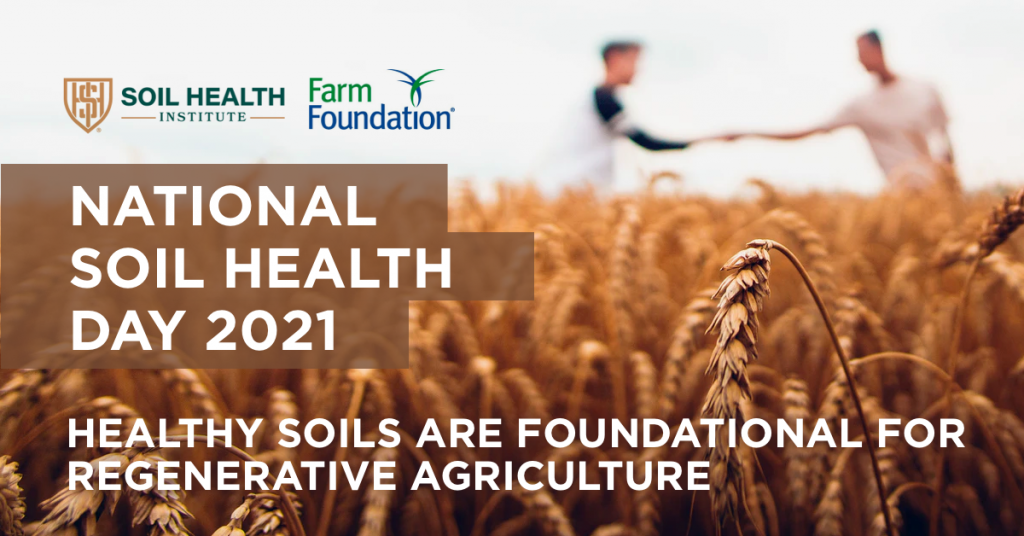
Resources to Celebrate National Soil Health Day 2021

National Soil Health Day 2021

Enriching Soil, Enhancing Life

National Soil Health Day celebrates the vitality and productivity of our soils. This year, the Soil Health Institute is teaming up with the Farm Foundation, an organization that was instrumental in creating the Institute, to advance the adoption of soil health systems that are foundational for regenerative agriculture. Below are some video resources to learn more about the importance of soil health for farmers, communities, and the environment.


Soil Health Institute Selected as Soil Science Research Partner for Dairy Feed, Soil and Water Outcomes for the Net Zero Initiative

FOR INFORMATION:
Cristine Morgan +1-919-230-0343
cmorgan@soilhealthinstitute.org

Research Triangle Park, NC, June 17, 2021 – The Soil Health Institute (SHI), the non-profit charged with safeguarding and enhancing the vitality and productivity of soils, has been selected as the soil science research partner for Dairy Soil & Water Regeneration, an essential project to advance the work of the U.S. dairy Net Zero Initiative (NZI).

In support of the NZI, the Foundation for Food & Agriculture Research (FFAR) has awarded a $10 million grant as the on-farm pathway to advance the industrywide 2050 Environmental Stewardship Goals set by the Innovation Center for U.S. Dairy.

The funding will support a six-year project – “Dairy Soil & Water Regeneration: building soil health to reduce greenhouse gases, improve water quality and enable new economic benefits” – that will produce data to be broadly shared among the dairy community to:

  • Provide measurement-based assessments of dairy’s greenhouse gas footprint for feed production
  • Set the stage for new market opportunities related to carbon, water quality, and soil health

The FFAR grant will be matched by financial contributions from NZI partners such as Nestlé, the dairy industry, including Newtrient, and in-kind support for a total of $23.2 million. The funds will be managed by the Dairy Research Institute (DRI), a 501(c)(3) non-profit entity founded and staffed by Dairy Management Inc. (DMI) to conduct vital research on behalf of the industry. SHI will work alongside DMI scientists to address research gaps in feed production and manure-based fertilizers that, once filled, will enable new markets, incentives, and investments in dairy sustainability.

“Addressing the U.S. dairy industry’s emissions is a critical solution to climate change,” said FFAR Executive Director Dr. Sally Rockey. “I know dairy farmers are working hard to decrease their environmental footprint and I’m thrilled to support their efforts by advancing research needed to adopt climate-smart practices on dairy farms across the country.”

Through foundational science, on-farm pilots, and development of new product markets, NZI aims to knock down barriers and create incentives for farmers that will lead to economic viability and positive environmental impact.

“After six years, we will have data that accurately reflect our farms’ greenhouse gas footprint for dairy crop rotations with consideration for soil health management practices and new manure-based products,” said Dr. Jim Wallace, senior vice president of environmental research for DMI. “We expect to develop critical insights that link soil health outcomes, such as carbon sequestration, with practice and technology adoption. This will provide important background information to support the development of new carbon and water quality markets.”

Specifically, SHI will be responsible for:

  • Providing the design, implementation, and technical expertise, from plot to national scales, for measuring soil health, greenhouse gas emissions, and soil carbon storage.
  • Quantifying the role of new manure products and soil health systems for reducing the greenhouse gas footprint of dairy feed production.

“Through the adoption of soil health systems, research has shown many on-farm and environmental benefits,” said Dr. Cristine Morgan, Chief Scientific Officer at the Soil Health Institute, ”We’re excited to apply these learnings to a dairy context and validate, beyond a proof of concept, real-world outcomes of adopting soil health management and novel manure products on soil health, water quality, and greenhouse gases that have a positive impact for the planet.”

The project will be executed across four dairy regions responsible for about 80 percent of U.S. milk production: Northeast, Lakes, Mountain, and Pacific. It entails a collaboration of NZI, the Soil Health Institute, and leading dairy research institutions, including: Cornell University, University of California at Davis, Texas A&M AgriLife Research, University of Wisconsin-Madison, University of Wisconsin-Platteville, University of Vermont, and U.S. Department of Agriculture Agricultural Research Service (USDA ARS) Northwest Irrigation and Soils Research in Kimberly, Idaho.

Dozens of dairies representing climates and soils of these major production regions will participate in a baseline survey of soil health and carbon storage. Additionally, eight farms, including five operating dairies, two university research dairies, and one USDA ARS research farm, will participate in the project. These pilots will be used to engage farmers in soil health management practices and monitor changes in greenhouse gas emissions, soil carbon storage, soil health, and water quality.

FFAR builds public-private partnerships to support bold science that fills critical research gaps. Working with partners across the private and public sectors, FFAR identifies urgent challenges facing the food and agriculture industry and funds research to develop solutions.

NZI is an industry-wide effort led by six national dairy organizations: DMI, Innovation Center for U.S. Dairy, International Dairy Foods Association, Newtrient, National Milk Producers Federation, and the U.S. Dairy Export Council. This collaboration represents a critical pathway on U.S. dairy’s sustainability journey.

Ultimately, NZI hopes to support the industry to advance toward its collective goals, realize untapped value to support economic viability, and enable other industries and communities to be more sustainable.

For more information about dairy sustainability, visit www.usdairy.com/sustainability.

ABOUT SOIL HEALTH INSTITUTE

The Soil Health Institute is a global non-profit with a mission to safeguard and enhance the vitality and productivity of soil through scientific research and advancement. We bring together leaders in soil health science and the industry to help farmers, ranchers, and landowners adopt soil health systems that build drought resilience, stabilize yield, and benefit their bottom line. The Institute’s team of scientists, holding doctorates in various soil science and related disciplines, has developed highly effective soil health targets and standardized measurements to quantify progress at achieving regenerative and sustainable agricultural systems, and leads the cutting-edge fields of carbon sequestration and decoding the soil microbiome. Healthy soils are the foundation for rejuvenating our land. Together, we can create a secure future for all, mitigate the effects of climate change, and help agriculture and organizations meet production and environmental goals at scale. Visit soilhealthinstitute.org to learn more and follow us on LinkedIn, Twitter, and Facebook.

ABOUT DAIRY MANAGEMENT INC. 

Dairy Management Inc.™ (DMI) is funded by America’s 35,000 dairy farmers, as well as dairy importers. Created to help increase sales and demand for dairy products, DMI and its related organizations work to increase demand for dairy through research, education and innovation, and to maintain confidence in dairy foods, farms and businesses. DMI manages National Dairy Council and the American Dairy Association, and founded the U.S. Dairy Export Council, and the Innovation Center for U.S. Dairy.

ABOUT THE INNOVATION CENTER FOR U.S. DAIRY®

The Innovation Center for U.S. Dairy is a forum that brings together the dairy community to address the changing needs and expectations of consumers through a framework of shared best practices and accountability. Initiated in 2008 by dairy farmers, Innovation Center members collaborate on efforts that are important both to us and our valued customers – issues like animal care, food safety, nutrition and health, the environment and economics. The Innovation Center is committed to continuous improvement from farm to table, striving to provide the world responsibly produced dairy foods that nourish people, strengthen communities and foster a sustainable future.

ABOUT THE FOUNDATION FOR FOOD & AGRICULTURE RESEARCH

The Foundation for Food & Agriculture Research (FFAR) builds public-private partnerships to fund bold research addressing big food and agriculture challenges. FFAR was established in the 2014 Farm Bill to increase public agriculture research investments, fill knowledge gaps and complement USDA’s research agenda. FFAR’s model matches federal funding from Congress with private funding, delivering a powerful return on taxpayer investment. Through collaboration and partnerships, FFAR advances actionable science benefiting farmers, consumers and the environment.



The Soil Health Institute Announces its Virtual 2021 Annual Meeting: “Enriching Soil, Enhancing Life”

FOR INFORMATION:
Byron Rath +1-919-230-0343
brath@soilhealthinstitute.org

Research Triangle Park, NC, June 9, 2021 – The Soil Health Institute (SHI), the non-profit charged with safeguarding and enhancing the vitality and productivity of soils, announced today its much-anticipated annual meeting will be held on August 11 and 12, 2021. This year’s theme is “Enriching Soil, Enhancing Life” and the event will be hosted virtually.

“Enriching Soil, Enhancing Life” is designed to connect and advance the science, adoption, and environmental benefits of soil health. A wide array of practical information, research, and actionable takeaways will be presented that is relevant to farmers, agribusiness, consultants, scientists, field conservationists, government, and non-governmental organization professionals around the world.

The two-day event will feature six plenary sessions:

  • Farmers’ Experiences with Adopting Soil Health Systems
  • Business Case for Regenerative Soil Health Systems
  • Agricultural Input Impacts on Soil Health
  • Climate Change Mitigation and Adaptation through Soil Health
  • Establishing Soil Health Interpretations for Farmers and Conservation Planners
  • Understanding and Managing the Soil Microbiome

Each day, sessions will run from 10 a.m. to 12 p.m. ET, break for an hour, then resume from 1 p.m. to 3 p.m. ET.

“We’re at a critical juncture in the fight against climate change,” said Dr. Wayne Honeycutt, CEO of the Soil Health Institute. “Our organization hosts this event to connect more people to the most recent science behind soil health to empower implementation of practices and soil health systems that not only benefit farmers’ livelihoods but can significantly reduce greenhouse gas emissions, nutrient runoff, and provide many other environmental benefits worldwide.”

ABOUT SOIL HEALTH INSTITUTE

The Soil Health Institute is a global non-profit with a mission to safeguard and enhance the vitality and productivity of soil through scientific research and advancement. We bring together leaders in soil health science and the industry to help farmers, ranchers, and landowners adopt soil health systems that build drought resilience, stabilize yield, and benefit their bottom line. The Institute’s team of scientists, holding doctorates in various soil science and related disciplines, has developed highly effective soil health targets and standardized measurements to quantify progress at achieving regenerative and sustainable agricultural systems, and leads the cutting-edge fields of carbon sequestration and decoding the soil microbiome. Healthy soils are the foundation for rejuvenating our land. Together, we can create a secure future for all, mitigate the effects of climate change, and help agriculture and organizations meet production and environmental goals at scale. Visit soilhealthinstitute.org to learn more and follow us on LinkedIn, Twitter, and Facebook.


CEPHaS Conservation Agriculture Perspectives – 4

CEPHaS is interested in a broad perspective on conservation agriculture, in the context of the farming system, the constraints farmers face and the ways in which they are adapting to climate change. For this reason we have engaged with a range of partners, and in this series we invite them to respond to some questions.

The Indaba Agricultural Policy Research Institute (IAPRI) is a private company in Zambia with a board of directors drawn from stakeholders across the public and private sector. Its principal mandate is to conduct research in agricultural policy and to undertake outreach activities, supporting the agricultural sector in Zambia and pursuing agricultural development which is sustainable and pro-poor. More information can be found at their website https:// www.iapri.org.zm/ 

Dr Hambulo Ngoma (pictured above) answers our questions.

CEPHaS 4

Conservation Agriculture Perspectives

1. What are the main ways in which you have seen smallholder farmers adapting to climate change in southern and central Africa in recent years?

Farmers in Southern Africa adapt to climate change mainly through staggered planting, planting early maturing and drought-tolerant varieties, and the adoption of conservation agriculture practices. Farmers have diversified their livelihoods by venturing into non-farm enterprises like trading. More about farmer responses to climate change in Zambia has been published by Mulenga et al. (2017). Climate Trends and Farmers’ Perceptions of Climate Change in Zambia. Environmental Management 59, 291–306.

2. In what sets of circumstances (biophysical, socio-economic etc) are conservation agriculture practices most likely to be beneficial to rural communities, and in what circumstances are they least likely to be useful?

Biophysical
CA would be most likely to be beneficial under semi-dry conditions with low rainfall, I am not sure that it would be beneficial in under very dry and wet conditions.
Socio-economic
CA is most beneficial for those with finance to hire in labour and, more importantly, to afford herbicides and to finance other CA activities. Secure tenure might help the uptake of CA and make it more feasible to retain crop residues.

3. What components of conservation agriculture systems are most problematic from the perspective of farmers? 

Making planting basins under minimum tillage with hand hoes is challenging for farmers because of the drudgery, as is weeding, where they do not have access to herbicides. Retaining residues is difficult given competing uses, and on communal open grazing land. Limited market access for legumes makes full rotation an issue for some farmers.

4. What do you think are the main research questions that need to be addressed to support food security in sub-Saharan Africa under climate change?

An overarching area of interest is to understand how best smallholder farming systems can best become resilient to climate change while meeting a rising demand for food. A top priority should be to identify instruments to enhance resilience, and to test these out. It would also be interesting to understand how markets can enhance food security and help support the uptake of CA amidst climate change.

Biography of Dr Hambulo Ngoma (pictured overleaf)

Dr Hambulo Ngoma was a research fellow at IAPRI and lead, climate change and natural resource management thematic area at the time of this interview. He is now Agricultural Economist, International Maize and Wheat Improvement Center (CIMMYT), Southern Africa Regional Office in Harare, Zimbabwe.

Dr Hambulo Ngoma is a Development Economist with research interests spanning the development-environment nexus. His current research applies various methods to understand the connections among land use, agricultural practices, and livelihoods of smallholder farmers in the context of climate change in Southern Africa. He is particularly interested in factors influencing the adoption of new technologies and the impacts of these practices on livelihoods and welfare of smallholder farmers.

To find out more, visit our web pages at www2.bgs.ac.uk/CEPHaS and follow us on twitter @CEPHaS_Soil