For decades, yield has been at the center of agricultural decision-making. More bushels per acre have often been viewed as the clearest measure of productivity, progress, and success.
But higher yield doesn’t always mean higher profit.
As farmers navigate rising input costs, market volatility, and increasing weather risk, there is an opportunity for technical advisors to help redirect the conversation from maximizing yield to improving profitability and long-term farm resilience.
Profitability comes down to a simple equation: revenue minus total costs. A field with lower yield can still deliver a stronger profit margin if input costs are lower, which means yield and profitability don’t always move together.
A profitable farm is better positioned to:
- Withstand volatile markets
- Manage weather risks
- Invest in future improvements
- Reduce financial stress
- Achieve long-term sustainability
Shifting from a Yield Mindset to a Profitability Mindset
Many farmers already use the term return on investment (ROI) when discussing equipment, technology implementation or marketing decisions. Applying ROI thinking to crop production can make profitability discussions more relatable:
- Where are costs increasing without adding value?
- Which practices generate the strongest return per acre?
- Which inputs consistently pay off?
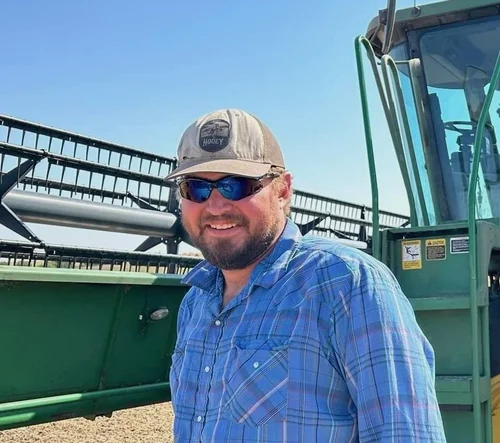
“We’re not seeing more productivity: What we’re seeing is better ROI,” says Nebraska farmer Jordan Uldrich, describing what happened as he worked to build more resilient soil and reduce his reliance on synthetic inputs.
A Few Language Shifts That Change the Conversation
Small changes in how advisors frame recommendations can open the door to a more productive conversation:
When working with producers, advisors can steer the conversation by shifting the language used in recommendations away from maximizing yield and toward improving overall profitability and return on investment. Rather than focusing solely on yield, conversations should emphasize the outcomes that support long-term farm profitability and resilience, including margin stability, input efficiency, risk management, soil health, sustained productivity and financial flexibility during periods of market volatility.
Encouraging producers to start small can help reduce perceived risk and build confidence in new practices. For example, suggesting a reduced nitrogen application rate on a single field allows them to evaluate results firsthand before making changes across their whole operation.
Advisors can help redirect the conversation from maximizing yield to improving profitability by sharing examples of producers who have achieved stronger financial results through a more holistic approach to decision-making. Whenever possible, advisors should incorporate local data and real-world economic performance metrics, as these help ground conversations in operational realities and support more informed business decisions. You can find real-world farm profitability data at soilhealthinstitute.org/profitability.
By focusing on long-term stability, resilience and profitability rather than short-term yield gains alone, advisors can initiate more productive conversations and support more sustainable decision-making.
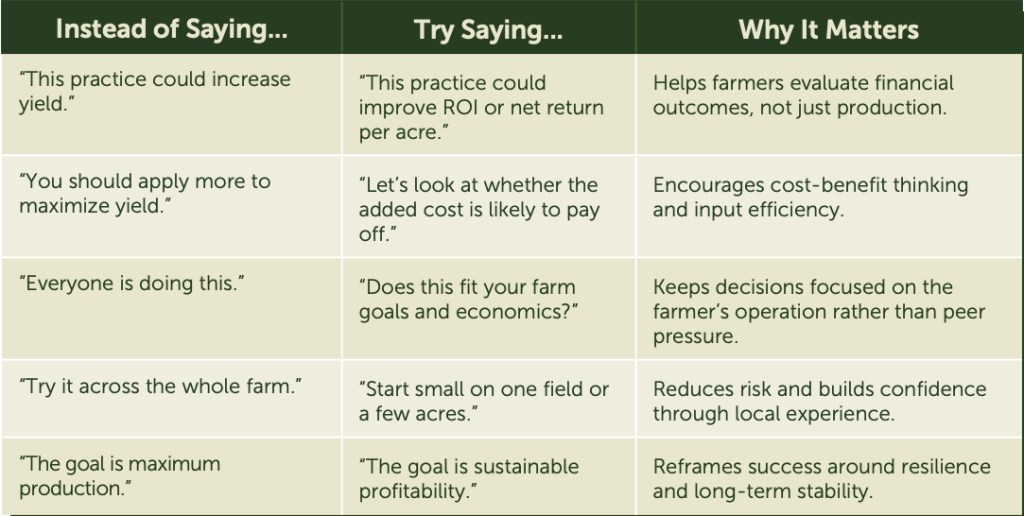
Advisors can also anchor conversations around cost per bushel rather than yield per acre or frame soil health and reduced erosion as land and soil equity: long-term value in the land itself, not just this season’s margin.
Download a printable version of the factsheet
This resource is one of many developed through the Farmers for Soil Health partnership. The Farmers for Soil Health (FSH) collaboration, covering 20 states across the Midwest, Great Lakes, and Chesapeake Bay, aims to boost cover crop adoption on corn and soybean acres to 30 million by 2030. Along with the University of Missouri Center for Regenerative Agriculture, SHI leads the FSH education team, collaborating with technical assistance leads in each state to offer education and resources for successful adoption of soil health management systems.