Soil health isn’t just about improving your fields; it can also make a real difference to your bottom line.
Through interviews with farmers who have used soil health practices for five years or more, we quantify the real economic impact of soil health practices like cover crops and reduced tillage.
What method do you use?
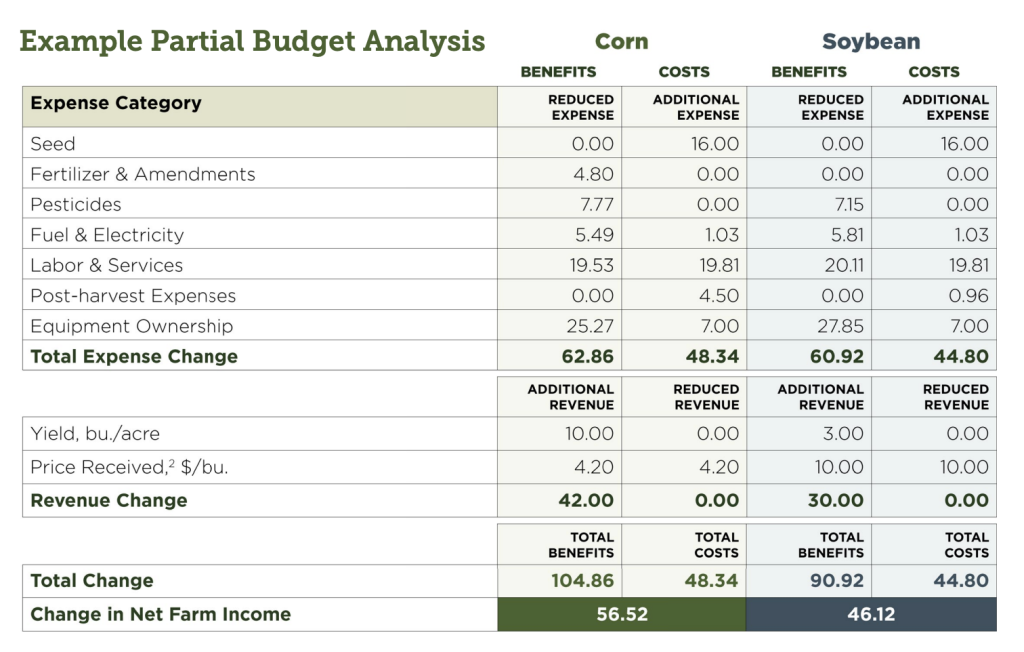
We use partial budget analysis to measure how soil health practices affect net farm income. Instead of analyzing every farm expense, this approach focuses only on what changes after adopting soil health practices.
What are some examples of expense changes?
- Reduced fuel and equipment costs from fewer tillage passes
- Lower fertilizer expenses due to improved nutrient cycling
- Reduced pesticide use over time
- Increased seed costs from adding cover crops
Here’s an example of a partial budget from a real farm:
How do you choose growers for the interviews?
We select participants based on several criteria. Participating producers must have managed for soil health for at least five years. We also focus on different regions and climates representating various crop types and farming systems. We often work with local partnering organizations to identify suitable producers.
What do you do with producers’ information?
We take participants’ confidentially seriously. We never share any individual producer data without permission from participants. This includes farmer names, farm details (i.e. exact location, size, etc.), and responses to partial budget interview questions.
We use the collected data to create:
- Aggregated regional reports that combine and synthesize findings across multiple farms in a geographic area, available at https://soilhealthinstitute.org/resources/
- Individual case studies that highlight specific farms and their experiences (only with participant permission)
By focusing on real farmer experiences and measurable financial outcomes, we are helping producers better understand the business case for soil health.
To learn more about SHI’s methodology or view detailed profitability reports, visit our Resources page. You can also connect with a Soil Health Educator to learn how these practices could work on your farm.
This resource is one of many developed through the Farmers for Soil Health partnership. The Farmers for Soil Health (FSH) collaboration, covering 20 states across the Midwest, Great Lakes, and Chesapeake Bay, aims to boost cover crop adoption on corn and soybean acres to 30 million by 2030. Along with the University of Missouri Center for Regenerative Agriculture, SHI leads the FSH education team, collaborating with technical assistance leads in each state to offer education and resources for successful adoption of soil health management systems.